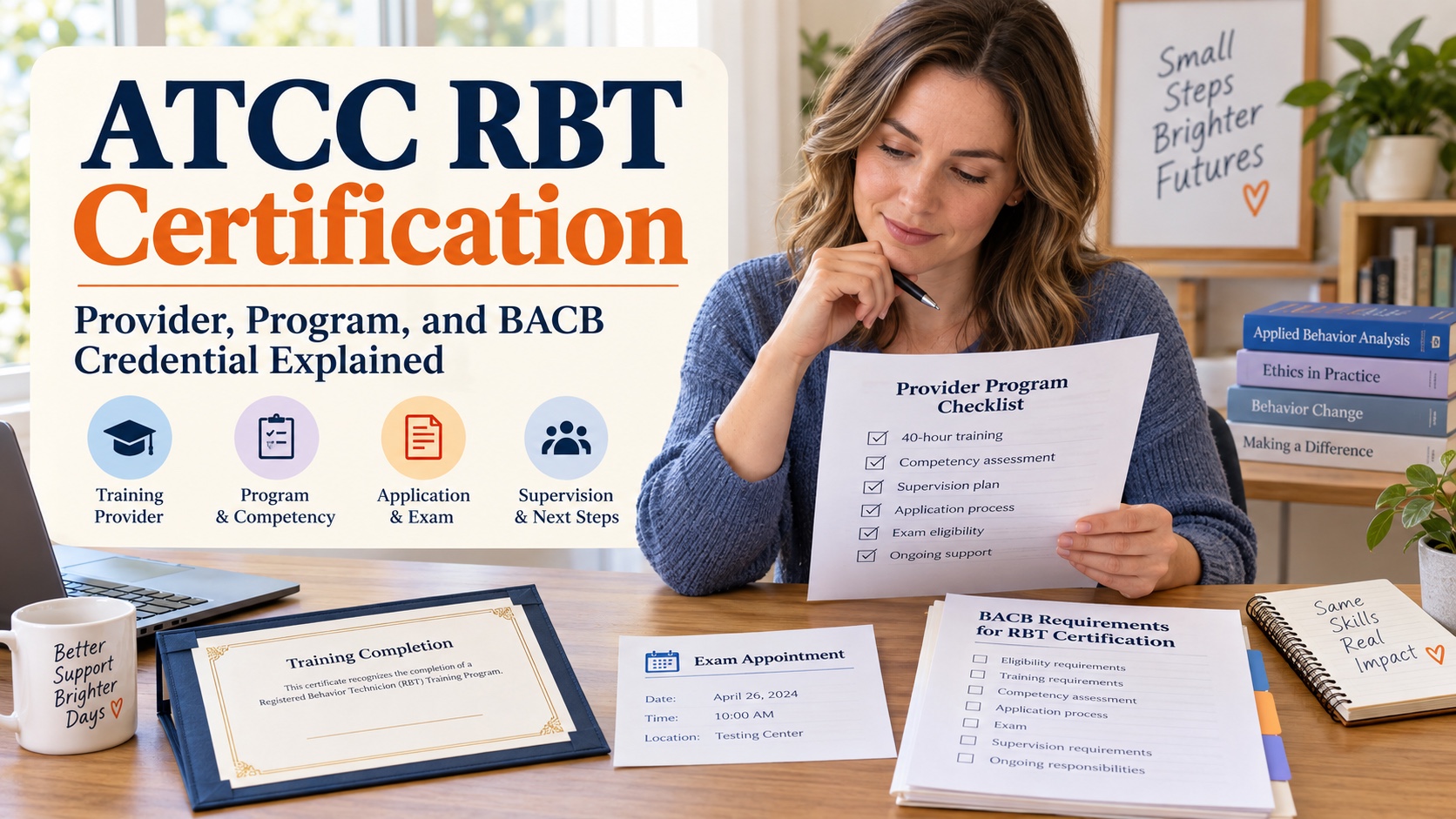
ATCC RBT Certification: Provider, Program, and BACB Credential Explained
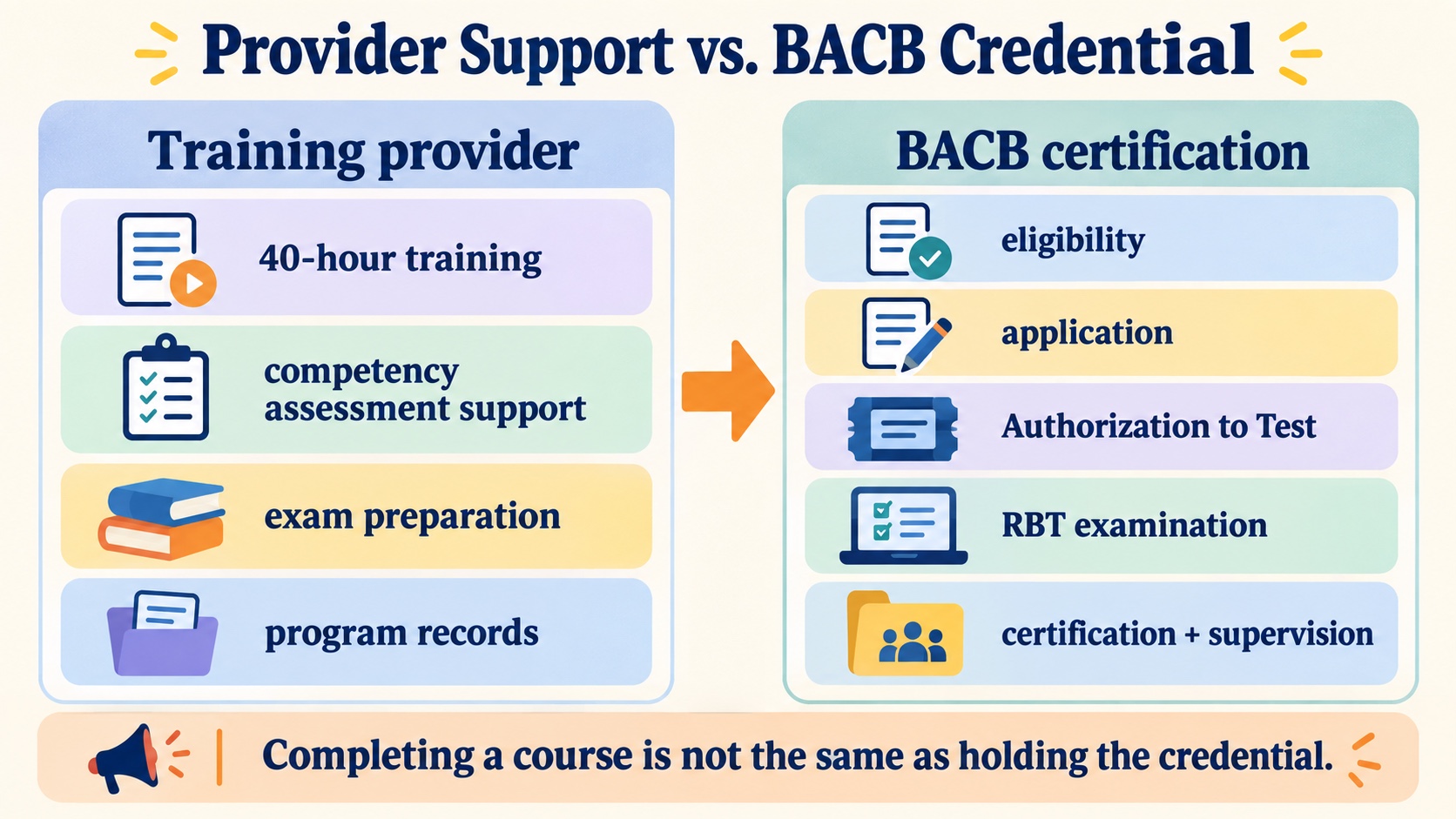
If you search for ATCC RBT certification, the first question to settle is who does what. ATCC describes training, competency-assessment, exam-prep, and bundled RBT certification-support programs. The Behavior Analyst Certification Board (BACB) administers the RBT certification program and examination. Completing a provider’s course is not the same thing as already holding the BACB credential.
That distinction is useful when comparing a program. Ask what the provider includes, which step you still need to complete, what version of the 2026 requirements the materials follow, and which document proves completion. Then verify the final eligibility, application, authorization, examination, supervision, and maintenance requirements with the current BACB sources.
Table of Contents
Short answer: does ATCC issue the RBT certification?
No. ATCC can provide education and certification-support services, but the BACB is the organization whose RBT certification program and examination determine the credential. A course completion certificate may show that you completed a provider’s training. It is not the same document as BACB certification.
The exact package depends on the ATCC product you choose. Its public pages describe a 2026 40-hour RBT training course, a full certification program, competency-assessment support, exam preparation, and other services. Read the product page and enrollment terms carefully because a lower-cost training-only option may not include the competency assessment, application support, supervisor signature, or other step included in a bundled program.
ATCC and BACB have different roles
Think of the process as two layers. The provider layer is where you learn, complete a training course, prepare for an assessment, or receive administrative support. The credential layer is where the BACB’s current requirements, application review, Authorization to Test, examination, and certification status apply. Your provider can help you prepare for a layer; it cannot rewrite the layer.
BACB describes the RBT as a paraprofessional certification in behavior analysis. RBTs assist with behavior-analytic services and practice under the direction and close supervision of an RBT Supervisor and/or RBT Requirements Coordinator. That supervision relationship continues after a training course and exam. A provider page should therefore be read as a description of services, not as a replacement for the RBT Handbook or current transition guidance.
What an ATCC program may include
ATCC’s public RBT pages describe several program types. A 40-hour training course is designed around the current RBT training requirement and provides a provider certificate after completion. A fuller program may combine training, a competency assessment, application support, and a supervisor’s role or signature. Exam-prep resources may help with practice and review but do not themselves authorize you to test.
Do not infer inclusion from a headline. Before paying, open the exact product terms and ask:
- Is the training designed for the 2026 RBT eligibility requirement, and what approval statement appears on the certificate?
- Is the initial competency assessment included, or must I arrange and pay for it separately?
- Who completes the attestation, observation, or supervisor-related step, and what qualifications do they hold?
- Does the program help with the BACB application, or does it only provide instructions?
- Are exam-prep questions independent practice, and are they clearly separated from official BACB examination content?
- What happens if I pause, fail, cancel, or need accessibility support?
These questions protect you from a common misunderstanding: “full certification program” is a provider’s package name, not proof that the provider has granted the credential. Save the course name, version, certificate language, payment terms, and completion date with your application records.
The 2026 BACB requirements still matter
For applications under the 2026 requirements, BACB guidance continues to require the relevant age and education criteria, background and abuse-registry checks, a qualifying 40-hour training, an updated initial competency assessment, an application, and the RBT examination. The training certificate language and assessment version matter during the transition. Your application date and approval status can affect which transition rule applies.
The current BACB Examination Information page lists the RBT examination as an in-person multiple-choice exam with 85 questions and 90 minutes. The provider can help you study or schedule parts of your preparation, but the current BACB examination information and RBT Handbook remain the source for official testing requirements. Use the RBT learning path and RBT practice questions as independent study support, not as a substitute for the application process.
How to compare an RBT provider
Compare programs across five dimensions: requirement alignment, included steps, evidence of completion, support quality, and total cost. Requirement alignment means the provider clearly identifies the current version and does not rely on an old task list label for a 2026 applicant. Included steps means you know exactly what is bundled and what remains your responsibility. Evidence of completion means you receive records that match the provider’s description and can be retained.
Support quality is more than a chat button. Ask how quickly questions are answered, whether a human reviews your documentation, and what happens when your application is returned for correction. Total cost includes subscription renewals, assessments, exam fees, background checks, supervision, rescheduling, and any required materials. A free trial or weekly price can be useful, but it is not the same as the full cost of reaching an approved examination attempt.
How to read pass-rate claims
ATCC publicly advertises a first-time pass-rate figure for students who complete its training. Treat that as a provider-specific claim with a defined population and time period, not as the BACB-wide RBT pass rate and not as a promise for an individual student. Ask what “student,” “first attempt,” “completion,” and “time period” mean, and whether the figure is independently documented.
The BACB’s examination information reports its own pass-rate data across defined candidate groups. Those data answer a different question from a provider’s marketing statistic. Neither figure tells you that you personally will pass. A better comparison asks whether the curriculum is current, whether explanations help you correct errors, whether practice reflects the scope of the RBT TCO, and whether the program makes the remaining administrative steps visible.
A before-you-enroll checklist
- Open the current BACB RBT page and transition guidance.
- Write down your application timing and which 2026 requirement version applies.
- Compare the exact provider product, not only the brand homepage.
- Confirm training, competency assessment, application, examination, and supervision responsibilities separately.
- Save certificate wording, receipts, completion records, and support instructions.
- Use independent practice to locate errors; do not seek or reproduce secure exam questions.
- Recheck the BACB source before submitting the application or relying on a transition claim.
ATCC RBT certification FAQ
Is ATCC the same as BACB?
No. ATCC is a training and certification-support provider. BACB administers the RBT certification program and examination. Confirm the credential status in your BACB account and official records.
Does finishing ATCC training make me an RBT?
No. Training is one eligibility step. You may also need the competency assessment, application, approval, examination, and ongoing supervision and maintenance steps required by the current BACB rules.
Is ATCC’s pass rate a guarantee?
No. A provider-reported pass rate describes a defined group under the provider’s chosen conditions. It cannot guarantee an individual result or replace the BACB’s official information.
Should I choose the cheapest RBT course?
Compare the full cost and included steps, not only the advertised price. A lower-cost course may be appropriate if you already have a qualified assessor and supervisor, while a bundled program may be useful if those steps are otherwise difficult to arrange.