Applied Behavior Analysis Study Guide: A Practical Map for Learning ABA
An applied behavior analysis study guide is most useful when it helps you connect ideas instead of giving you a long list of isolated definitions. You should be able to move from a socially important goal to an observable behavior, select a sensible measurement procedure, interpret the data, and explain why an intervention should work.
This guide is a cross-track study map for ABA learners. It can help you organize foundations before you choose an RBT, BCaBA, or BCBA resource. It is not an official BACB task list, a collection of live examination questions, or a substitute for the Handbook and content outline that apply to your certification track.
Quick answer: what should an ABA study guide cover?
A useful guide should cover behavior-analytic concepts, measurement and data display, assessment, intervention and behavior change, experimental reasoning, and ethical/professional practice. It should then ask you to apply those ideas to short cases, graphs, and decision points.
The BACB explains that, for certification and examination purposes, ABA is defined by the content of the applicable BCBA, BCaBA, and RBT task lists. That means “ABA study guide” is a broad starting phrase, not a complete scope. The same foundation can support different learners, but the final study plan must follow the current track-specific content outline and Handbook.
Study in three layers:
- Concept: define the principle and distinguish it from a nearby term.
- Application: identify the antecedent, behavior, consequence, measurement, or design feature in a case.
- Decision: explain what the data mean and what should happen next, including an ethical or procedural-integrity check.
1. Start with the foundations of behavior analysis
Behavior analysis treats behavior as something that can be observed, measured, and related to environmental events. A study guide should therefore move beyond “behavior is what a person does” and ask what happens before and after the response, how the response is defined, and whether the proposed relation is supported by data.
Keep these foundation questions visible:
- What is the behavior, stated in observable and measurable terms?
- Why is the goal socially important to the learner and the people affected?
- What environmental events may influence the behavior?
- What consequence changes the future likelihood of the behavior?
- What data would show improvement, no change, or an unintended effect?
The classic dimensions of ABA are useful as an evidence check: applied, behavioral, analytic, technological, conceptually systematic, effective, and generalized. When you read an example, ask whether it addresses a meaningful behavior, measures the behavior directly, describes the procedure clearly, demonstrates a functional relation, and considers whether change lasts or transfers to other settings.
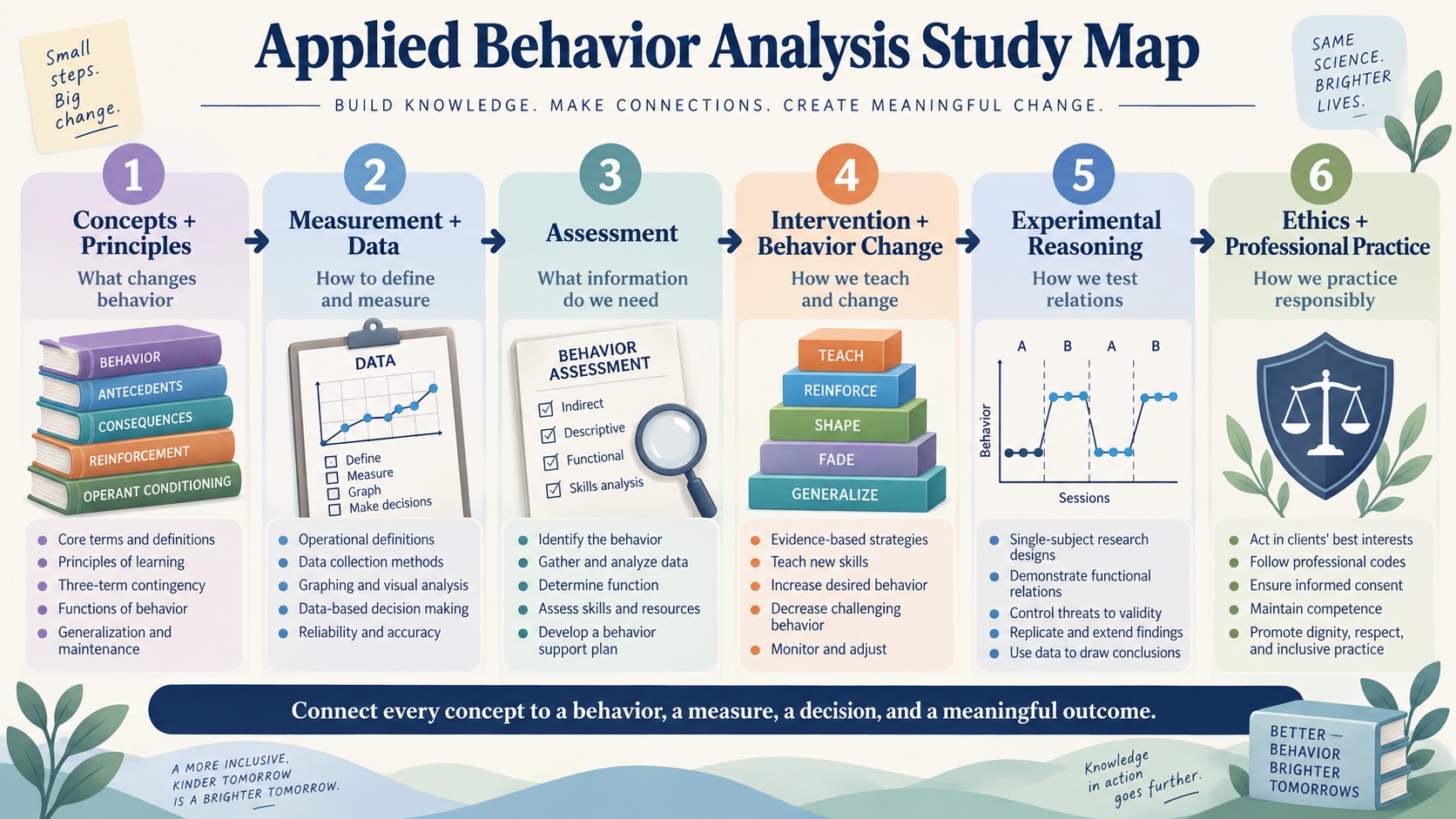
2. Build a six-part ABA study map
Part 1: Concepts and principles
Start with reinforcement, punishment, motivating operations, stimulus control, respondent and operant conditioning, schedules, prompting, shaping, chaining, and generalization. Do not memorize a word alone. For each term, write a definition, a contrast term, and a short example that identifies the relevant contingency.
Part 2: Measurement and data display
Practice operational definitions, frequency, rate, duration, latency, interresponse time, percentage, interval methods, time sampling, permanent-product measures, graphs, and visual analysis. The study question is not only “What is duration?” It is “When would duration represent the important dimension of this behavior, and what limitation should I consider?”
Part 3: Assessment
Review record review, interviews, direct observation, preference assessment, skill assessment, descriptive assessment, and functional analysis. Keep assessment purpose clear: a preference assessment is not a functional analysis, and identifying a correlation is not the same as demonstrating a functional relation.
Part 4: Intervention and behavior change
Study antecedent strategies, consequence-based procedures, prompting and fading, differential reinforcement, extinction, self-management, token systems, teaching communication, and treatment integrity. For each procedure, identify the target behavior, the change mechanism, possible side effects, and how you would monitor progress.
Part 5: Experimental design and reasoning
Know the logic of prediction, verification, and replication. Compare reversal, multiple-baseline, multielement, and changing-criterion designs. When you read a graph, identify the independent and dependent variables, phase changes, level, trend, variability, immediacy, overlap, and plausible threats to internal validity.
Part 6: Ethics and professional practice
Include consent, confidentiality, competence, cultural humility, professional communication, documentation, public statements, multiple relationships, scope of practice, and transitions in service. Ethical questions are not a separate memorization island: they affect assessment, goal selection, data handling, supervision, and intervention decisions.
3. Practice the measurement-to-decision loop
Many ABA questions become easier when you use a repeatable data loop:
- Define: write an observable operational definition and identify what counts as an instance.
- Select: choose a measurement system that captures the important dimension and fits the setting.
- Display: graph the data in a way that makes the relevant relation visible.
- Interpret: describe level, trend, variability, and changes across conditions without overstating the conclusion.
- Decide: continue, modify, fade, generalize, or reassess based on the data and treatment goals.
- Check integrity: ask whether the intervention was implemented as planned and whether measurement was accurate.
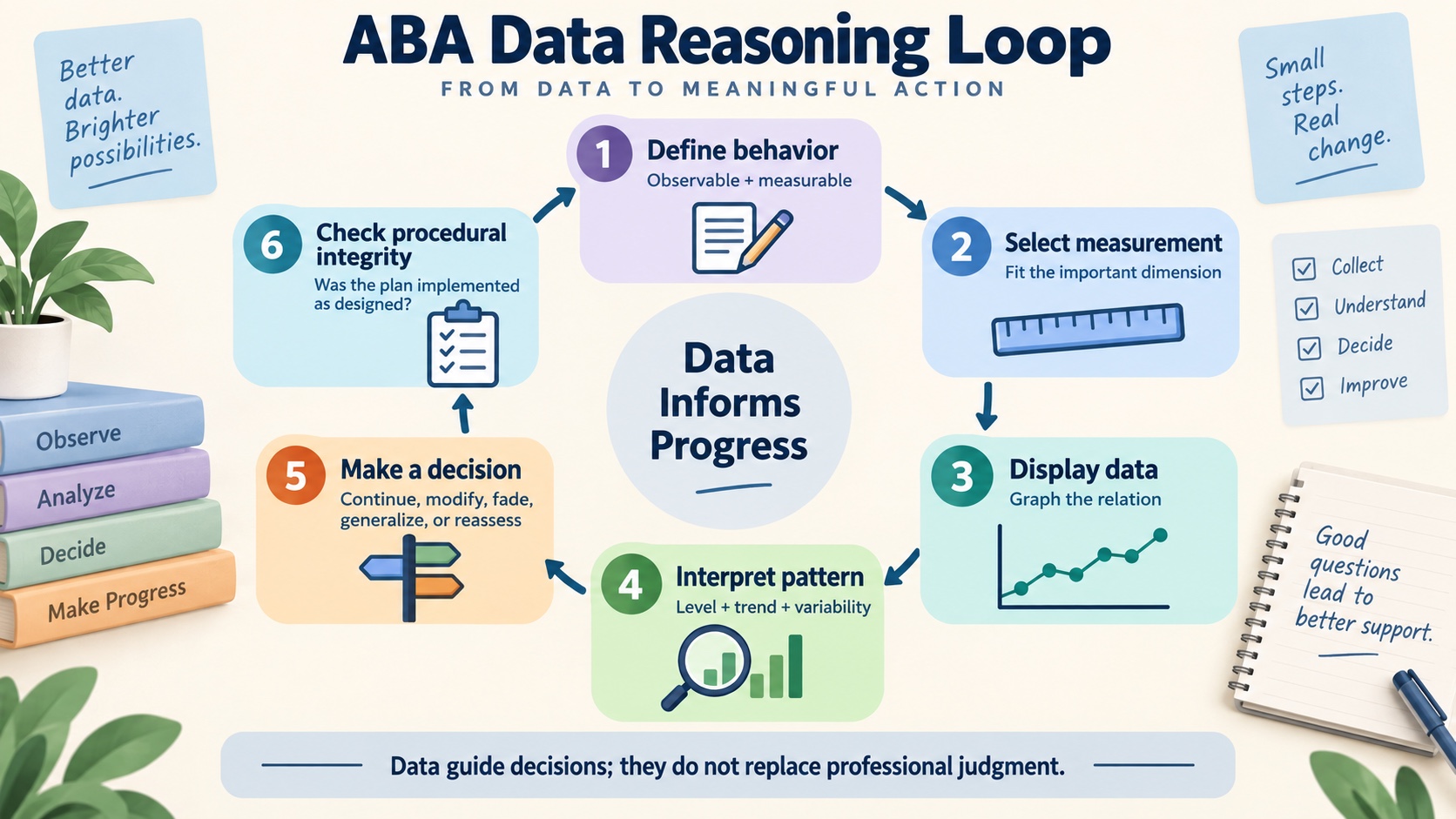
For study practice, take a small graph and write one sentence for each step. This is more powerful than rereading a definition because it makes you coordinate measurement, visual analysis, and action. If two answer choices both sound plausible, return to the behavior dimension, the measurement fit, and the evidence shown.
Use the seven dimensions as an evidence filter
When a study example proposes an ABA intervention, run it through a short evidence filter. Is the goal applied, meaning it matters to the learner or community? Is the target behavioral, meaning it is described and measured directly? Is the relation analytic, meaning the design gives you a reason to connect the change to the intervention? Is the procedure technological, meaning another trained person could understand and replicate it?
Then ask whether the procedure is conceptually systematic, whether the change is effective enough to matter, and whether it generalizes across people, settings, materials, or time. This rubric is useful for short-answer practice because it turns a broad claim—“the intervention worked”—into several testable questions. It also reminds you that a statistically or visually noticeable change is not automatically socially meaningful or ready to generalize.
Keep the rubric as a study card, not as a promise that every real case can be judged from one paragraph. In practice, decisions require client-informed goals, accurate data, competent supervision, and review of the current ethical and regulatory context.
When your error log shows repeated confusion, do not only mark the answer wrong. Write the missing distinction, find one new example, and retrieve it again later. The goal is flexible reasoning: recognizing the same principle when the wording, learner, setting, or data display changes.
That flexibility is the point of a durable study guide and practice.
4. Design a study session that produces usable knowledge
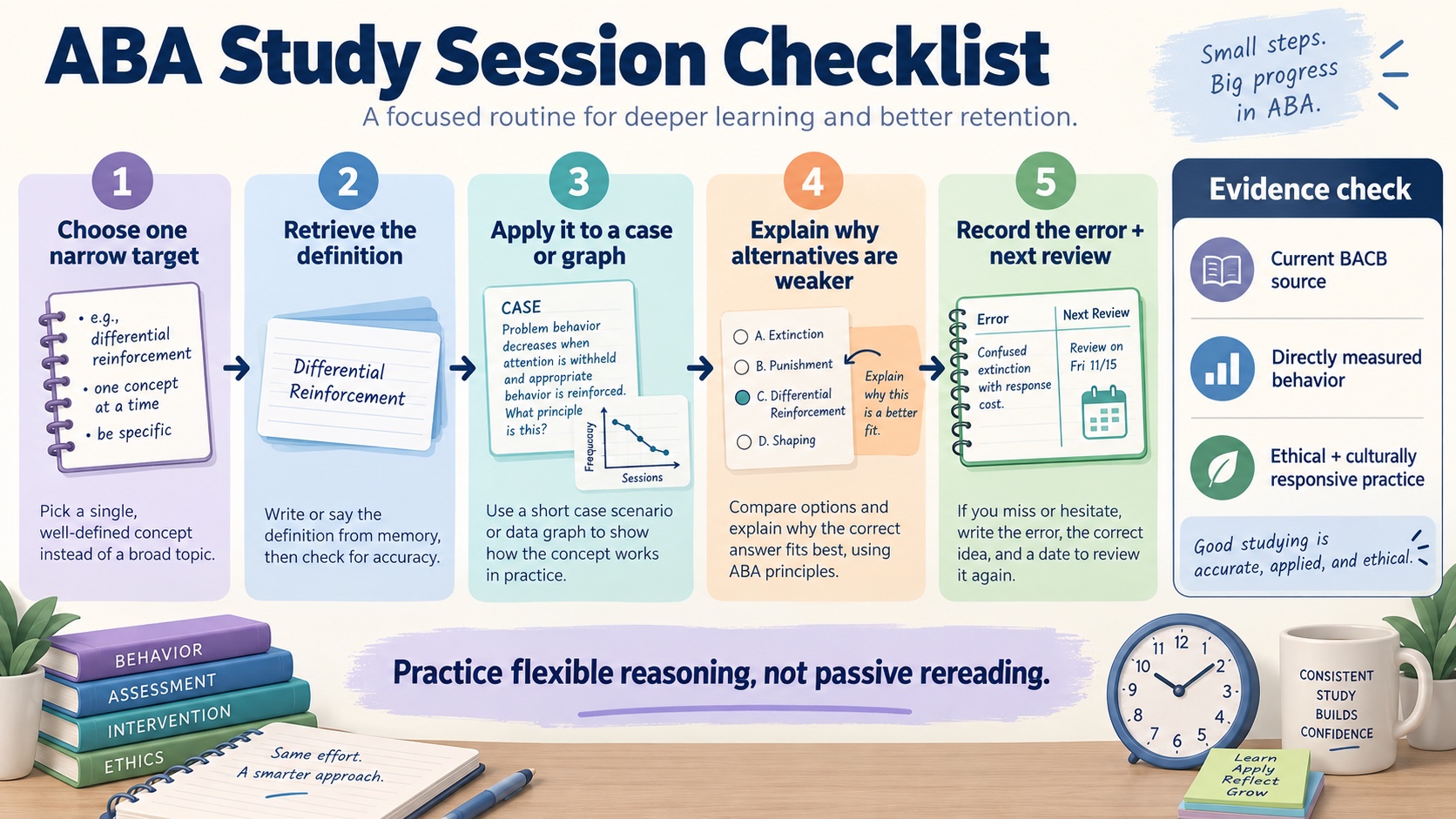
A 45-minute session can be structured around retrieval and application:
- Five minutes: choose one narrow target, such as discontinuous measurement or differential reinforcement.
- Ten minutes: retrieve the definition and write a contrast pair from memory.
- Fifteen minutes: solve two short cases or interpret one graph.
- Ten minutes: explain the answer aloud or in writing, including why the alternatives are weaker.
- Five minutes: record the error, the source you need to revisit, and the next retrieval date.
Use varied examples. A principle that works only in a child-clinic vignette may not be understood deeply. Move between education, home, employment, health, and community examples when appropriate, and keep the learner’s dignity and context visible. This helps prevent memorized vocabulary from becoming detached from socially significant practice.
5. Choose the right certification track
Once the foundation is organized, choose the current source for your intended role:
- RBT: use the current RBT Handbook and RBT content outline. Focus on technician-level implementation, measurement, documentation, and supervision boundaries.
- BCaBA: use the current BCaBA Handbook and BCaBA content outline. Add broader assessment, intervention, ethics, and supervised-practice responsibilities to the foundation.
- BCBA: use the current BCBA Handbook and BCBA content outline. Study advanced assessment, intervention, experimental design, supervision, ethics, and independent professional decision-making.
Track-specific pages should narrow the study plan; they should not be treated as interchangeable. Check the date and edition of the official content outline, especially when a requirement transition is approaching. A general guide is a map, not the complete itinerary.
Common study-guide mistakes
Memorizing without applying. Add cases, graphs, and contrast questions to every concept set.
Using unofficial “verified answers.” Unofficial question banks can contain errors and do not represent live BACB examination content. Use them only with careful source checking.
Studying only one weak area. BACB guidance cautions against using a small score report as the entire study plan. Review the full applicable content and then target errors.
Ignoring ethics and cultural responsiveness. They affect how goals, data, communication, and interventions are selected and delivered.
Mixing certification tracks. An RBT explanation cannot replace the BCaBA or BCBA Handbook, and a general ABA article is not a certification requirement.
FAQ
What is the best way to use an ABA study guide?
Use it to organize concepts, retrieve definitions, apply principles to cases, interpret data, and track errors. Then confirm the final coverage against the current BACB source for your RBT, BCaBA, or BCBA track.
Should an ABA study guide include practice questions?
Yes, but practice questions should support learning rather than imitate or reproduce protected examination content. Choose questions that explain the reasoning and connect to the current content outline.
How much measurement should I study?
Enough to define behavior, choose a measurement that fits the important dimension, recognize limitations, graph the result, and interpret the pattern. Measurement is a decision skill, not only a vocabulary list.
Can a general guide prepare me for the BCBA exam?
It can build foundations and reveal gaps, but it is not a substitute for the current BCBA Handbook, BCBA content outline, coursework, fieldwork, and full exam preparation. Use the official track-specific source to determine scope.
Official and academic sources
- BACB: About Behavior Analysis
- BACB: Test Content Outlines for Certifications
- BACB: Examination Information
- APBA: Identifying ABA Interventions
- Baer, Wolf, & Risley (1968), “Some Current Dimensions of Applied Behavior Analysis”
- ABA Study Online RBT learning path
- ABA Study Online BCaBA learning path
- ABA Study Online BCBA learning path