Applied Behavior Analysis Checklist: 9 Checks for Study and Practice
An applied behavior analysis checklist is most useful when it turns a broad idea into observable review questions. It should help a learner, technician, supervisor, or behavior analyst notice what still needs clarification: the behavior and context, the goal, the data, the intervention logic, the people affected, and the next review point. It is not an automatic treatment approval, a substitute for supervision, or a universal form that makes a service plan compliant.
This guide treats the checklist as a structured learning and quality-review tool. It draws its boundaries from the BACB’s overview of behavior analysis and current ethics materials, while keeping individual clinical decisions with appropriately qualified professionals and the relevant service, legal, and funding requirements.
Table of Contents
What an ABA checklist should check
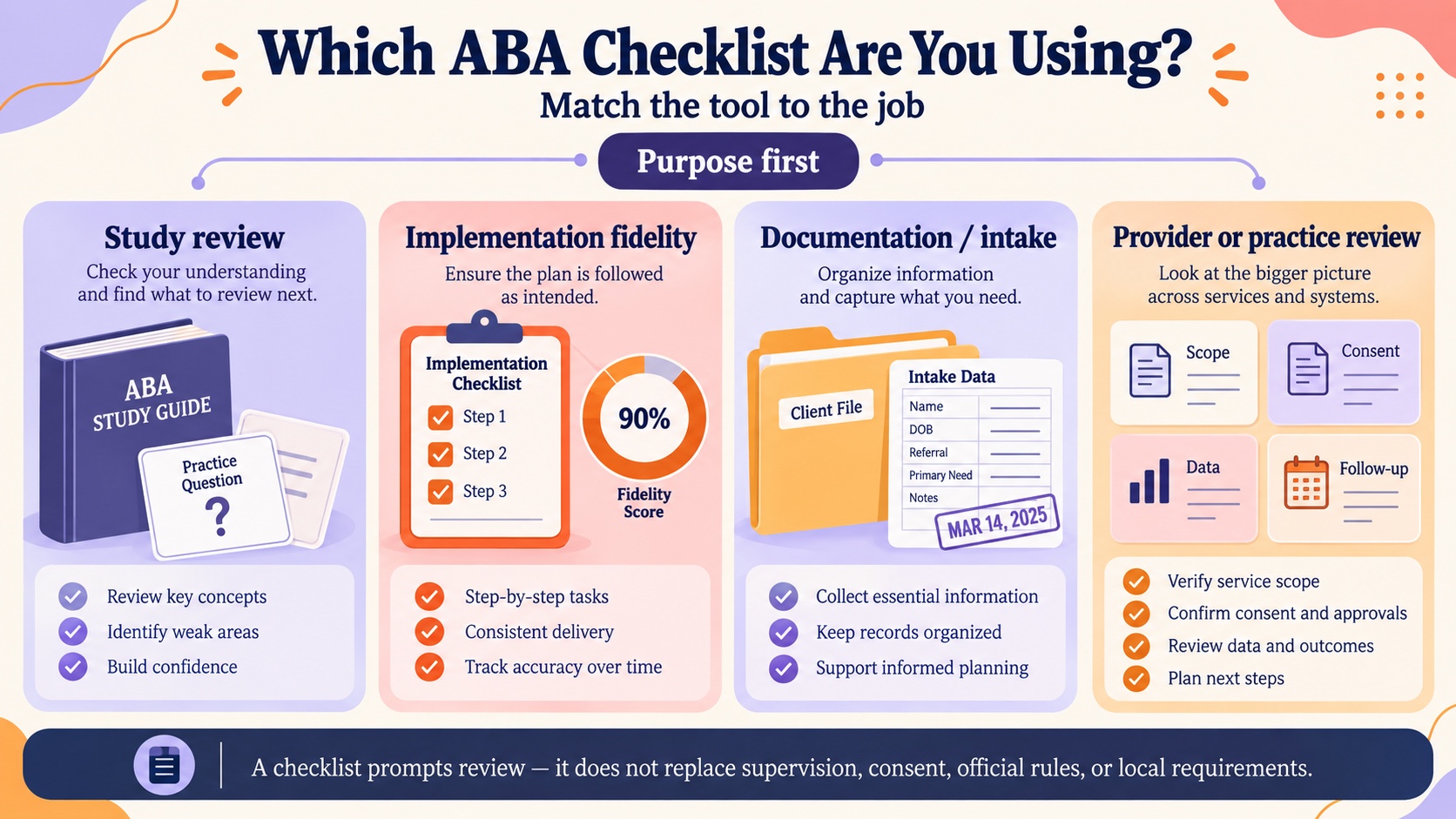
The phrase “ABA checklist” can describe several different things: a study checklist, a session-fidelity form, an intake or documentation list, a fieldwork review, or a treatment-plan audit. Those tools have different users and different consequences. Before using one, write its job in a single sentence. For example: “This sheet helps a student check whether an answer explains the measurement decision,” or “This form helps a supervisor review whether the written teaching procedure was implemented as described.”
The BACB describes behavior analysis as a science focused on behavior and the circumstances in which it occurs. Its ethics materials also connect assessment, intervention selection, stakeholder involvement, consent, data collection, and continual evaluation. A useful checklist therefore follows a chain rather than a random pile of boxes: define what matters, identify why it matters, choose a measurable plan, implement within competence, and use evidence to decide what to review next.
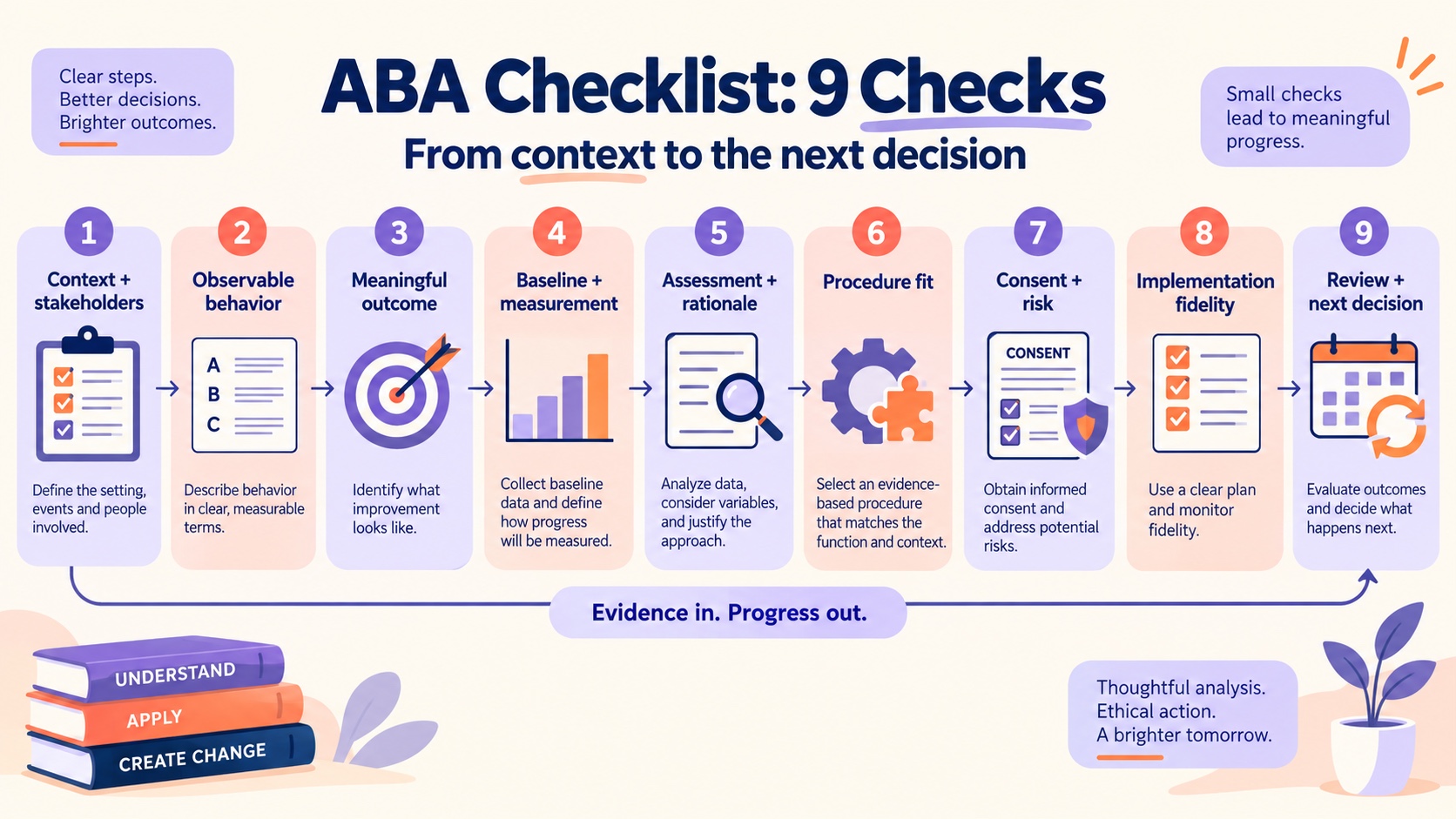
The nine-check ABA review
Use these checks as prompts. A “not yet” answer is not a diagnosis of failure; it tells you what question needs evidence, clarification, supervision, or a source review.
- Context and stakeholders: Who is affected by the goal or procedure? What setting, routines, communication needs, preferences, and constraints matter? Record the relevant stakeholders instead of describing a learner as if the environment were irrelevant.
- Observable behavior: Could two trained observers identify what counts and what does not count? Replace labels such as “noncompliant” or “has poor attention” with a description of an observable response and the conditions in which it occurs.
- Meaningful outcome: Does the goal improve a useful skill, participation, communication, safety, independence, or another clearly defined outcome? State what success would look like in a real routine, not only on a practice sheet.
- Baseline and measurement: What is being measured, which dimension fits the behavior, and when will data be collected? A good checklist asks whether the measure can answer the decision question and whether the recording method is realistic for the people who will use it.
- Assessment and rationale: What information supports the hypothesis or teaching decision? Keep descriptive observations, record review, preference information, skill assessment, and other assessment activities distinct. Do not turn one brief observation into certainty about function.
- Procedure and fit: Is the written procedure conceptually consistent, based on the assessment information, understandable to the implementer, and matched to the person’s context and resources? Note the antecedent arrangement, teaching or response steps, reinforcement plan, prompting or fading details when relevant, and decision rules.
- Consent, assent, and risk: Has the team explained what will happen, when consent or re-consent is required, and how client preferences or assent will be considered when applicable? Does the plan identify foreseeable risks, less intrusive options, and a path for review? A checkbox does not replace a conversation or a required local process.
- Implementation fidelity: Can a reviewer tell whether the written steps were actually used? A fidelity checklist should list observable procedure steps, allow a clear yes/no/not-observed response, and create a coaching or revision action when implementation drifts.
- Review and next decision: When will the data be graphed or summarized? What result would lead to continuing, modifying, pausing, consulting, referring, or ending a plan? Include the review date, responsible person, and record-storage boundary rather than treating the checklist as the final decision.
How students can use the checklist
For exam study, convert each check into a discrimination question. If the item is about measurement, ask which dimension and recording system fit the behavior. If it is about assessment, ask what information the procedure can and cannot establish. If it is about intervention, ask whether the proposed step follows from the assessment and whether the answer includes a measurable decision rule.
Then practice with a small case. Hide the checklist, read the scenario, and write the missing questions before looking at the answer. This is more useful than memorizing “nine checks” as a list. The current BACB Test Content Outlines and examination information define the official exam boundary; an independent study checklist is only a way to organize retrieval and application.
Keep track labels visible. An RBT learner may use the list to recognize a written procedure, collect data as trained, and identify when to ask for supervision. A BCaBA or BCBA learner may need to reason further about assessment, intervention selection, data-based decisions, supervision, stakeholder communication, and ethical boundaries. The same checklist architecture can serve all three tracks, but the expected decision depth is not identical.
What a checklist cannot decide
A checklist cannot determine that a person has a diagnosis, that an intervention is appropriate for a particular client, that a provider meets state licensure requirements, or that a fieldwork entry qualifies. It also cannot replace a current BACB Handbook, an ethics code, a supervisor’s review, a service agreement, informed consent, or a payer’s documentation requirements.
It cannot solve a scope-of-competence problem by adding more boxes. A published competence-and-confidence framework in behavior analysis asks practitioners to consider procedures and strategies, populations, settings, prior experience, literature familiarity, and available resources. When confidence or competence is low or unknown, the useful checklist result may be additional supervision, professional development, consultation, or referral—not an unchecked “complete.”
A short worked example
Imagine a study question describing a learner who leaves a work area when a difficult task begins. A weak checklist answer might label the behavior “escape-maintained” immediately. A stronger review starts with the observable response and context: how is leaving defined, what tasks preceded it, what happened afterward, how often did it occur, and what other variables were present? It then asks what assessment information is still needed before selecting a behavior-change procedure.
For a fidelity review, the same case becomes more concrete. Can the implementer identify the task cue, deliver the agreed prompt, provide the planned reinforcement for the replacement response, record the selected measure, and note an unusual event? If the data show no improvement, the next step is not automatically “make the consequence stronger.” Review measurement quality, implementation fidelity, environmental barriers, preference, health or safety concerns, and the need for qualified consultation.
Common checklist mistakes
- Using a generic clinical form for every purpose: study review, implementation fidelity, intake, and treatment-plan audit need different fields.
- Checking labels instead of evidence: “assessment completed” is less useful than naming what was observed, measured, and still uncertain.
- Skipping the environment: a behavior description without context can lead to a narrow or misleading interpretation.
- Confusing fidelity with effectiveness: a procedure can be implemented accurately and still require revision; poor outcomes can also reflect implementation drift.
- Turning a prompt into permission: a completed checklist is not authorization to practice outside competence or local requirements.
- Leaving no next action: every “not yet” item should point to a source check, observation, coaching step, consultation, or scheduled review.
Applied behavior analysis checklist FAQ
What should an applied behavior analysis checklist include?
At minimum, include context and stakeholders, an observable behavior definition, a meaningful outcome, a measurement plan, assessment rationale, procedure fit, consent and risk prompts, implementation fidelity, and a next-review decision. Adapt the fields to the checklist’s actual user and purpose.
Is this an official BACB checklist?
No. This is an educational review framework from ABA Study Online. Use current BACB materials and qualified supervision for certification, fieldwork, ethics, or service decisions.
Can an RBT use an ABA checklist?
Yes, when the checklist is limited to the RBT’s role and training. It can help an RBT recognize procedure steps, recording requirements, implementation questions, and situations that need supervisor guidance. It should not direct an RBT to independently design or change a behavior-change plan.
What is the difference between an ABA checklist and a fidelity checklist?
An ABA checklist may cover a broad review of goals, assessment, data, ethics, and next steps. A fidelity checklist is narrower: it lists observable steps of a defined procedure and checks whether those steps were implemented as designed.