APF RBT Training: What to Check for the 2026 Requirements
Autism Partnership Foundation, often called APF, is known for offering a free online RBT training course. If you are considering APF RBT training in 2026, the most important question is not only whether the course is free. You also need to verify which APF course version you are taking, whether the certificate contains the current BACB wording, how long you have to finish, and what steps you still need after training.
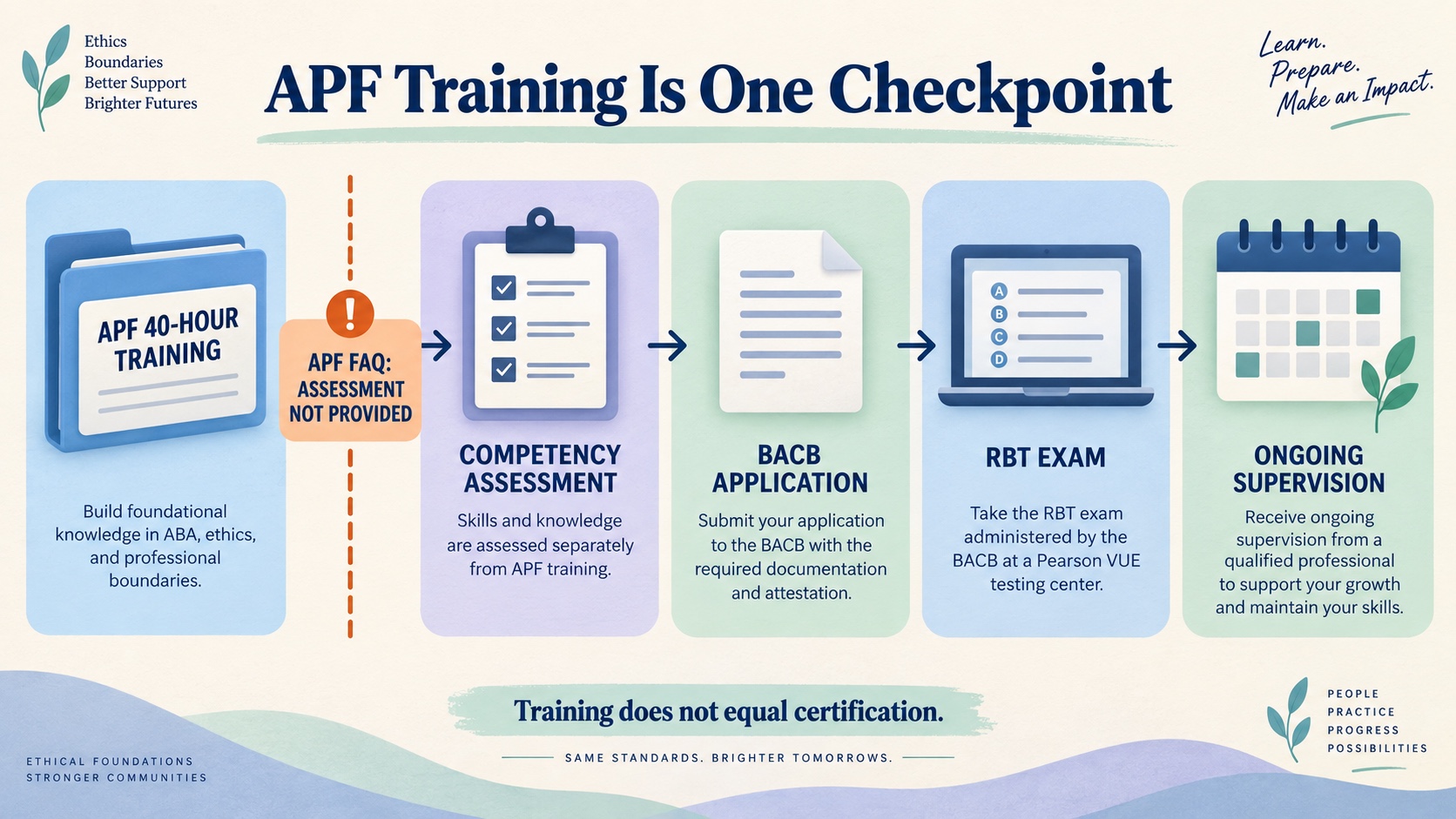
APF’s current RBT FAQ says its RBT 2.0 training meets the new 2026 requirements and covers the RBT Test Content Outline, 3rd edition. The same FAQ says APF does not offer the RBT competency assessment. That distinction is essential: completing an APF course may address the 40-hour training step, but it does not by itself complete the Initial Competency Assessment, BACB application, examination, or ongoing supervision requirements.
Table of Contents
Is APF RBT training current for 2026?
According to APF’s current FAQ, the RBT 2.0 training is designed to meet the new 2026 requirements and covers the RBT Test Content Outline, 3rd edition. That is the current provider statement to review when you register. However, APF’s older public “Free RBT Training” page still describes the course as based on the 2nd edition task list. The difference is a reminder to confirm that you are enrolled in the current RBT 2.0 course, not to rely on an older page, saved bookmark, or third-party description.
The BACB is the authority for RBT eligibility requirements. APF is an independent training provider. The BACB’s 2026 training outline requires the training certificate to state that the program is designed to meet the 2026 training eligibility requirement and is offered independent of the BACB. A course can be useful and still not be an official BACB course.
Before beginning, save the current APF course description and FAQ page for your records. Then compare the course version and certificate details with the current BACB training outline and RBT transition guidance. This simple record makes it easier to explain which training you completed if a course page changes later.
What must a 2026 RBT training include?
The BACB’s RBT 2026 40-Hour Training Requirements and Curriculum Outline applies to applicants applying on or after January 1, 2026. It sets requirements that apply to any provider, including:
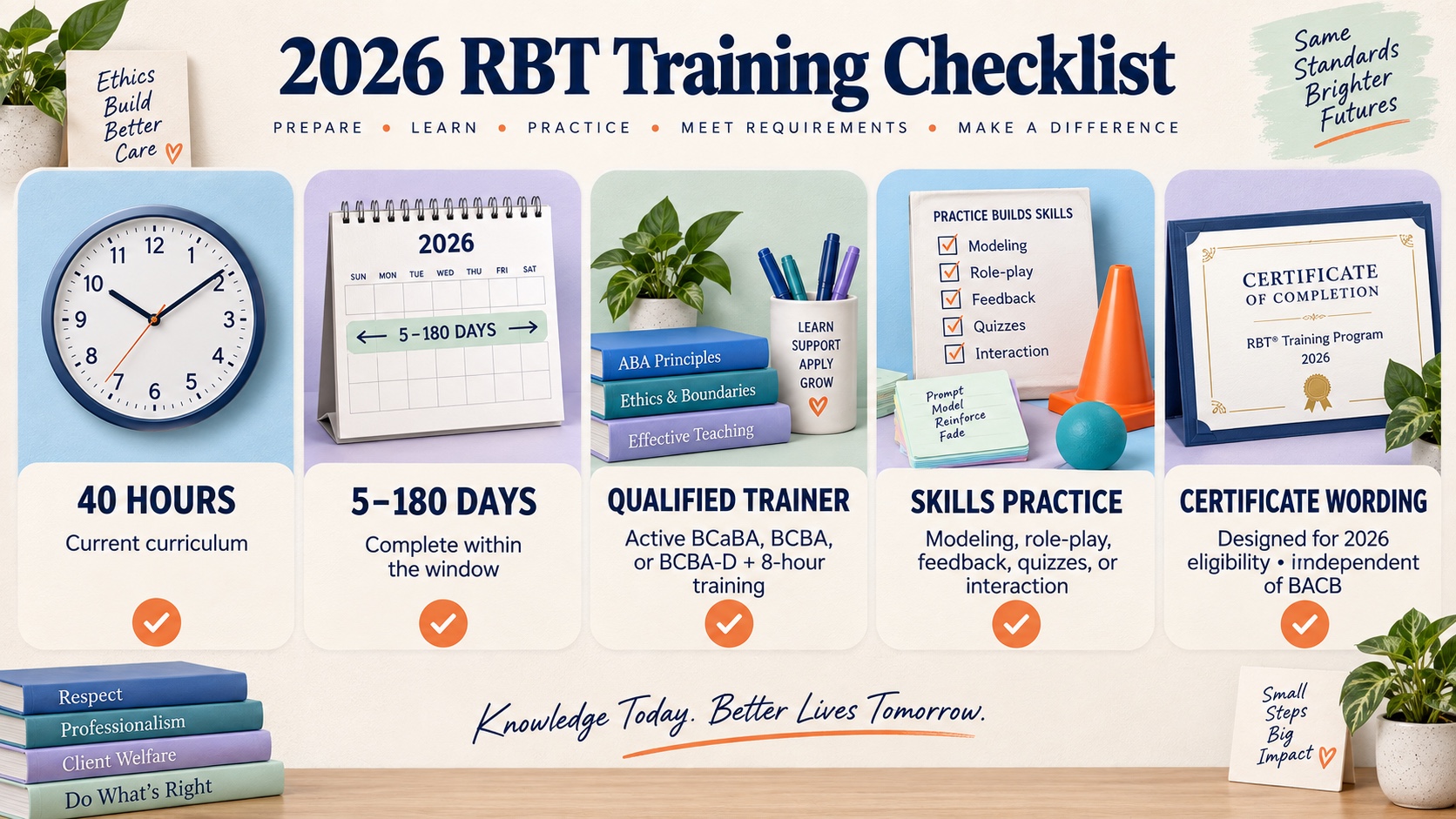
- At least 40 hours: the training covers the current curriculum outline, not simply a collection of unrelated videos.
- A five-to-180-day completion window: the trainee must complete the training in no fewer than 5 days and no more than 180 days.
- Behavioral skills training components: delivery may include video or didactic instruction, modeling with exemplars and nonexemplars, role-play with feedback, quizzes, interactive activities, and instructor-led discussion. Assigned reading alone does not count toward the training duration.
- A qualified responsible trainer: the responsible trainer is an active BCaBA, BCBA, or BCBA-D who has completed the 8-hour supervision training. Assistant trainers may hold RBT certification or higher under the outline’s conditions.
- Required certificate information: the certificate must identify the trainee, BACB ID, training dates, time spent, responsible trainer, certification number, and assistant trainers when applicable, and include the required independent-of-BACB statement.
The outline also describes the content areas, including introduction to ABA, preparing for service delivery, data collection and graphing, assisting with assessments, behavior-change interventions, service-delivery documentation and reporting, ethics and professionalism, and next steps in the certification process. A provider’s course outline should make it possible to see how the current curriculum is covered.
What does APF say its training provides?
APF presents its RBT 2.0 course as free and says in its current FAQ that the training meets the new 2026 requirements and covers the 3rd-edition RBT content outline. The FAQ also says the course includes automatically generated closed captions, is currently available in English, and has a separate support route for course-account questions. These are provider-specific details and can change, so confirm them on the current APF pages before registering.
The most important APF limitation is clear: APF says it does not offer the competency assessment. After completing the training, you need to contact an employer or a qualified supervisor/assessor for the current RBT Initial Competency Assessment. The assessment must be completed after the qualifying training and is a separate step in the certification process.
Also keep the word “free” in context. A free course may reduce the cost of the training itself, but you may still have costs or time requirements related to an assessor, application, examination, background checks, supervision, transportation, or employer onboarding. APF training is an educational option, not a promise that the complete RBT pathway has no cost.
When the APF page and the BACB page use different labels, compare the underlying requirements instead of choosing the more reassuring phrase. Write down the course name and version, the provider’s statement about the 2026 eligibility requirement, the trainer information, the completion window, and the separate assessment plan. If one of those items is unclear, pause before starting or ask the provider for written clarification. This is especially important when an employer has its own preferred training system: an employer may accept or recommend a course for workplace onboarding, but that preference is not the same as the BACB’s certification requirement.
You can also use the course as a learning experience while keeping the certification checklist separate. Take notes by current content area, mark questions for your future supervisor, and save the completion evidence in one folder. That makes the training more useful than simply collecting a certificate at the end.
What should you check on the certificate?
When you finish, read the certificate before assuming the step is complete. For a 2026 application, check that the certificate is for the current 2026 training eligibility requirement and includes the statement that the training is offered independent of the BACB. Confirm the following details:
- your name and BACB ID;
- training start and end dates;
- the amount of time you spent engaged in training;
- the responsible trainer’s name and certification number;
- assistant trainer names and certification numbers, if applicable; and
- the required independent-provider statement.
Save the certificate with your APF registration information and a record of when you completed the course. Do not edit the certificate yourself to add a missing statement or change a date. Ask APF support or the responsible trainer to correct documentation, and check the BACB requirements before uploading anything that appears incomplete.
What does APF training not complete?
Finishing APF training is not the same as becoming an RBT. The next steps depend on your application timing and current BACB rules, but the training course does not replace:
- the current RBT Initial Competency Assessment;
- the BACB certification application and required checks;
- the RBT certification examination;
- ongoing supervision after certification; or
- employer, state, payer, or service-setting requirements that may also apply.
Training also does not grant permission to provide services to a client. The BACB’s training outline teaches concepts and service-delivery preparation, but your employer and supervisor determine how you are trained and supervised in a specific setting. The Initial Competency Assessment is a separate demonstration of relevant skills, not a certificate for watching course modules.
How should you plan the RBT pathway?
Use a five-part record instead of keeping only a course completion email:
- Course version: record that you enrolled in the current APF RBT 2.0 training and check the provider’s current FAQ.
- Completion window: note your start date and make sure completion occurs within the BACB’s five-to-180-day window.
- Certificate: review the current certificate against the BACB checklist before uploading it.
- Assessment: arrange the current Initial Competency Assessment with an eligible assessor; APF says it does not provide this step.
- Application and exam: use the current RBT Handbook and BACB portal instructions for the remaining application, examination, and supervision steps.
The ABA Study Online RBT learning path can help you review the concepts introduced in training, and the RBT practice area can help you turn those concepts into retrieval practice. These are supplemental study resources and are not APF or BACB certification documents.
What APF training mistakes should you avoid?
- Using the old public course page as the only evidence: it still contains 2nd-edition task-list language. Check the current APF RBT 2.0 FAQ and your actual certificate.
- Calling APF BACB approved: APF is an independent provider. The BACB-required wording makes that boundary explicit.
- Assuming the course includes the competency assessment: APF’s FAQ says it does not. Arrange that step separately.
- Finishing too quickly or too slowly: the 2026 outline requires no fewer than 5 days and no more than 180 days.
- Uploading an incomplete certificate: verify dates, trainer details, time, BACB ID, and the independent-provider statement.
- Assuming free training means free certification: the application, assessment, examination, checks, and supervision are separate parts of the pathway.
APF RBT training FAQ
Is APF RBT training free? APF presents its RBT training as free. Confirm the current registration and course-access terms on the APF website because provider processes can change.
Does APF RBT 2.0 meet the 2026 requirements? APF’s current FAQ says that RBT 2.0 meets the new 2026 requirements and covers the RBT Test Content Outline, 3rd edition. Compare your course version and certificate with the current BACB outline before applying.
Does APF provide the competency assessment? No. APF’s FAQ says it does not offer the competency assessment and directs learners to an employer or BCBA supervisor for that step.
How long do I have to finish? The BACB 2026 training outline requires completion in no fewer than 5 days and no more than 180 days. Record your start date and confirm the course’s tracking system.
Is APF training an official BACB course? No. It is independent provider training. The certificate and course materials should use the required language that the program is designed to meet the 2026 eligibility requirement and offered independent of the BACB.