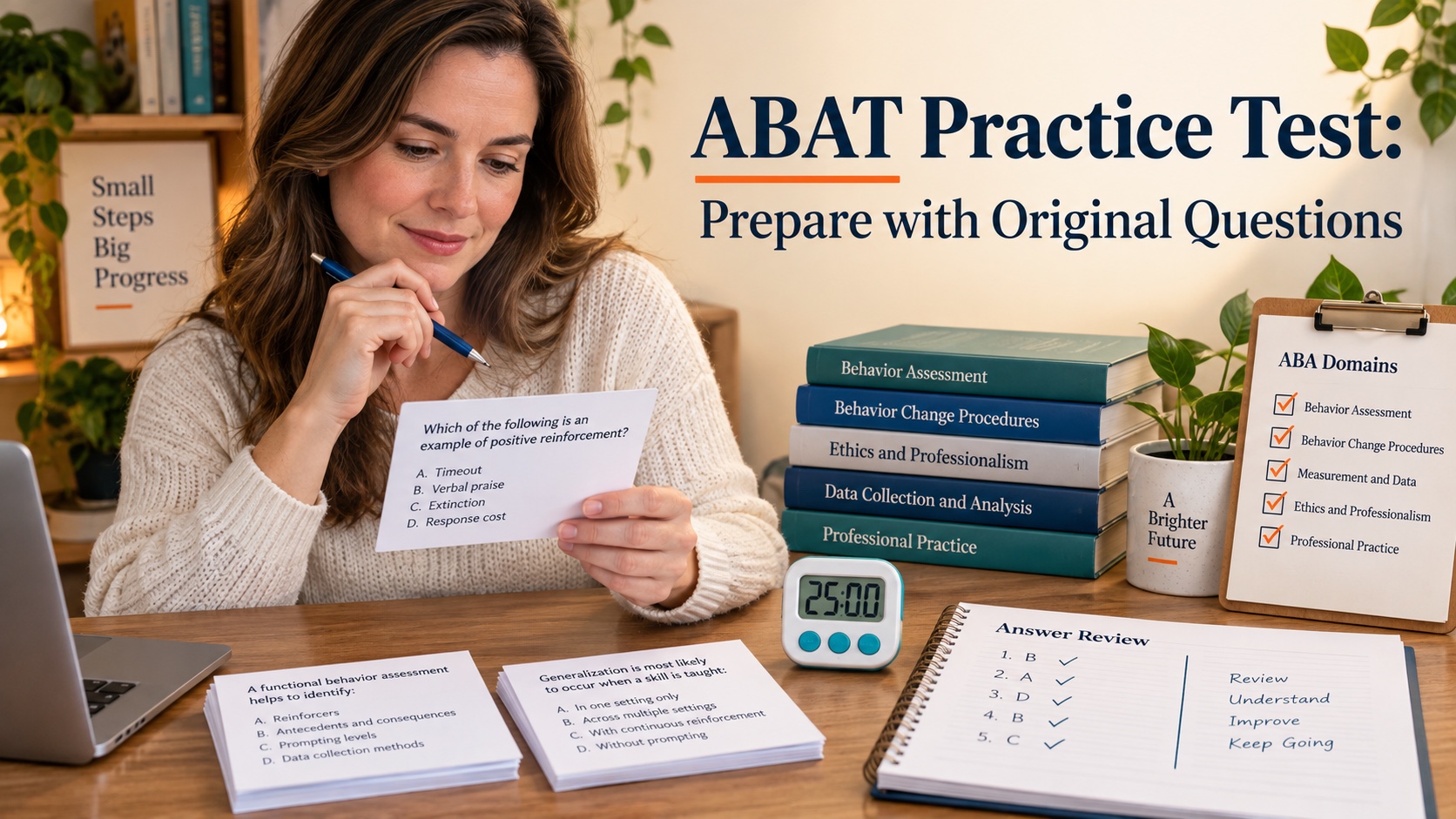
ABAT Practice Test: How to Prepare with Original Questions
Searching for an ABAT practice test usually means you want more than a list of definitions. You want to see how Applied Behavior Analysis Technician topics appear in multiple-choice form, practice under a time limit, and find the areas that need another review. A good practice test can make those next steps visible.
Start with an important boundary: ABAT refers to the Applied Behavior Analysis Technician credential associated with QABA. An independent practice page or question bank is not the certifying body, is not an official exam, and should never imply access to live exam questions. QABA’s current requirements and handbook are the authority for eligibility and examination information. Use practice materials to rehearse thinking, not to replace the official source or promise a pass.
Table of Contents
What is an ABAT practice test?
An ABAT practice test is an unofficial set of questions designed to help a candidate rehearse content, answer choices, explanations, and pacing related to the ABAT credential. Formats vary. One resource may offer a short free sample; another may let you select a domain, review explanations, save missed questions, or complete a longer timed session.
Those features answer different learning needs. A short untimed quiz is useful when you are learning a concept. A domain quiz helps you find a narrow gap. A mixed quiz tests whether you can discriminate among topics after the labels are removed. A full simulation is useful later, when you need to practice sustained attention and pacing. None of these formats is automatically “most realistic” simply because it is longer.
Public QABA material and the current ABAT handbook should be checked for the latest exam details. The current public information reviewed for this article describes an examination with 125 questions and a two-hour time limit. Treat those details as version-sensitive: confirm them directly with QABA before you schedule or make a final test-day plan.
What to check before choosing one
Before you start a practice bank, inspect the page as carefully as you would inspect a teaching tool. Look for:
- Credential clarity: Does the resource say that it is for QABA’s ABAT pathway, rather than blending ABAT with RBT, BCaBA, or BCBA requirements?
- Current-source statement: Does the provider identify the blueprint, handbook, or version it used, and tell you to verify current QABA information?
- Original content: Does it clearly state that its questions are original practice questions rather than real exam items?
- Explanations: Does each answer explain the relevant principle and why the distractors do not fit?
- Coverage: Can you see which domains or competencies a question is intended to practice?
- Review controls: Can you return to missed, uncertain, or bookmarked questions instead of starting from zero?
- Terms and access: Are the price, access period, renewal, privacy, and refund conditions easy to find?
Be cautious with pages that use “real questions,” “guaranteed pass,” or “official” as sales language without evidence. A practice test can resemble a test format while remaining independent. That separation protects exam security and gives you a more honest interpretation of your score.
How to use a practice test well
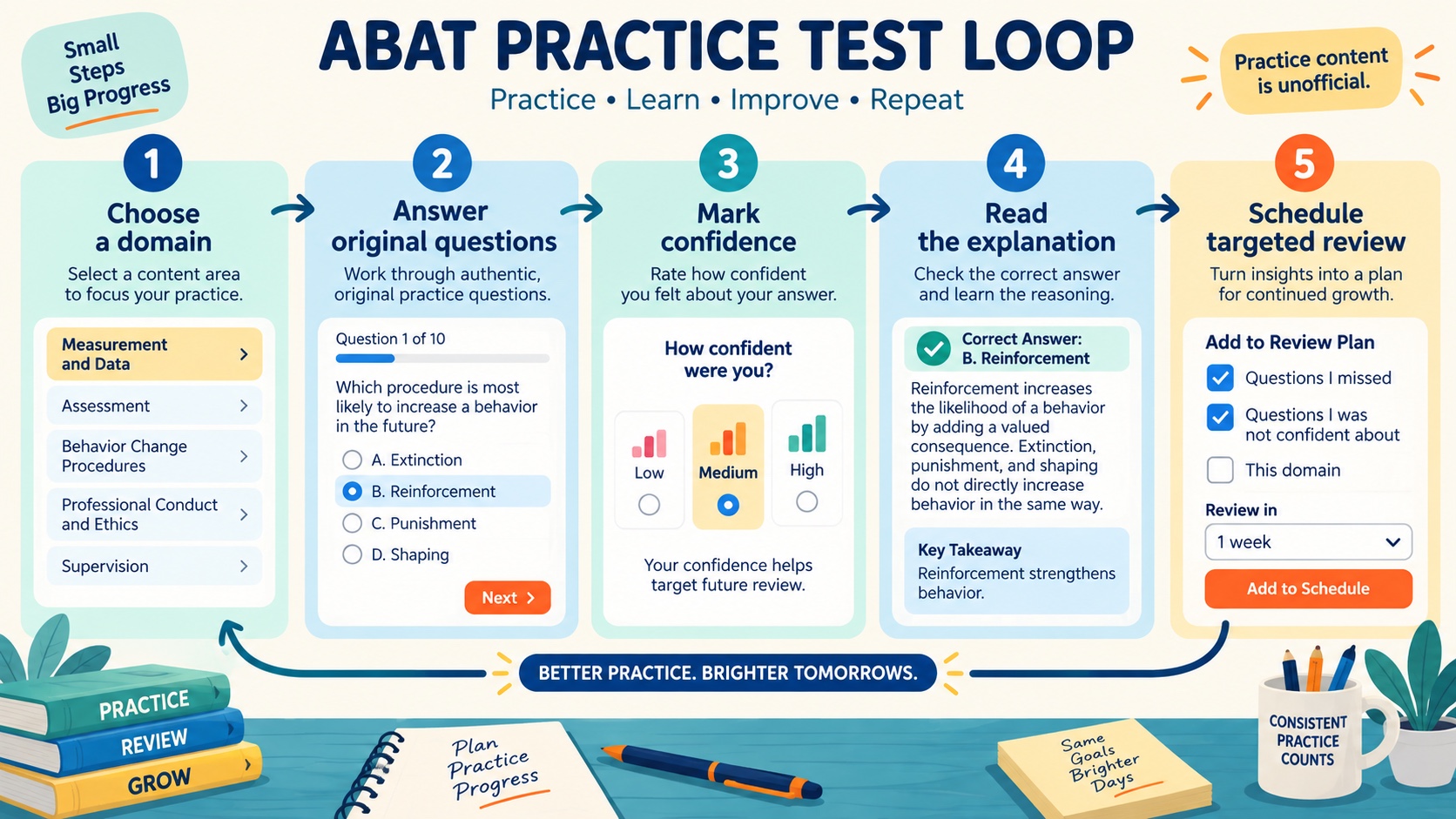
Use three passes instead of taking the same quiz repeatedly until the percentage looks comfortable.
- Diagnostic pass: answer without looking up every term. Mark your confidence as certain, uncertain, or guessed.
- Learning pass: read the explanation, check the source, and write one sentence about the distinction that controlled the answer.
- Transfer pass: return later with mixed or changed questions. Ask whether you can recognize the principle when the wording and context are different.
Keep your notes short. For a missed item, record the topic, your answer, the best answer, the reason your choice failed, and the next action. “Review ABA” is not a next action. “Compare positive reinforcement with negative reinforcement and write one original example of each” is more useful.
How to review missed questions
A wrong answer can reflect different problems, so do not treat every miss as the same. You may have forgotten a definition, confused two related terms, missed a detail in the stem, selected an answer that was true but not the best response, or rushed the final decision. Labeling the error tells you what to practice next.
For example, if a question asks about data collection and you choose a system that sounds familiar, revisit the behavior and measurement requirements in the scenario. If you knew the term but overlooked a qualifier, practice reading stems for the decision feature. If two distractors both seem plausible, write a comparison table and create a new example that separates them.
Return to the missed item after a delay, but do not memorize the letter or exact sentence. Cover the options and explain the principle first. Then answer a new question on the same topic. A repeated correct response on an unchanged item is encouraging; it is not enough evidence of flexible understanding by itself.
How to study by domain without losing the big picture
Domain practice is useful early and between simulations. Choose one domain that is both important to your plan and weak enough to improve. Complete a short set, review the errors, and connect the terms to a realistic technician decision. Then mix a few questions from other domains before you stop.
This mixed finish matters because a real examination does not announce the topic before every question. Interleaving also helps you notice when one principle changes the answer. A question about teaching procedures may still require attention to data, prompting, reinforcement, ethics, or person-centered practice. A domain label is a study organizer, not a permission to ignore neighboring concepts.
When to use a timed simulation
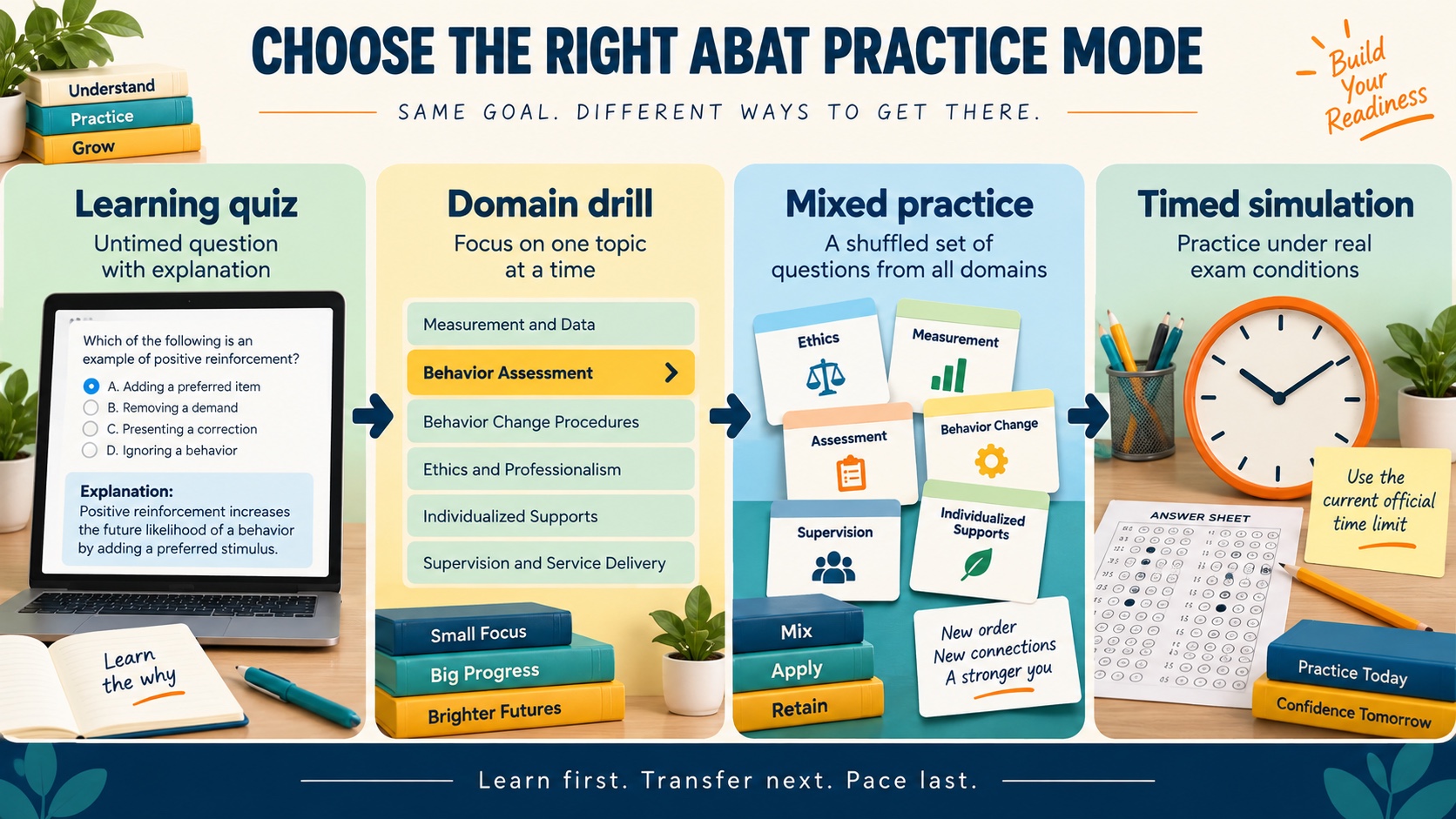
Use a full timed simulation after you have built enough content familiarity to learn from the result. Prepare the same kind of quiet setting you expect to use, follow the current official timing information, and avoid pausing to research every item. When you finish, take a break before reviewing.
The simulation score is a planning signal, not a certification prediction. Look at the pattern: Did accuracy fall near the end? Did one domain remain weak? Did you change correct answers because of anxiety? Did you spend too long on a few items? Use those observations to adjust practice rather than treating one number as a verdict.
Common practice-test mistakes
- Taking only free samples: a sample shows format, not complete readiness.
- Repeating the same quiz: recognition can rise without flexible recall.
- Skipping explanations: an answer key without reasoning cannot repair a discrimination error.
- Using the wrong credential track: ABAT, RBT, BCaBA, and BCBA materials are not interchangeable.
- Studying a stale blueprint: verify current QABA rules and handbook information before final preparation.
- Chasing a pass promise: no independent provider controls eligibility, test-day conditions, or the result.
- Copying live exam content: use original practice items and respect exam-security rules.
A simple ABAT study plan
Start by reading the current QABA requirements and handbook and writing down your exam date, available study time, and domains to cover. During the first phase, use short untimed sets to learn the response style and find gaps. During the second phase, alternate domain drills with mixed questions and keep an error log. In the final phase, add timed simulations, but reserve enough time to review the decisions behind the misses.
When you are ready to practice with original ABA questions, use ABA Study Online’s practice questions and app review tools as part of that loop. The resource is independent, so keep the current QABA sources beside it and use the questions for rehearsal, explanation, and review—not as a claim that you will pass.
FAQ and sources
Is an ABAT practice test official?
Usually no. A practice test is generally an independent study resource. QABA’s current requirements and handbook are the official sources for the credential and examination boundaries.
How many questions are on the ABAT exam?
The current public QABA material reviewed for this article describes 125 questions and a two-hour time limit. Verify those details in the current QABA handbook before scheduling or planning test-day pacing.
Are practice-test questions real ABAT exam questions?
They should not be. Responsible practice resources use original questions that reflect the intended content and reasoning demands without reproducing secure exam items.
Should I use domain quizzes or a full mock exam first?
Use domain or short mixed quizzes while learning and repairing gaps. Add full timed simulations after you have enough familiarity to interpret the result and change your study plan.