ABA Technologies Mock Exam: Features, Fit, and What to Compare
If you searched for an ABA Technologies mock exam, you are probably trying to decide whether the BOOST product fits your BCBA study plan. You may also want to try the free sample, understand how the full-length mocks are scored, or compare feedback and access with another practice tool.
This article summarizes what ABA Technologies publicly lists for its BOOST mock exams and then gives you a comparison lens you can use for any paid practice product. The goal is not to declare one product “the best.” A mock exam is useful only when its content is current, its feedback is usable, and you can turn the result into a specific study action.
Quick answer: what ABA Technologies lists
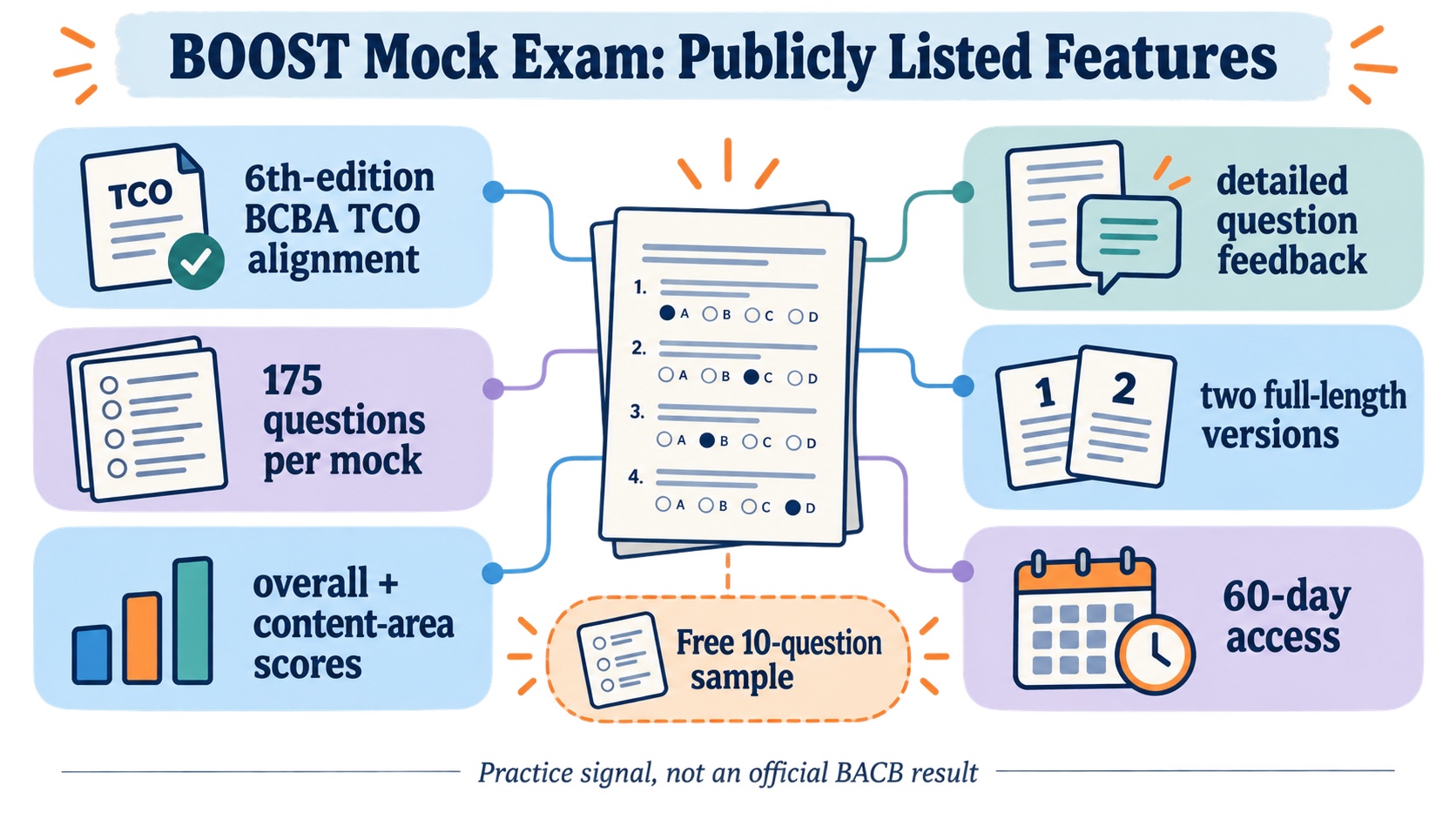
ABA Technologies’ BOOST pages currently list BCBA-level mock exams designed around the 6th Edition BCBA Test Content Outline. The public product page lists two full-length versions, Mock Exam A and Mock Exam B. Each mock is listed with 175 questions, overall and content-area scores, detailed question feedback, one attempt with unlimited review, and 60 days of access. The company also offers a free 10-question “petite” sample for learners who want to inspect the experience first.
Those are product features, not BACB credentials. ABA Technologies states that BOOST products are offered independently of and are not affiliated with the BACB. A mock score is a practice signal; it is not an official exam result, a certification decision, or a guarantee that you will pass.
The publicly listed BOOST mock-exam snapshot
Here is the cleanest way to read the current listing without confusing a product description with an official rule:
| Listed feature | What it may help you do | What it does not prove |
|---|---|---|
| 6th Edition BCBA TCO alignment | Study against the current nine-domain blueprint. | That the questions are official BACB questions or identical to the real exam. |
| 175 questions per mock | Rehearse a long scored-question session and pacing. | That your result will match an official scaled score or pass decision. |
| Overall and content-area scores | See a broad baseline and possible domain-level priorities. | That a weak domain score alone explains every error or predicts eligibility. |
| Detailed question feedback | Review the rationale after answering and identify reasoning gaps. | That reading an explanation once creates durable mastery. |
| Two full-length versions | Take a later form after targeted study and compare progress. | That two attempts are enough practice for every learner. |
| 60 days of access | Plan a review window around the purchase and feedback period. | That access length or pricing will never change. |
| Free 10-question sample | Preview the interface and explanation style before buying. | That ten questions represent the full difficulty or content distribution. |
How the official BACB boundary fits
The BACB’s current BCBA Test Content Outline (6th ed.) describes 104 tasks across nine domains and an examination with 175 scored questions plus 10 unscored pilot questions. That official outline is the right place to understand the exam blueprint. The BACB examination-information page is the right place for official registration, testing terms, and current administration information.
A commercial mock can choose to mirror the 175 scored-question count, but that does not make it the real examination. The mock may differ in wording, difficulty, timing controls, score interpretation, and content balance. Treat “aligned with” as a study-design claim that still needs a date and a source, not as “approved by BACB.”
The same boundary applies to readiness claims. A high mock score can mean that you performed well on that particular form under those conditions. It cannot establish that you meet the BCBA eligibility requirements, that your fieldwork is approvable, or that you will pass a future official exam attempt. A low score is also not a professional verdict; it is a prompt to inspect your errors.
Who may find this format useful?
The listed format may fit a learner who wants a full-length rehearsal, domain-level score information, detailed feedback, and a second form for a later check. It may also help someone who studies better when a score gives the week a concrete starting point.
It may be a weaker fit if you are still learning basic concepts, need short daily practice, have not reviewed the current TCO, or will not have enough time to read and act on feedback. A full-length mock is not always the best first step. Many learners benefit from a short baseline, targeted concept repair, mixed practice, then a timed rehearsal later.
What the free sample can—and cannot—tell you
A petite sample is useful for a narrow question: do you understand the interface, answer format, feedback style, and pacing of the product well enough to decide whether to explore it further? It can also reveal whether explanations are visible after the attempt and whether the language feels readable to you.
It cannot tell you whether you are ready for all nine domains, whether the full-length form will feel similar, or whether your performance will transfer to the official exam. Treat a short sample as a product preview, not a readiness score. If you use it, write down what you learned about the tool before interpreting the content result.
What to compare before buying
Use the following questions for ABA Technologies or any other mock-exam product:
- Which edition and blueprint? The page should name the current TCO edition and show how domains are represented.
- What kind of practice? Does it provide one baseline, multiple full-length forms, domain repair sets, or only short quizzes?
- What does feedback explain? Look for rationales that address the stem, the best answer, distractors, and the concept or discrimination being tested.
- Can you act on the score? A useful report should help you identify a domain, task, error type, or confidence problem that you can study next.
- How does access work? Check attempts, review rules, expiration, device requirements, and whether feedback remains visible after submission.
- Is the independence clear? The product should not imply BACB ownership, endorsement, official questions, or a pass guarantee.
- Does it fit your learning loop? Plan where you will keep an error log, revisit concepts, and practice again after a delay.
Do not buy based on question count alone. Two products can both advertise a full-length mock while differing greatly in rationale quality, accessibility, review controls, and how clearly they connect missed questions to the current blueprint.
Also compare the product’s role in your wider study system. A mock that gives a domain score is most useful when you already have a place to review concepts, save missed-question notes, and practice again later. If the mock is isolated from your study materials, you may need to build that bridge yourself with a notebook, spreadsheet, flashcards, or an app review queue. That small distinction prevents overreading the result.
How to turn a mock score into a study plan
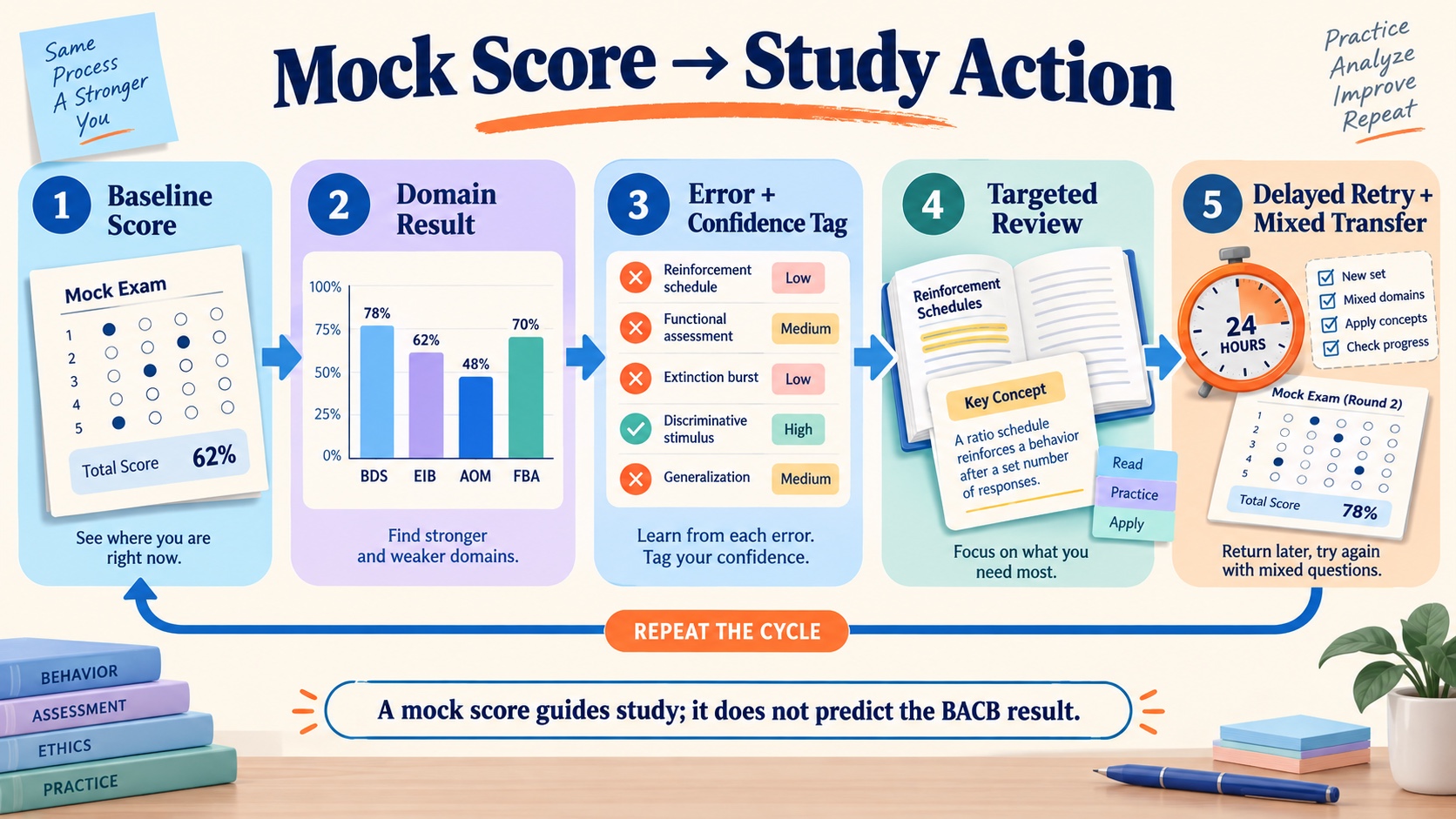
After a mock, record more than the percentage. For every missed or uncertain item, tag the domain, the task or concept, the error type, and your confidence before seeing the answer. Common error tags include “did not know the concept,” “misread the stem,” “confused two similar procedures,” “calculation or graph error,” and “changed a correct answer without evidence.”
Then choose one repair action: read a short concept explanation, work two or three new scenarios, explain the distinction aloud, complete a small mixed set, or review a data display. Wait before retaking a similar form. A delayed retry tells you more about retention than immediately repeating the same answers.
FAQ
What is the ABA Technologies mock exam?
ABA Technologies’ BOOST line lists BCBA-level mock exams designed around the 6th Edition BCBA Test Content Outline. The current public page lists two full-length versions, scores by overall and content area, detailed feedback, and a free 10-question sample.
Is the ABA Technologies mock exam an official BACB exam?
No. ABA Technologies states that BOOST products are offered independently of and are not affiliated with the BACB. The product is practice material, not the official examination.
How many questions are in the mock exam?
The current BOOST product page lists 175 questions per standalone mock. The official BCBA examination also includes 10 unscored pilot questions, so a matching scored-question count does not make a commercial mock identical to the official test.
Does a high mock score mean I will pass?
No. Use the score as a diagnostic for that form and those testing conditions. Review the missed and uncertain questions, repair the underlying concepts, and check the official BACB requirements separately.
Is there a free ABA Technologies mock exam?
ABA Technologies currently lists a free 10-question “petite” sample. It can help you preview the interface and feedback style, but it is not a full readiness assessment.
Sources and next steps
- ABA Technologies BOOST Mock Exams
- ABA Technologies Mock Exam FAQ
- ABA Technologies BCBA Petite Mock Exam
- BACB BCBA Test Content Outline (6th ed.)
- BACB Examination Information
- ABA Study Online mock exams
- ABA Study Online BCBA practice questions
- ABA Study Online app review loop
Compare your next practice step
Try ABA Study Online’s independent website mock-exam and practice resources to build a baseline, review explanations, and choose targeted follow-up work. Our materials are unofficial and independent of the BACB; they do not guarantee a pass or replace the official examination requirements.