
ABA Supervision: Roles, Training, and Effective Practice
ABA supervision is more than a scheduled conversation or a signature on a form. It is a professional relationship in which a qualified supervisor helps another person build skills, apply behavior analysis responsibly, protect clients, and meet the requirements that apply to the role. The exact rules differ depending on whether the person is an RBT, a BCaBA, or a trainee accruing fieldwork toward BCBA or BCaBA certification.
This guide gives you a practical map of the common supervision arrangements and the behaviors that make supervision useful. It does not replace the current BACB handbook for a specific certification track, state or provincial licensure rule, or organization policy. When a percentage, contact requirement, observation rule, or form matters to your situation, check the role-specific source.
Table of Contents
Short answer: what is ABA supervision?
ABA supervision is structured oversight and teaching connected to behavior-analytic service delivery or professional development. A supervisor observes relevant work, sets goals, provides feedback, checks performance, addresses ethical and scope issues, and documents what happened. The supervisee should leave supervision knowing what to practice, how performance will be evaluated, and when to ask for help.
Supervision is not the same as ordinary management. A manager may assign shifts or approve time off. A behavior-analytic supervisor also has responsibilities related to competent service delivery, procedural integrity, client welfare, professional development, and the boundaries of the supervisee’s role. A single meeting can include administrative issues, but administration alone is not a complete supervision system.
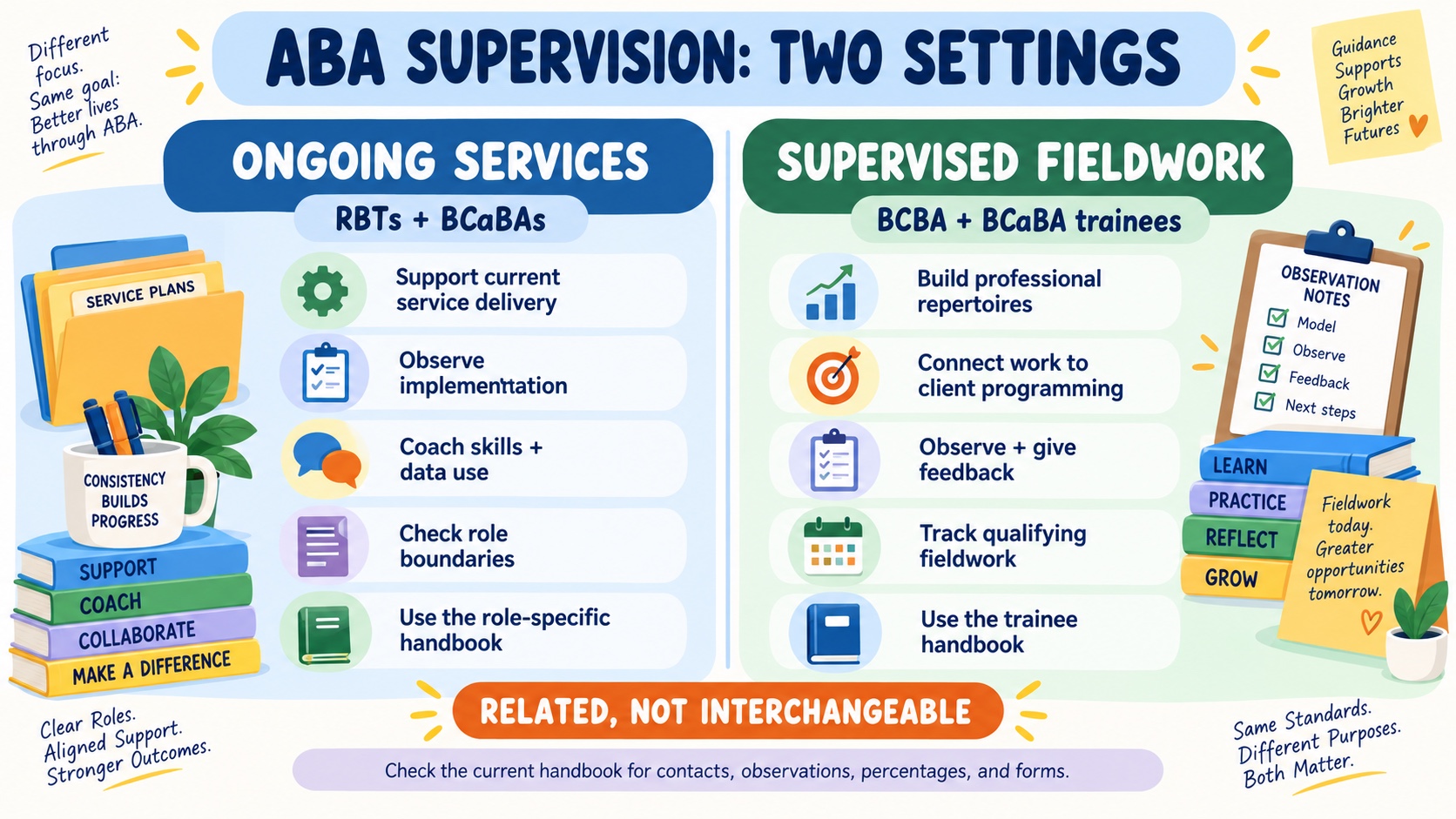
Two common supervision settings
Supervising ongoing services
In this setting, a supervisor oversees a current RBT or BCaBA who is providing behavior-analytic services. The work may include reviewing a written program, observing implementation, coaching the supervisee, checking data and documentation, and coordinating with the wider service team. The supervisor must keep the supervisee’s role and competence in view. An RBT, for example, should not be taught to independently redesign an intervention that requires a qualified analyst’s decision.
The BACB’s supervision resources identify role-specific requirements for supervising RBTs and BCaBAs. The current RBT and BCaBA handbooks control details such as contacts, observations, documentation, and ongoing certification requirements. Avoid copying a requirement from one track into another simply because both arrangements use the word supervision.
Supervising future behavior analysts
In fieldwork supervision, the trainee is accruing experience toward BCBA or BCaBA certification. The supervisor helps the trainee develop behavior-analytic, professional, and ethical repertoires while ensuring that the fieldwork is connected to qualifying service delivery and documented under the applicable handbook.
This relationship needs more than a monthly signature. The supervisor and trainee should agree on roles, expectations, goals, feedback methods, client-related activities, and recordkeeping. The supervisor must also consider scope of competence, workload, conflicts, multiple relationships, and whether the arrangement gives the trainee meaningful opportunities to practice.
The 8-hour supervision-training boundary
The BACB’s current supervision resources state that supervisors who oversee individuals acquiring fieldwork for BCBA or BCaBA certification, and supervisors of current BCaBA or RBT certificants who require ongoing supervision, must complete an 8-hour supervision training based on the Supervisor Training Curriculum Outline (2.0) before providing supervision.
As of January 1, 2026, the curriculum outline says that the 8-hour supervision training may only be offered by ACE Providers. The training requirement belongs to the person providing supervision; it is not a certificate that automatically makes a trainee ready for independent practice. Confirm the supervisor’s eligibility and training status through the current BACB resources and Certificant Registry when appropriate.
The 8-hour training is also not a substitute for learning how to supervise a particular person in a particular service setting. A supervisor still needs to understand the client programs, the organization’s procedures, the supervisee’s role, the applicable handbook, and the ethical risks of the relationship.
What effective supervision looks like
Effective supervision is observable in the way the relationship is designed and delivered. A useful supervision system usually includes:
- Clear goals: define the skills or decisions the supervisee is expected to develop.
- Direct observation: watch the relevant behavior when possible, rather than relying only on a verbal summary.
- Behavior-specific feedback: describe what happened, what effect it had, and what to do differently or continue doing.
- Practice with feedback: use rehearsal, modeling, role-play, or guided implementation when a skill needs to be built.
- Data or performance checks: use meaningful information to decide whether the supervisee is improving.
- Scope and competence checks: keep assignments within the supervisor’s and supervisee’s relevant competence.
- Client and family respect: include dignity, assent, cultural and contextual responsiveness, privacy, and practical quality of life.
- Follow-through: record the plan, revisit it, and change the teaching strategy when the current approach is not working.
Consider a supervisee who is implementing a prompting procedure inconsistently. A weak supervision response would be “be more consistent.” A stronger response would identify the step that varies, model the procedure, rehearse it with a neutral example, observe the next implementation, and review procedural-integrity data. The second response teaches a behavior instead of only expressing a preference.
Documentation and ethical boundaries
Documentation should make the supervision relationship understandable to someone who was not in the room. Depending on the role and handbook, records may include a supervision contract or agreement, dates and duration, topics, observations, feedback, goals, performance data, fieldwork forms, and signatures or attestations. The exact forms and retention rules are track-specific.
Keep client information protected and share only what the supervisor is authorized to receive. A supervision record should not become a casual repository of unnecessary identifying details. Use secure systems, follow organizational requirements, and document decisions in a way that supports continuity of care.
Power differences also matter. Supervisors may control access to hours, evaluations, assignments, or employment. Discuss conflicts of interest, multiple relationships, gifts, personal boundaries, and complaint routes before a problem occurs. A supervisee should have a clear way to raise concerns without being forced to choose between silence and losing access to required supervision.
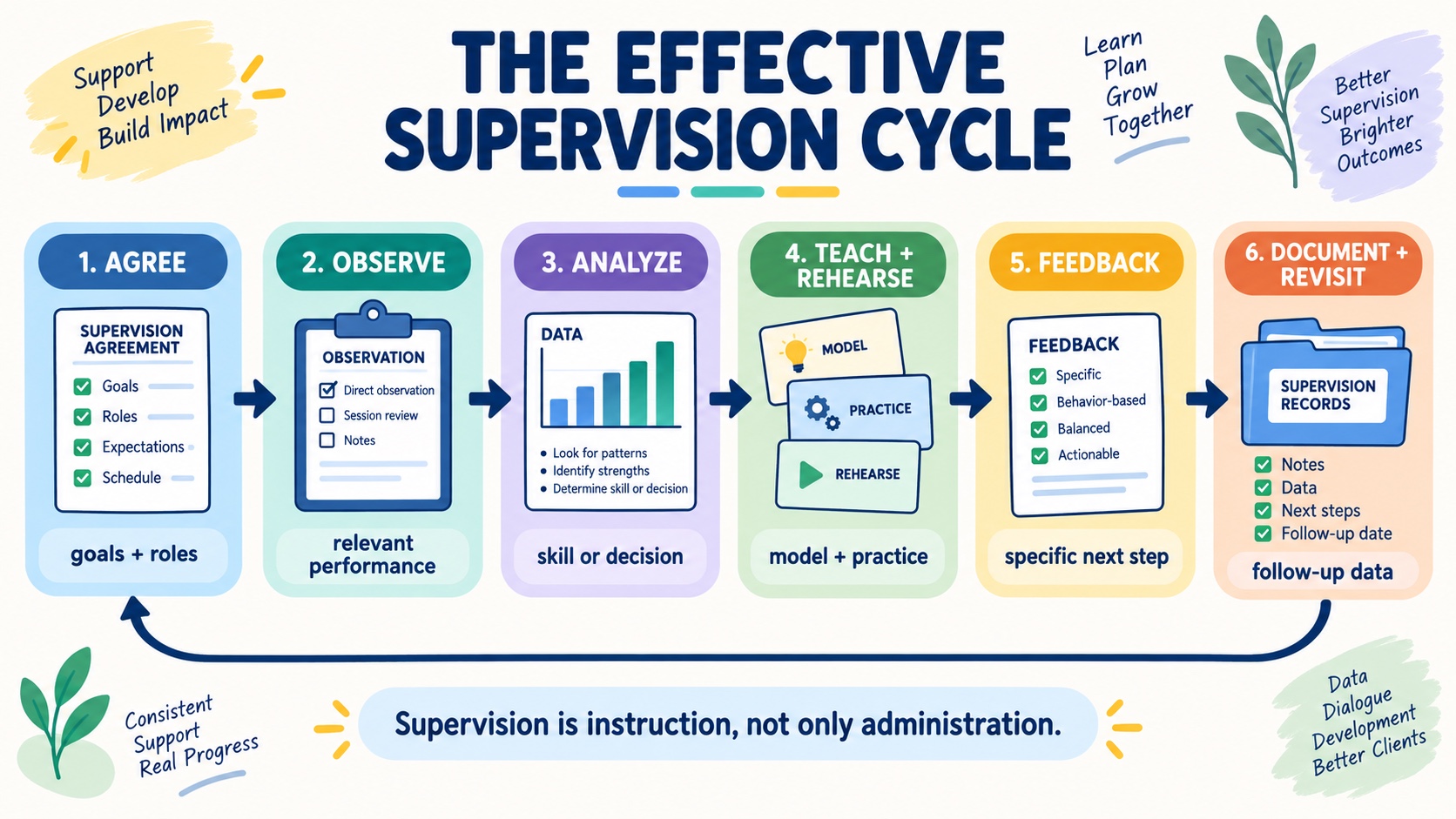
A practical supervision cycle
Use this cycle to turn a supervision meeting into an ongoing teaching system:
- Agree: define the role, goals, responsibilities, communication, confidentiality, and documentation.
- Observe: watch the relevant service, teaching, assessment support, data work, or supervision behavior.
- Analyze: identify the skill or decision that produced the current result and the variables affecting performance.
- Teach and rehearse: model, explain, role-play, or guide the next attempt.
- Give feedback: reinforce effective behavior and specify the next improvement step.
- Document and revisit: record the plan and use later data to decide whether the supervision strategy worked.
Common supervision mistakes
Watch for these patterns:
- treating a signature or attendance record as proof that supervision occurred;
- using the same contact, observation, or documentation rule for RBTs, BCaBAs, and trainees;
- discussing a case without observing the relevant behavior or checking data;
- giving vague feedback such as “do better” without a teachable next step;
- accepting a supervisee whose goals are outside the supervisor’s competence or capacity;
- ignoring power, multiple relationships, privacy, or cultural context; or
- assuming the 8-hour training replaces role-specific handbook requirements.
Supervision is strongest when it helps the supervisee do something better on the next real opportunity. If the same problem appears repeatedly, change the teaching arrangement, not only the wording of the reminder.
You can use the RBT learning path, BCaBA learning path, and BCBA learning path to organize track-specific study. The ABA glossary and ABA Study Online app can support review, but neither replaces qualified supervision, a supervision contract, or the current BACB requirements.
FAQ and official sources
What is ABA supervision?
It is structured professional oversight and teaching connected to behavior-analytic service delivery or certification fieldwork. It includes goals, observation, feedback, ethical attention, skill development, and documentation.
Is RBT supervision the same as BCBA fieldwork supervision?
No. Ongoing supervision for an RBT and supervised fieldwork for a future BCBA or BCaBA have different purposes and requirements. Use the current handbook for the role and application pathway involved.
Who needs the 8-hour supervision training?
The current BACB supervision resources require it before supervising BCBA/BCaBA fieldwork trainees and before supervising current BCaBA or RBT certificants who require ongoing supervision. Other oversight roles may have their own requirements.
What should happen during supervision?
The supervisor should connect the meeting to goals, observe or review relevant performance, provide specific feedback, teach or rehearse skills, address ethics and scope, and document the plan for follow-up.
Does ABA supervision guarantee competence?
No. Supervision is a structured way to teach, observe, and evaluate performance. Competence depends on the person, the skill, the evidence, the setting, and the requirements that apply to the role.