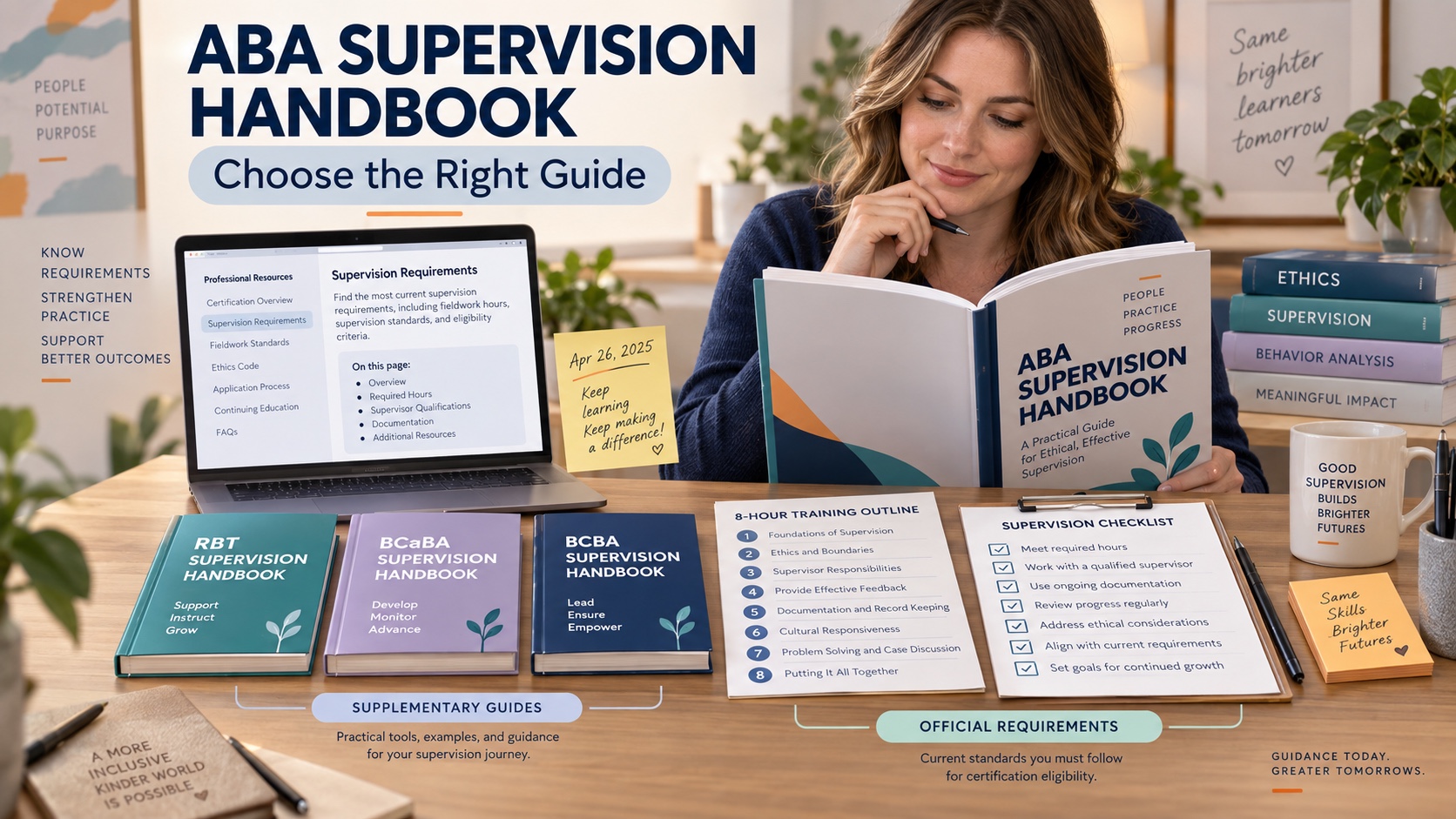
ABA Supervision Handbook: How to Choose the Right Guide
Searching for an ABA supervision handbook can lead to a commercial fieldwork guide, an RBT supervision workbook, a BCBA or BCaBA handbook, an 8-hour training course, or a general checklist. These resources may sit beside one another in search results, but they do not have the same authority or purpose. Choosing the right one starts with a simple question: who is being supervised, and what decision are you trying to make?
A handbook can help you organize meetings, practice feedback, prepare questions, and document a supervision routine. It cannot replace the current BACB handbook, required training, ethics code, supervision contract, or the judgment of a qualified supervisor. This guide gives you a practical way to compare resources without mistaking a useful study tool for an official rulebook.
Table of Contents
Short answer: is there one official ABA supervision handbook?
There is not one universal book that controls every ABA supervision situation. The BACB supervision hub directs readers to role-specific resources and the relevant certificant handbooks. The correct source depends on whether the relationship concerns an RBT, a BCaBA, a BCBA trainee completing fieldwork, or ongoing supervision and training in an organization.
Commercial handbooks can be helpful because they turn broad principles into meeting agendas, competency checklists, examples, or reflection prompts. Treat them as supplementary learning material. When a guide gives a number, date, eligibility condition, form, or reporting instruction, verify it against the current BACB page and the handbook for the credential involved.
Build a source hierarchy
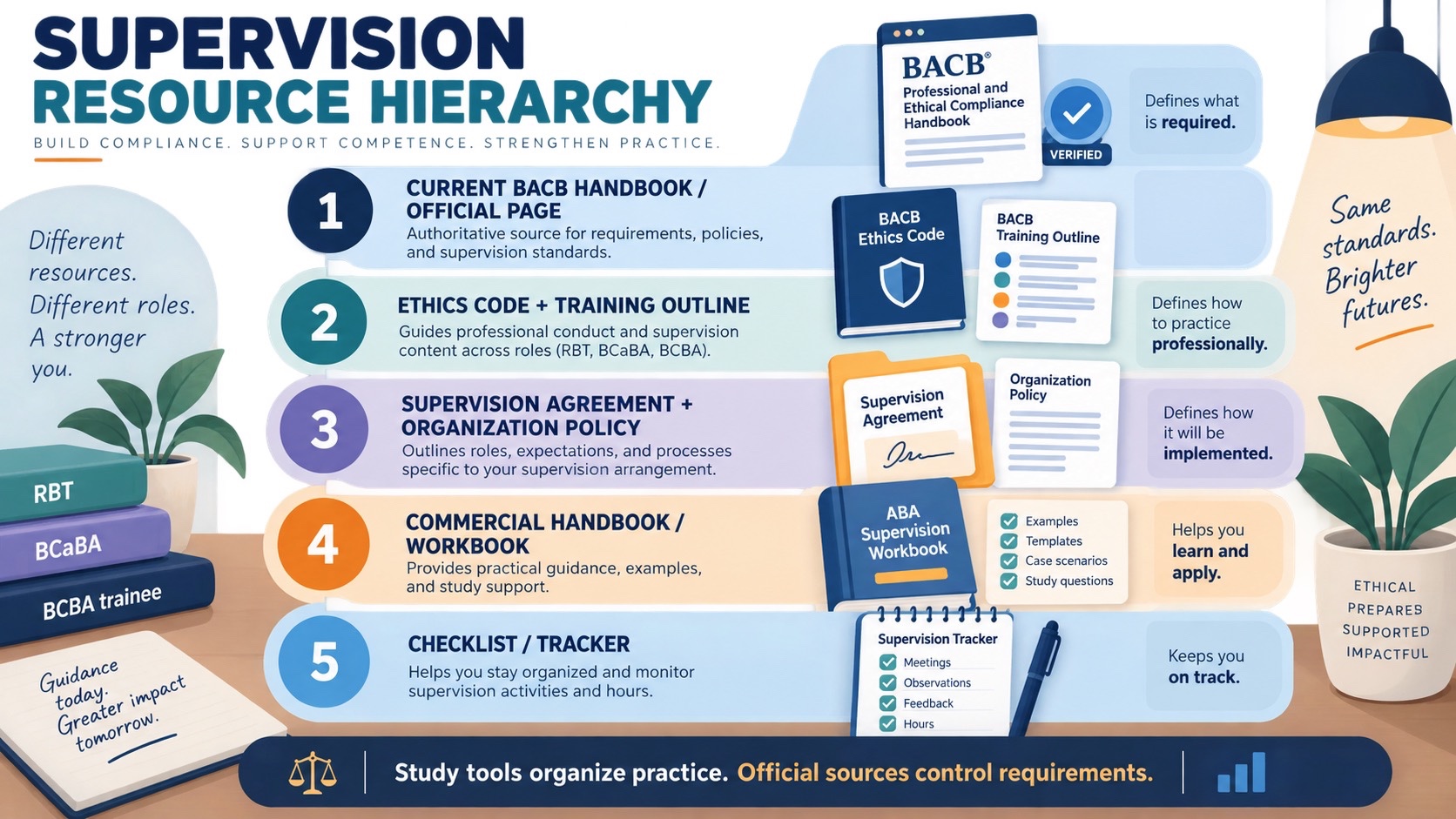
- Current BACB handbook or official resource page: start here for eligibility, supervision, maintenance, forms, and current role boundaries.
- Ethics code and formal training outline: use these for ethical responsibilities and the learning objectives for required supervision training.
- Supervisor agreement and organization policy: use the documents that define the actual relationship, privacy rules, feedback process, and escalation route.
- Commercial handbook or workbook: use it for examples, meeting structure, practice activities, and organization after the controlling sources are clear.
- Checklist or tracker: use it to reduce missed steps, not to decide whether a requirement applies.
Check the publication or revision date every time you use a guide. A thoughtful handbook can become misleading when a certification pathway, ethics code, examination outline, or supervision requirement changes. “Third edition” describes a book’s edition; it does not automatically mean it is the BACB’s current edition.
Match the resource to the role
RBT ongoing supervision
Start with the current RBT Handbook and the RBT supervision materials linked from the BACB hub. A practical guide may help an RBT and supervisor plan competency practice, feedback, and documentation. It should not replace the RBT Handbook or imply that an RBT is independently designing treatment.
BCaBA supervision
Use the current BCaBA Handbook and BCaBA supervision resources for the credential-specific relationship, fieldwork, and maintenance questions. A general ABA handbook may offer useful communication examples, but the BCaBA requirements belong to the official BCaBA source.
BCBA trainee fieldwork
Use the current BCBA Handbook’s supervised-fieldwork section and the supervisor training materials. A fieldwork workbook can help with activity ideas, feedback, and reflection, but it cannot approve unrestricted or restricted hours. Your qualified supervisor must evaluate the actual activity and documentation.
Supervisors and organizations
Supervisors may need different materials for RBTs, BCaBAs, and trainees. The BACB supervision page explains the roles, qualification resources, and 8-hour supervision-training boundary. An organizational handbook may add local policies, but it cannot relax BACB requirements or state-law obligations.
What a useful supervision guide should include
Once the official source is clear, evaluate the handbook as a learning tool. A useful guide usually includes:
- Role clarity: it says whether the material is for RBTs, BCaBAs, BCBA trainees, supervisors, or organizations.
- Competency focus: it connects supervision activities to observable skills, not just attendance or discussion time.
- Feedback practice: it shows how to give specific, behavior-based feedback and how the supervisee can demonstrate improvement.
- Individualization: it leaves room for the learner’s experience, client population, language, setting, and goals.
- Documentation prompts: it helps record what was practiced, observed, discussed, revised, and followed up.
- Ethics and boundaries: it addresses competence, confidentiality, multiple relationships, cultural responsiveness, and the supervisor’s responsibility.
- Source transparency: it distinguishes recommendations from formal BACB requirements and links readers to the current authority.
Be cautious with a guide that promises a shortcut, treats every meeting as compliance, or presents a checklist as proof of competence. Good supervision is not only the transfer of information. It is repeated observation, practice, feedback, decision-making, and evaluation of whether the supervision is helping the person provide safer and more effective services.
Handbook versus required training
The BACB supervision page states that supervisors who oversee BCBA or BCaBA fieldwork, or certain ongoing supervision roles for RBTs and BCaBAs, must complete 8-hour supervision training based on the Supervisor Training Curriculum Outline (2.0) before providing supervision. Reading a handbook—commercial or official—is not the same thing as completing that required training.
The distinction matters for organizations purchasing materials. A digital handbook may provide a curriculum, tracker, or meeting templates. It does not automatically make the organization an Authorized Continuing Education provider, grant a supervisor qualification, or satisfy an upload or documentation requirement. Verify the current BACB process and the provider’s status before relying on a course.
Common resource-selection mistakes
- Searching for one universal book: start with the role and the relevant BACB handbook.
- Confusing a book edition with a BACB edition: verify current dates and official links.
- Using a commercial checklist as authority: use it to organize, then confirm requirements in the controlling source.
- Assuming reading satisfies training: distinguish a handbook, a course, the 8-hour training requirement, and continuing education.
- Ignoring state or employer rules: BACB certification and local licensure or organizational policy may be separate layers.
- Tracking meetings instead of competency: record what the supervisee practiced, demonstrated, received feedback on, and improved.
FAQ and sources
What is the best ABA supervision handbook?
The best supplementary guide depends on the role, setting, and learning task. There is no single commercial book that replaces the current BACB handbooks and official supervision resources. Choose a guide with clear role boundaries, observable competencies, feedback tools, and transparent sources.
Is an ABA supervision handbook official?
Usually the phrase refers to a commercial learning or organization resource. Treat it as official only when you are reading a document published by the relevant authority. For BACB requirements, verify the current BACB website, handbook, ethics code, and supervision-training materials.
Does reading a supervision handbook count as the 8-hour training?
No. Reading a book is not automatically the required 8-hour supervision training. Check the BACB supervision page and the current training provider requirements for the role you will supervise.
Which BACB handbook should I use?
Use the RBT Handbook for RBT requirements and ongoing supervision, the BCaBA Handbook for BCaBA requirements, and the BCBA Handbook for BCBA certification and supervised fieldwork. Use the BACB supervision hub to connect the role with the current resource.