
ABA Study Notes: Build a System That Helps You Apply Concepts
Good ABA study notes do more than copy definitions into a notebook. They help you recognize a concept, explain why it fits a situation, distinguish it from a similar concept, and use feedback to repair a misunderstanding. That matters whether you are studying for the RBT, BCaBA, or BCBA examination—or building a foundation before you choose a track.
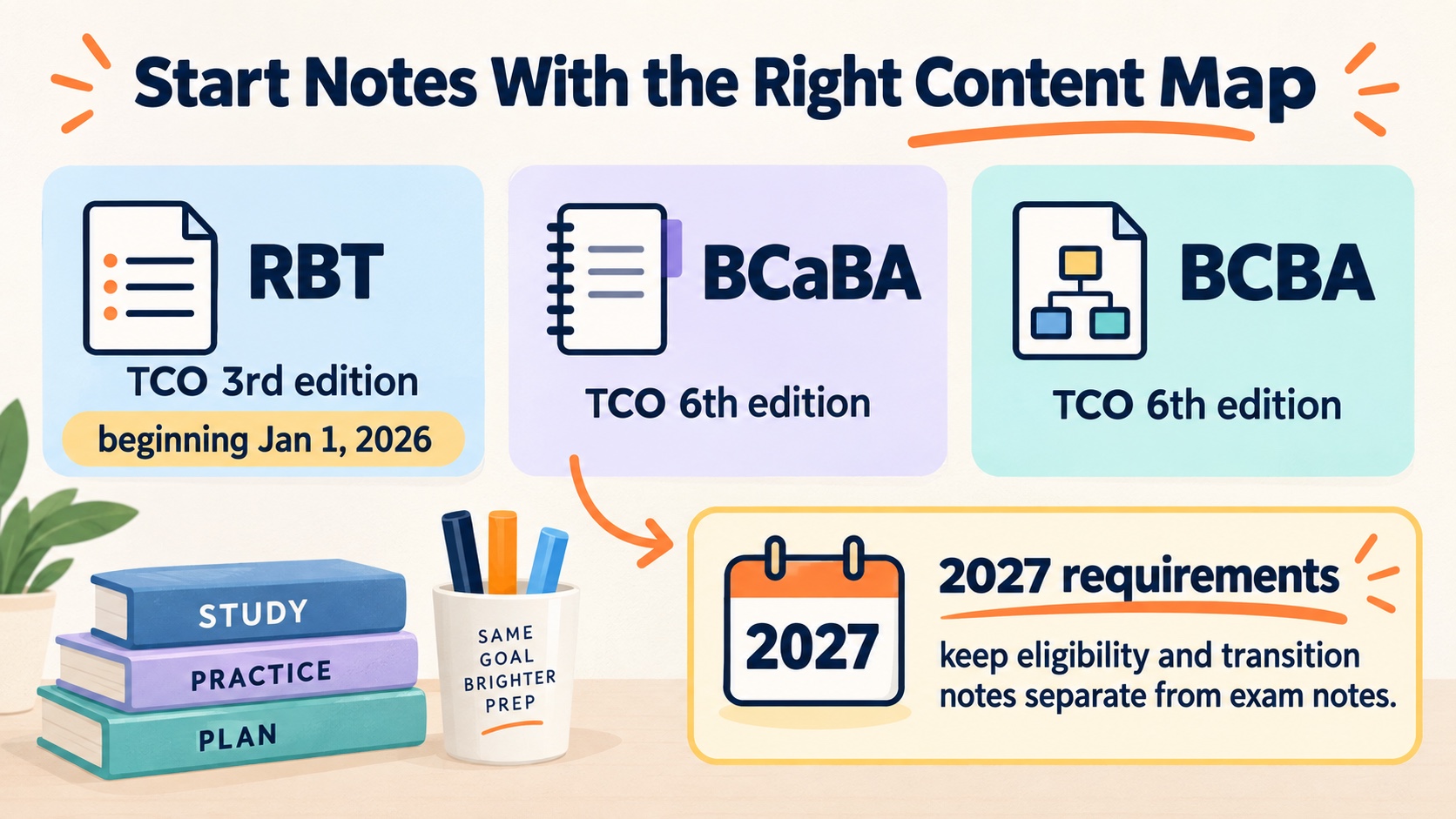
Start with the current Test Content Outline (TCO) for your credential. BACB’s current inventory lists the RBT TCO, 3rd edition, beginning January 1, 2026, and the BCaBA and BCBA TCOs, 6th editions. A note system should follow the relevant TCO instead of blending every ABA topic into one giant glossary. Keep eligibility or fieldwork changes separate from examination content, especially when reviewing 2027 updates.
Table of Contents
Choose the right content map first
Before you write a note, write the track at the top: RBT, BCaBA, or BCBA. Then record the TCO edition and the date you checked it. The same word can require a different level of explanation across tracks. An RBT note may focus on implementing a procedure as written, recording data accurately, and recognizing when to seek supervision. A BCaBA or BCBA note may need more detail about assessment, intervention selection, measurement, ethics, supervision, or decision-making.
This label also prevents a common planning mistake: treating a future eligibility change as if it were a new exam outline. A 2027 requirement page may affect degree, coursework, fieldwork, or application planning, while the examination content reference remains a separate question. Put transition notes in a clearly marked “requirements and dates” section, not in the concept note you use for exam rehearsal.
Use one note architecture
A reusable note template reduces the temptation to copy everything. For each concept, create these fields:
- Plain-language definition: explain the term in one or two sentences without hiding behind the textbook wording.
- Observable or measurable anchor: state what you would see, count, record, or identify when the concept is present.
- ABA example: write one bounded scenario with an antecedent, behavior, consequence, or other relevant context.
- Non-example: show a tempting case that does not meet the definition and explain why.
- Contrast: name the closest confusing concept and give one decision cue that separates them.
- Track and source: record the credential, TCO task or domain, source date, and any scope boundary.
- Review prompt: end with a question that requires you to retrieve or apply the idea without looking.
For example, a note on differential reinforcement should not stop at “reinforce one behavior and reduce another.” Add what is reinforced, what is withheld or arranged, how the replacement response is selected, and how you would measure change. A note on measurement should connect the definition to the type of data, the dimension being measured, and the likely interpretation error. The exact depth depends on the track and TCO, but the architecture stays stable.
Turn a definition into an application note
Use a three-pass method. In pass one, write the definition from the source and highlight the essential features. In pass two, translate those features into a small case. In pass three, remove the labels and ask yourself to identify the concept from the case. This turns notes into retrieval practice instead of a pretty transcript.
Keep examples concrete but bounded. “A learner receives a token after completing each step of a task analysis” is easier to analyze than a long story with several interventions at once. If more than one concept appears in the example, label the primary concept and explain the role of the others. Avoid writing examples that accidentally imply a clinical recommendation for a real client; study examples are not individualized treatment plans.
Add contrast and decision cues
Many exam errors happen because two answers are both familiar. Build a contrast box whenever terms share a surface feature. Examples include reinforcement versus bribery, response cost versus punishment in general, continuous versus discontinuous measurement, stimulus prompt versus response prompt, and functional analysis versus descriptive assessment. The goal is not to memorize a longer list. The goal is to ask which feature changes the classification.
Write the cue as a decision question: “What consequence is contingent on the response?” “Does the procedure arrange test conditions to evaluate function?” “Is the measure capturing every occurrence or sampling opportunities?” “What exactly is being changed—the stimulus, the response form, or the consequence?” A strong cue makes the note useful when a practice question changes the surface details.
Connect notes to practice and errors
Do not create a new page of notes for every missed question. Add the miss to an error log, then decide whether the problem was a missing definition, a weak contrast, a measurement mistake, a reading error, or a failure to apply the concept. Link the error to the smallest note that can repair it. If the same error returns, rewrite the decision cue or add a better non-example rather than highlighting the same paragraph again.
Use practice results diagnostically. The BACB’s examination information and current TCO define the official content boundary; an independent quiz shows how well your current reasoning held up on that set of questions. Neither a practice percentage nor a note-completion percentage is an official pass standard. Track repeated error patterns and the time needed to explain an answer, not only how many pages you produced.
Build a website-to-app review loop
A useful digital workflow can have four steps: read a concept explanation on the website, save a short note using the template, retrieve the idea in an app flashcard or practice item, and return to the note only when feedback shows a gap. The website can hold the longer explanation and examples; the app can hold the compact prompt, repeated practice, and progress signal.
Keep the note portable. Use the concept name, track, TCO reference, one definition, one example, one contrast, and one review question. This gives you a clean unit for flashcards, task-by-task practice, and later updates. If an official source changes, you can revise the affected note without rebuilding an entire undifferentiated notebook.
Common ABA study-note mistakes
- Copying without retrieving: notes look complete but cannot answer a new scenario.
- Mixing tracks: RBT implementation notes are blended with BCBA-level assessment or supervision decisions.
- Using old labels: current BACB resources distinguish TCOs from older task-list terminology; always check the current source.
- Confusing requirements with exam content: a 2027 eligibility change is not automatically a new examination edition.
- Writing only positive examples: without non-examples and contrasts, similar concepts remain difficult to separate.
- Measuring pages instead of performance: completion is not the same as accurate recall or application.
ABA study notes FAQ
What should be included in ABA study notes?
Include a plain-language definition, observable or measurable anchor, bounded example, non-example, closest contrast, track-specific source, and a retrieval question. Add an error-log link when practice shows a gap.
Should RBT, BCaBA, and BCBA notes be separate?
Yes. They can use the same template, but each set should be labeled with the credential and current TCO. Separate notebooks or filters reduce cross-track confusion.
Are ABA study notes official BACB material?
No. Notes created by a learner or independent study site are study aids. Use the current BACB TCOs, Handbooks, and examination information for the official source boundary.
Do 2027 changes require a new set of exam notes?
Not automatically. First determine whether the change concerns eligibility, coursework, fieldwork, maintenance, or examination content. Keep dated transition notes separate and check the current BACB announcement before rewriting exam notes.