
ABA Study Materials: How to Build a Free-First Learning Stack
If you are searching for ABA study materials, you may be looking at a long list of textbooks, videos, flashcards, PDFs, practice tests, apps, and printable notes. More resources can feel reassuring, but a large folder does not automatically create a study plan. The useful question is: what job should each material perform, and does it match the RBT, BCaBA, BCBA, or general ABA goal you are pursuing?
A practical stack usually has six parts: an official scope, a plain-language explanation, retrieval prompts, application practice, an error record, and a review system. You can build much of that stack with free materials first, then use an app or paid resource where it adds a distinct function. This guide shows how to choose the pieces without treating third-party study materials as official BACB content or a pass guarantee.
Quick answer: start with the current official BACB outline or handbook for your goal, add one explanation source, use flashcards or prompts for retrieval, practice with original questions and scenarios, log errors, and schedule review. RBT, BCaBA, and BCBA learners should not use one undifferentiated ABA folder because the roles and examination outlines are different. Free resources can support the full learning loop when you use them deliberately.
Match materials to the track
“ABA” names a field, not one universal exam syllabus. The BACB currently lists a BCBA Test Content Outline (6th edition), a BCaBA Test Content Outline (6th edition), and an RBT Test Content Outline (3rd edition) beginning January 1, 2026. Use the document that matches the credential and effective date relevant to you. A popular video or old task-list summary may be useful background, but it should not silently replace the current source.
| Goal | Priority materials | What to keep separate |
|---|---|---|
| General ABA foundation | Concept explanations, glossary, examples, basic measurement and ethics notes | Do not present foundation notes as a credential-specific exam guide. |
| RBT preparation | Current RBT outline, implementation examples, data and documentation practice, role-boundary questions | RBT scope, supervision, and 2026 outline requirements. |
| BCaBA preparation | Current BCaBA outline, concept discrimination, application scenarios, fieldwork and role resources | BCaBA undergraduate-level role and BCBA supervision boundary. |
| BCBA preparation | Current BCBA outline, data interpretation, assessment, intervention, ethics, supervision, and mixed practice | BCBA-level decisions and any current or future transition rules. |
If your goal is still open, make a temporary “general foundation” stack and label it clearly. When you choose a track, move the relevant items into a new folder rather than assuming every general ABA explanation has equal exam value. Track labels prevent a common problem: studying a concept accurately but at the wrong level or role.
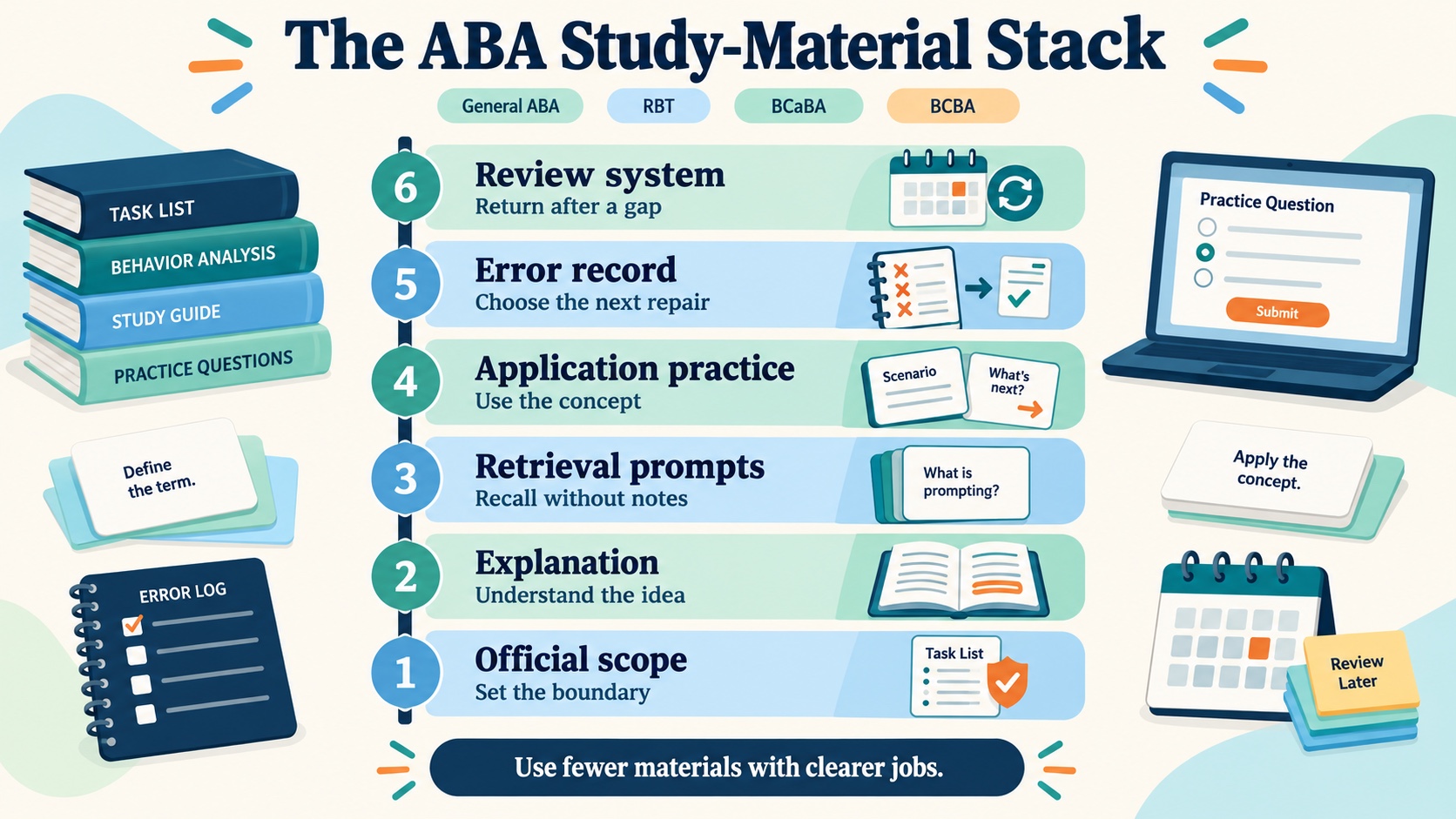
Six material types and their jobs
1. The scope document
This is the boundary document: the current BACB test-content outline, handbook, or official resource page that applies to your goal. It tells you what the official organization says the credential, exam, application, or maintenance process covers. Read it for scope and terminology, not for a friendly first explanation. Save the effective date and revisit it when requirements change.
2. The explanation layer
This can be an article, lesson, video, book chapter, or glossary entry that translates a concept into plain language. A good explanation defines the idea, shows a concrete example, compares it with a look-alike, and says what evidence would change the decision. Keep one primary explanation source per concept cluster so that conflicting shortcuts do not become your notes.
3. Retrieval materials
Flashcards, fill-in prompts, short-answer questions, and blank concept maps make you recall information with the source closed. A flashcard should ask one discriminable question. “What is ABA?” is often too broad; “What feature distinguishes negative reinforcement from negative punishment?” creates a more useful retrieval task. Add a short example to the back only after you attempt the answer.
4. Application practice
Practice questions and scenarios ask you to select a definition, interpret data, identify a measurement decision, or choose the next step. Use original or properly licensed material. Review why the correct option fits and why the distractors fail. A practice score without a rationale is a thermometer, not a lesson.
5. The error record
Keep a small log with the topic, question, answer, confidence, error type, and next action. Useful error labels include definition confusion, stimulus or response discrimination, measurement, data interpretation, reading error, role boundary, and ethics. The log tells you whether you need a new explanation, more retrieval, or a different scenario.
6. The review system
Use a calendar, flashcard scheduler, app review queue, or simple spreadsheet to bring material back after a gap. The system should show what is new, what is due, and what needs repair. A progress bar can be encouraging, but a completed item is not evidence that the item is stable. Pair completion data with a retrieval or application result.
Build a free-first weekly stack
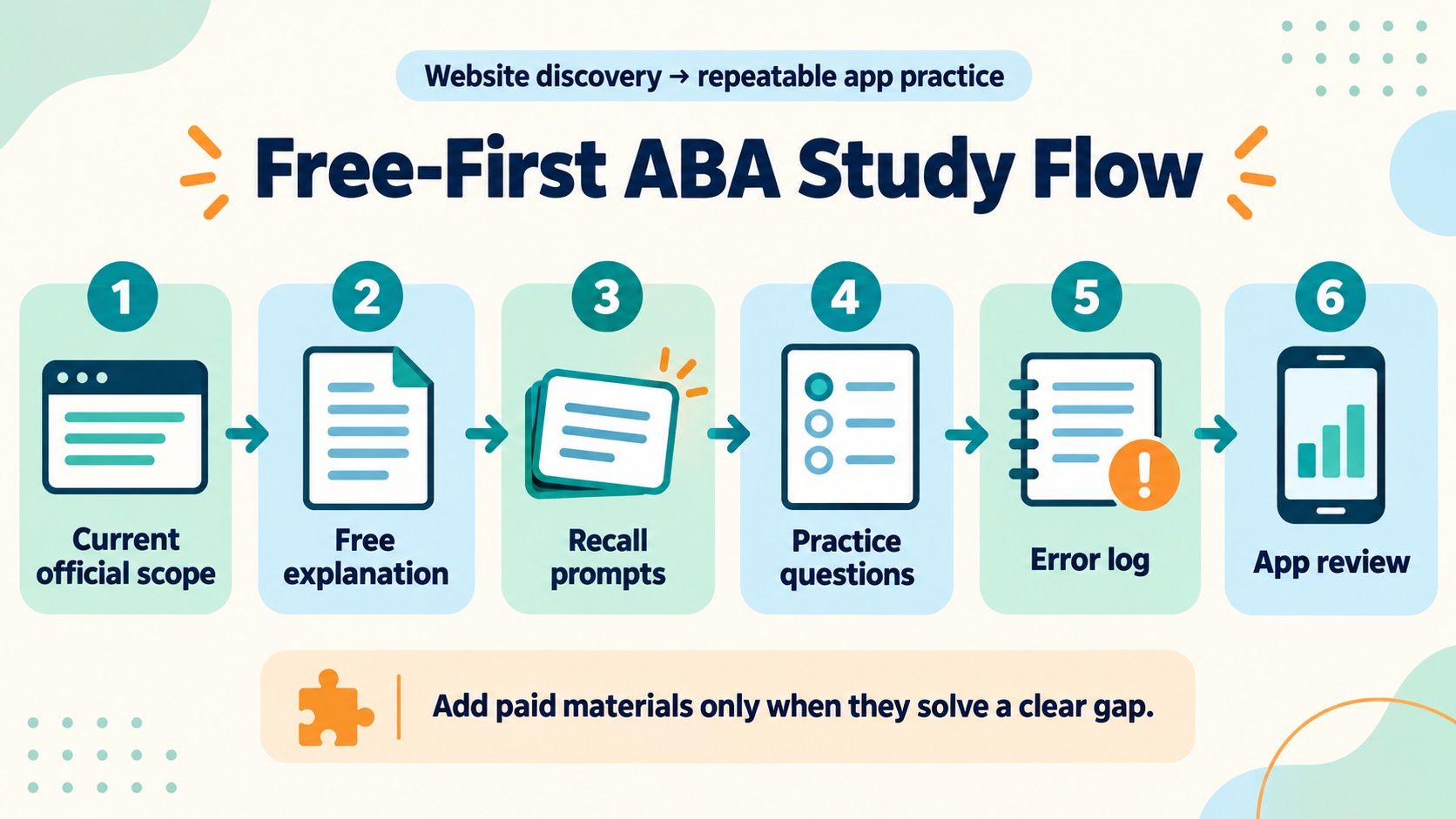
A free-first approach does not mean using random free downloads. It means starting with dependable public sources and adding a paid resource only when it solves a problem the free stack does not solve. A simple week can look like this:
- Scope day: open the current outline or official handbook section and choose one small domain or topic.
- Explanation day: read one ABA Study Online theory block or trusted explanation and write a two-sentence definition plus one comparison.
- Retrieval day: use free flashcards, glossary prompts, or blank-page recall without looking at the explanation.
- Application day: complete a small set of free practice questions or a scenario and write why the answer fits.
- Repair day: review the error log, return to only the weak concept, and create a new prompt.
- Mixed-review day: combine older and newer topics so you must choose the concept instead of following the order of a chapter.
The website can serve as the discovery and explanation layer: free theory articles, glossary definitions, printable tools, and question previews. The app can serve as the repeatable practice layer: today’s review, flashcards, section practice, audio review, and progress tracking. The same concept can move from a website article into an app task without turning the website into a hard-sell page. Keep the learning destination obvious, but let each surface do its own job.
Check quality, dates, and safety
Before adding a resource to your stack, ask five questions:
- Who made it? Is the author identifiable, and is the resource transparent about its educational purpose?
- What date or edition does it use? Does it match the current track and effective date?
- Does it explain the reasoning? A bare answer key makes errors harder to repair.
- Does it respect the role? Does it avoid presenting RBT implementation as BCBA-level assessment or treating study examples as individualized treatment directions?
- Does it make an unsupported promise? Be cautious with “official,” “guaranteed pass,” “leaked questions,” “BACB approved,” or CEU/ACE claims that are not supported by current evidence.
Do not use live examination questions, recalled items, leaked content, or materials that encourage copying protected exam content. Legitimate practice should test the knowledge and reasoning described by the current scope without pretending to reproduce secure items. Also remember that a study resource is not a clinical supervisor, a legal adviser, or an eligibility reviewer.
Organize materials so they become practice
Create one folder or dashboard for each track, then use the same six labels inside it: Scope, Explain, Retrieve, Apply, Errors, and Review. Give files descriptive names such as “RBT—measurement—duration versus latency—2026” rather than “final notes 3.” Add a source link and date to the top of any personal note. When an official page changes, you can identify which notes need review.
Limit active materials. Keep one current explanation, one retrieval set, one practice source, and one error log for a topic before adding another. If a new resource repeats the same job, archive it for later instead of making your study decision harder. The goal is not to own every possible ABA material. The goal is to make the next useful action obvious.
Use your app or spreadsheet to answer three weekly questions: What can I retrieve? What can I apply? What needs repair? If the answer is only “I completed 200 cards,” the tracking system is counting activity rather than learning. Add a short application check or explain the concept aloud to make progress more meaningful.
Common mistakes
- Collecting instead of studying: more PDFs do not create retrieval or application.
- Mixing tracks: shared ABA vocabulary does not erase RBT, BCaBA, and BCBA role boundaries.
- Using old editions without a label: write the source date and compare it with the current official outline.
- Trusting a bare answer key: require a rationale or write your own before moving on.
- Treating free as official: free access says nothing by itself about BACB authorization, CEUs, accuracy, or exam relevance.
- Using study material as clinical direction: real behavior-analytic services require appropriate supervision, individualized assessment, ethics, consent or assent, and applicable law.
- Expecting one resource to do every job: an explanation, a flashcard, a practice question, and an error log serve different functions.
FAQ
What are the best ABA study materials?
The best stack is the one that matches your track and makes you retrieve, apply, and review the relevant knowledge. Start with the current official scope, then add a clear explanation, original practice, and an error-review system. A famous resource that does not match your effective date or role is not automatically the best resource for you.
Can I study ABA using only free materials?
Free materials can provide a strong foundation when they include current scope, explanations, retrieval, practice, and review. You may later choose a paid book, mock exam, teaching tool, or app feature for convenience or depth, but price alone does not determine accuracy or official status.
Should RBT, BCaBA, and BCBA learners use the same materials?
They can share foundation explanations, but each learner should use the current track-specific outline and role resources. Keep examples, practice questions, ethics, supervision, and application material labeled by track.
Does ABA Study Online provide official BACB exam content or CEUs?
ABA Study Online provides educational materials, practice support, and app-based review. It should not be represented as BACB, as an ACE Provider, as an issuer of official BACB examination content, or as a source of CEUs unless a current, separately verified authorization exists.
How do I know when I need a new study resource?
Add a new resource only when your current stack cannot answer a specific need: a missing explanation, insufficient application practice, an accessibility issue, or a review workflow you cannot maintain. Write the job first, then choose the resource.