
ABA Study Guide: Core Concepts, Practice, and a Clear Study Plan
Searching for an ABA study guide can mean several different things. You may be learning the foundations of applied behavior analysis, reviewing concepts for work, preparing for an RBT, BCaBA, or BCBA examination, or trying to turn scattered notes into a routine you can repeat.
This guide starts with the shared concept map, then shows how to adapt it to the correct credential track. It is independent educational material. It is not official BACB examination content, a certification pathway, a substitute for training or supervision, CEU/ACE credit, or a promise of a passing result.
Quick answer: Begin with seven connected areas: measurement and visual analysis; behaviorism and concepts; assessment; skill acquisition; behavior reduction; generalization and maintenance; and ethics and professional practice. For every topic, move through four questions: What is being observed? How is it measured? What decision does the evidence support? What should happen next within the learner’s role and plan?
If you are preparing for a credential, use the general map only as a starting point. BACB maintains separate Test Content Outlines for BCBA, BCaBA, and RBT. The RBT examination uses its 3rd edition outline beginning in 2026; the current BCBA and BCaBA outlines are 6th editions. The correct outline matters more than a generic page title.
What an ABA study guide should do
A study guide is useful when it reduces the distance between a term and a decision. Instead of creating a long alphabetized list, give each concept a small learning card:
- Definition: what does the term mean in observable, plain language?
- Contrast: what nearby term or procedure is easy to confuse with it?
- Example: what would the concept look like in a real session or data set?
- Boundary: what can you conclude, implement, or change, and what requires supervision or more evidence?
- Practice: what question, graph, note, or scenario would show that you can use it?
This structure prevents a common problem: recognizing a definition but missing the concept when the wording changes. ABA learning often depends on distinctions such as frequency versus rate, reinforcement versus bribery, shaping versus chaining, preference versus reinforcer assessment, observation versus interpretation, and extinction versus simply withholding attention in an unrelated situation.
The core ABA concept map
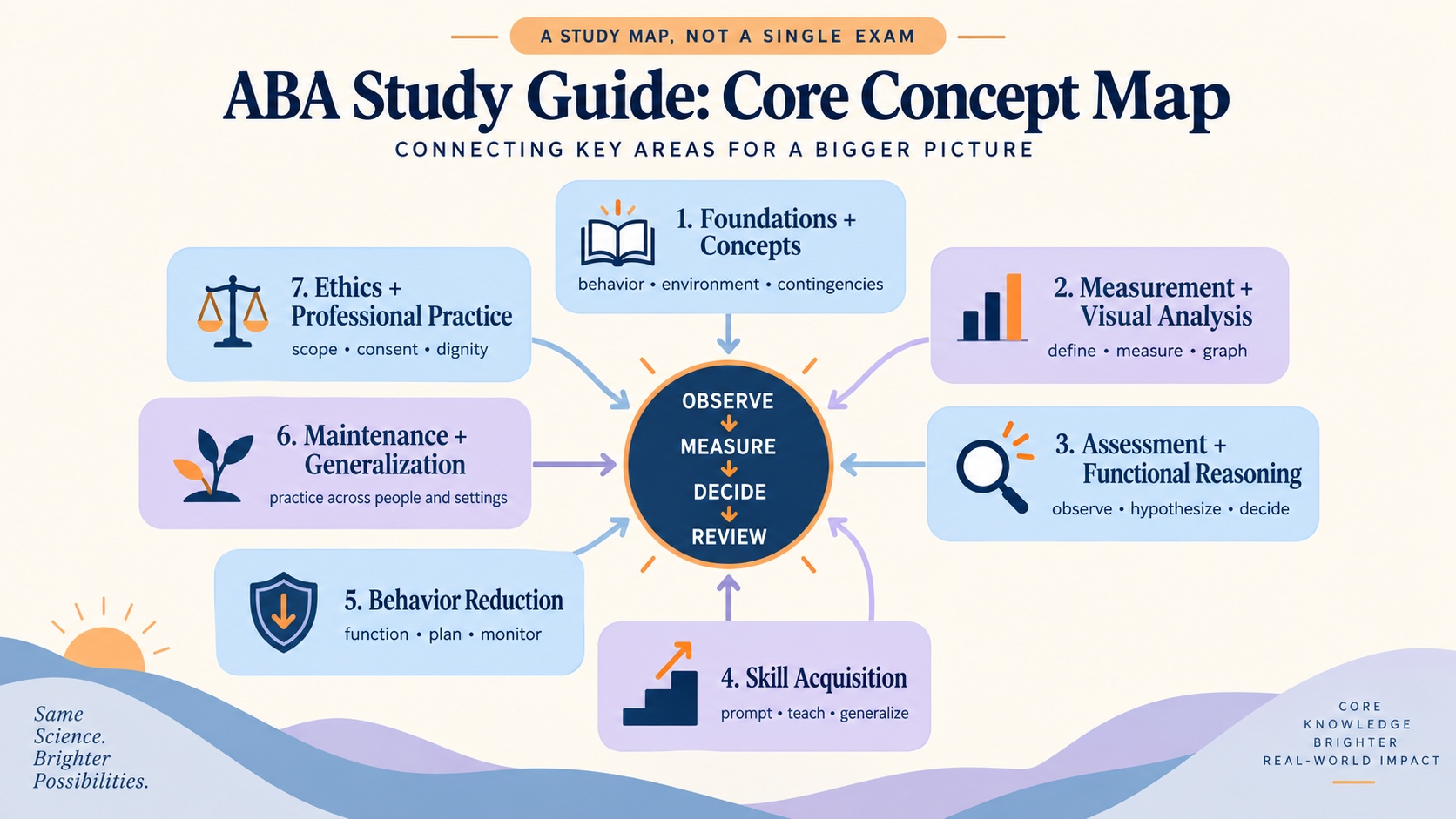
1. Foundations and concepts
Start with behavior, environment, antecedents, consequences, respondent and operant conditioning, reinforcement, punishment, extinction, motivating operations, stimulus control, generalization, and verbal behavior. Do not stop at “define reinforcement.” Ask what changed after the consequence, for whom, and under which conditions. The functional relation matters more than the pleasantness of the consequence.
2. Measurement and visual analysis
Study operational definitions, frequency, rate, duration, latency, interresponse time, interval measures, permanent product, and data quality. Then learn to read level, trend, variability, immediacy, overlap, and consistency in a graph. Practice choosing a measurement that matches the behavior dimension instead of selecting the easiest number to collect.
3. Assessment and functional reasoning
Separate indirect information, direct observation, descriptive assessment, preference assessment, skill assessment, functional behavior assessment, and functional analysis. A descriptive pattern can inform a hypothesis; it does not automatically demonstrate a function. A preference is not automatically a reinforcer. Your study notes should state what each method can answer and what it cannot establish by itself.
4. Skill acquisition and teaching
Build comparisons for prompting, prompt fading, shaping, chaining, task analysis, discrimination training, discrete-trial teaching, naturalistic teaching, reinforcement schedules, fluency, maintenance, and generalization. For each teaching plan, identify the target, opportunity, prompt, response, consequence, error correction, and plan for transferring the skill to new people, materials, or settings.
5. Behavior reduction and ethical practice
Study function-based intervention, differential reinforcement, extinction, antecedent strategies, crisis and safety boundaries, treatment integrity, and side-effect monitoring. Pair every procedure with dignity, assent or consent as applicable, stakeholder priorities, data review, and the professional role responsible for the decision. Ethics is not a final chapter to memorize after the “real” procedures; it changes what a responsible plan looks like.
Adapt the guide to your track
Once the concept map is stable, choose one track. Mixing several blueprints at once can make a study file look complete while leaving the actual task verbs unclear.
- RBT: use the current RBT Test Content Outline and focus on implementation, data collection, documentation, ethics, and supervision boundaries. The current 3rd edition applies to examination content beginning in 2026.
- BCaBA: use the current BCaBA Test Content Outline and add more assessment, intervention selection, data interpretation, and professional-practice reasoning to the same core concepts.
- BCBA: use the current BCBA Test Content Outline and extend the map into experimental design, selecting and implementing interventions, ethics, supervision, and analysis of competing explanations.
- General learner, caregiver, or educator: stay with the concepts that answer your practical questions. You do not need to study as if you were taking a credentialing examination.
The general ABA study path can hold the shared theory layer. For focused review, use the ABA glossary, the free practice area, and the ABA Study Online app for flashcards, section practice, audio review, progress, and tools.
An eight-week ABA study routine
Eight weeks is a planning example, not a certification requirement. Change the pace when your course, fieldwork, supervisor, work schedule, or learning needs call for it.
- Week 1 — Build the map: write the seven concept families and label your purpose: general learning, work support, RBT, BCaBA, or BCBA preparation.
- Week 2 — Make behavior measurable: practice operational definitions, measurement selection, graph reading, and short examples of observation versus interpretation.
- Week 3 — Connect concepts: study reinforcement, punishment, extinction, motivating operations, stimulus control, and verbal behavior through contrast cards.
- Week 4 — Study assessment: compare preference, skill, descriptive, functional behavior, and functional analysis methods by question, evidence, and boundary.
- Week 5 — Build skills: practice prompting, fading, shaping, chaining, task analysis, teaching formats, fluency, generalization, and maintenance.
- Week 6 — Plan behavior change: connect function, intervention, treatment integrity, monitoring, side effects, and stakeholder priorities.
- Week 7 — Add ethics and your blueprint: review professional boundaries and map every study session to the current track outline if you are preparing for a credential.
- Week 8 — Interleave and repair: mix topics, explain rationales, revisit the error log, and create a short next-cycle plan from the evidence.
How to practice instead of only rereading
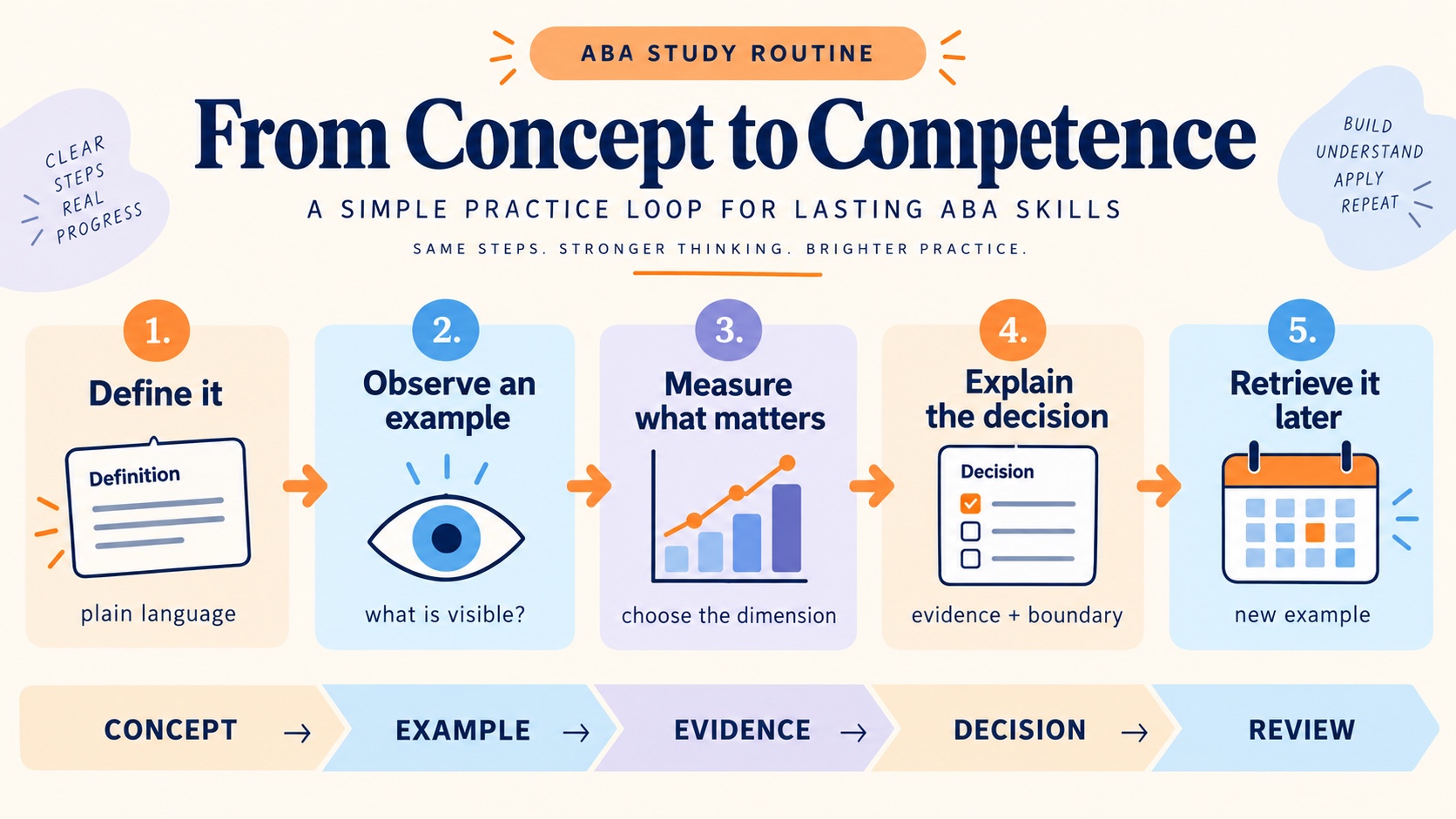
Use a five-minute practice loop. First, cover your notes and explain the concept in plain language. Next, identify what would be observable and how you would measure it. Then solve a small scenario or interpret a graph. Finally, state what the evidence does not justify and schedule a later retrieval.
Keep an error log with four columns:
- Concept: what topic was involved?
- Evidence: which fact, graph feature, or observation should have controlled the decision?
- Boundary: did you confuse a hypothesis with a conclusion, or act beyond the role or written plan?
- Next repetition: when will you answer a different example of the same concept?
Use a mixed review after you can answer isolated cards. Interleaving forces you to identify which concept applies, while explanation keeps “I recognized the word” separate from “I can use the idea.” Retrieval practice and spacing are general learning recommendations supported by research; they do not guarantee credentialing performance.
Common ABA study-guide mistakes
- Assuming “ABA” means one exam: select the RBT, BCaBA, or BCBA blueprint when exam preparation is your goal.
- Memorizing isolated definitions: add a contrast, example, measurement, and boundary to every important concept.
- Skipping graphs and data: intervention decisions should be connected to what was measured and what changed.
- Confusing preference with reinforcement: a preferred item becomes a reinforcer only when its consequence changes future behavior in the relevant context.
- Using old editions without checking: compare any study resource with the current official outline and Handbook.
- Turning study content into clinical advice: real services require qualified supervision, individualized assessment, consent or assent as applicable, and current ethical and legal guidance.
ABA study guide FAQ
What should I study first in ABA?
Start with measurable behavior, the antecedent-behavior-consequence relation, reinforcement, basic measurement, and the difference between observation and interpretation. Then move into assessment, teaching, behavior reduction, and ethics.
Is an ABA study guide the same as a BCBA study guide?
No. A general ABA guide teaches shared concepts. A BCBA study guide must follow the current BCBA Test Content Outline and include its task verbs, domain boundaries, and professional reasoning demands.
Can I use one guide for RBT, BCaBA, and BCBA preparation?
Use one shared concept notebook if that helps, but keep separate blueprint tabs and practice sets. The three credentials have different scopes, content outlines, and expectations.
Is ABA Study Online official BACB study material?
No. ABA Study Online provides independent explanations and practice. Use BACB’s current official pages and outlines for certification and examination information.
Sources
- BACB Test Content Outlines for BACB Certifications
- BACB Examination Information
- BACB RBT resources
- BACB BCaBA resources
- BACB BCBA resources
- Cooper, Heron, and Heward, Applied Behavior Analysis
- Carpenter, Pan, and Butler (2022), spacing and retrieval practice review
- Dunlosky et al. (2013), effective learning techniques review