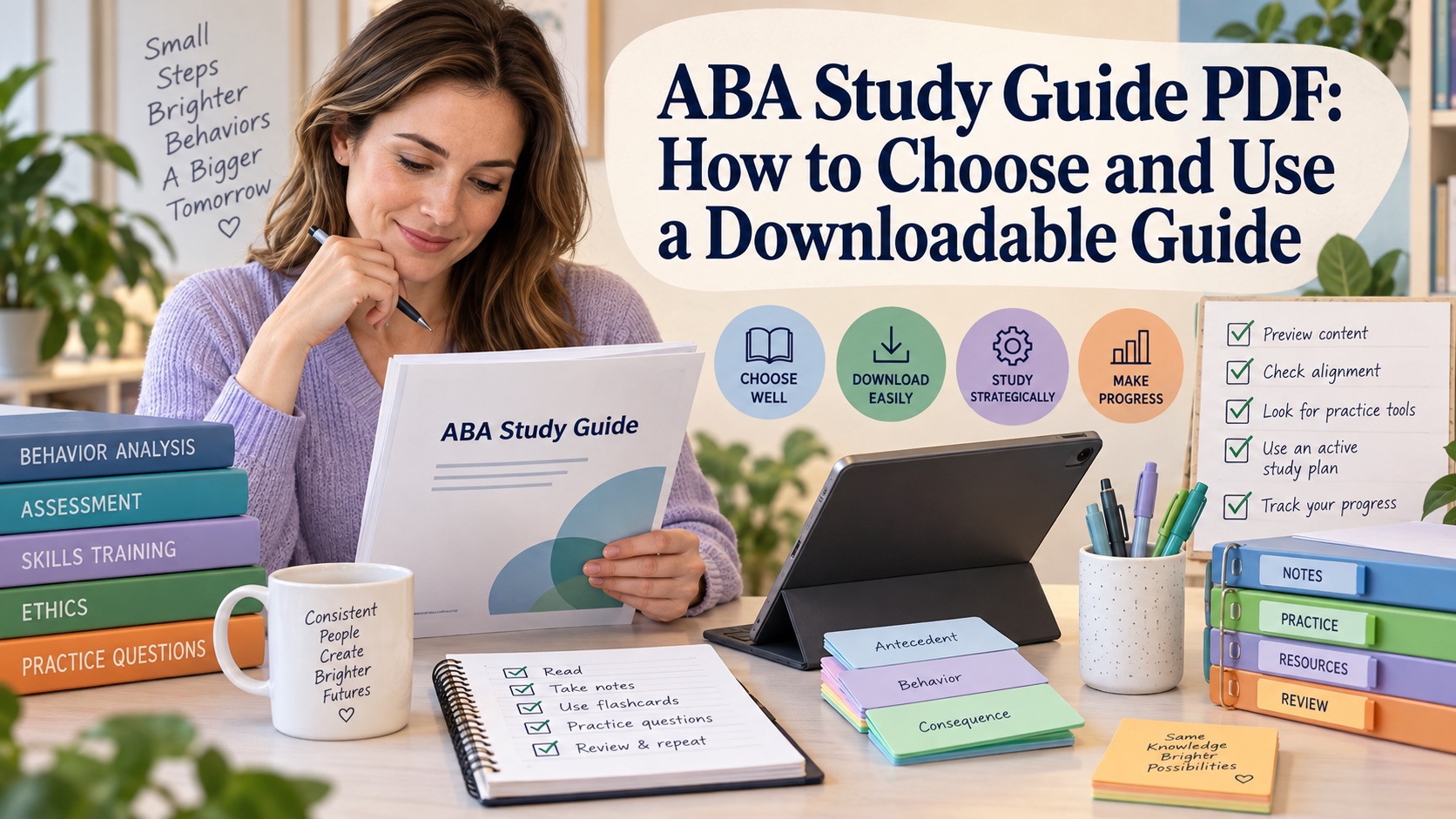
ABA Study Guide PDF: How to Choose and Use a Downloadable Guide
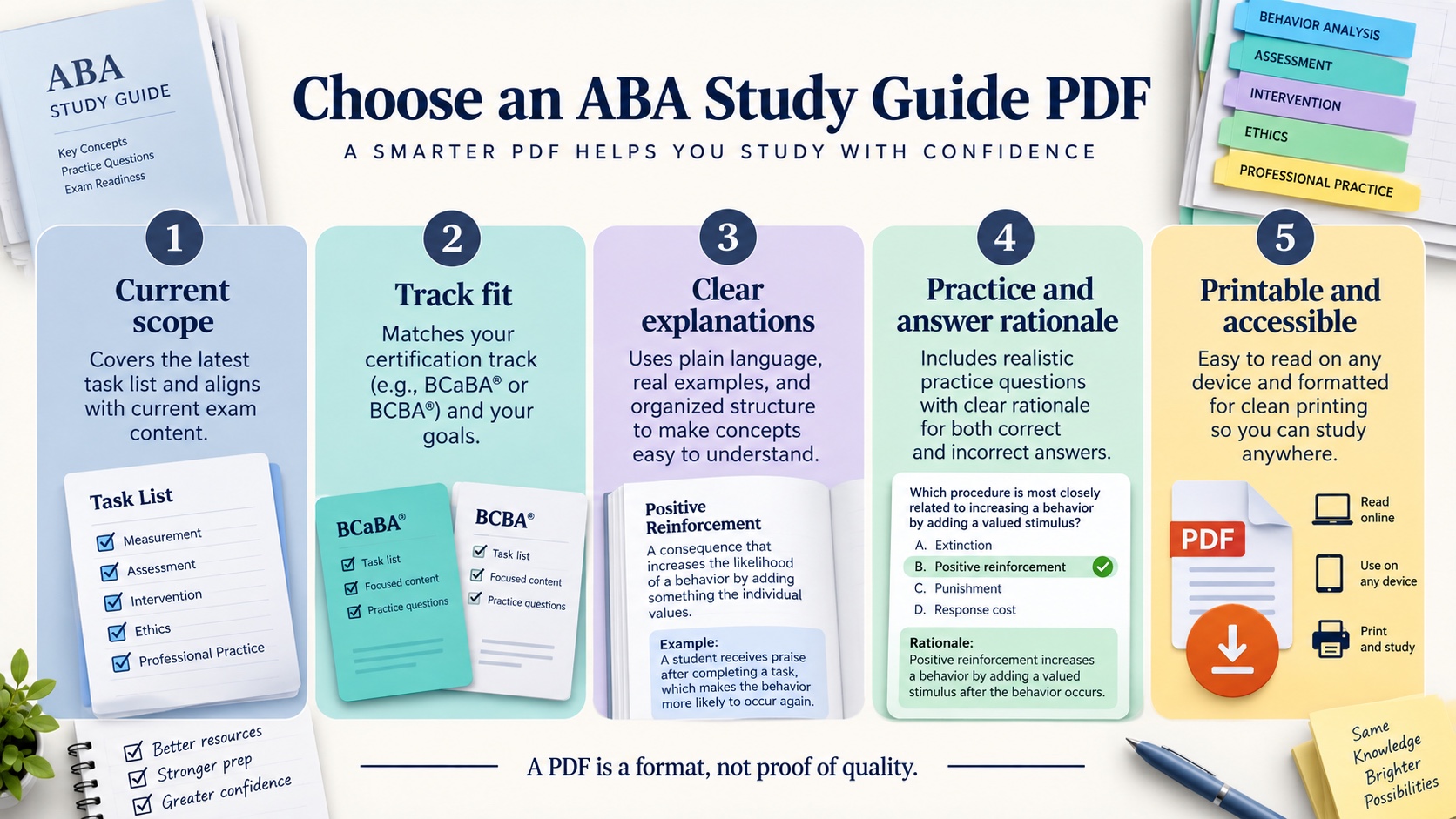
Searching for an ABA study guide PDF often means you want something practical: a file you can read on a tablet, print for annotation, or keep beside your notes while you review. That convenience is real, but a PDF is only a format. It does not tell you whether the guide matches your learning goal, uses current terminology, separates RBT, BCaBA, and BCBA content, or explains why an answer is stronger than another.
A good downloadable guide should give you a clear scope, understandable explanations, useful examples, and a way to practice retrieval. It should also make its boundaries visible. A study guide is not automatically an official BACB publication, a certification course, a current examination blueprint, or a guarantee of a passing result. Start with the current BACB content outlines and use a PDF as one layer in a larger study system.
Table of Contents
Short answer: is an ABA study guide PDF useful?
Yes, when it has a defined job. A PDF can be useful for building a concept map, reviewing vocabulary, comparing procedures, collecting examples, or preparing a short practice session. It is less useful when it becomes a very long file that you read once, highlight everywhere, and never use to retrieve or apply anything.
Before opening a guide, ask what you need next. Do you need a beginner-friendly overview? A track-specific exam map? A printable definition sheet? A visual example? A set of practice questions? One file rarely does every job equally well. The strongest approach is usually a small stack: an authoritative scope document, an explanation resource, practice questions with rationales, and a simple error or review record.
What to check before downloading
Look for a real title and clear source
A trustworthy resource identifies its author or organization, intended audience, revision information, and purpose. Be cautious when a download uses “official,” “guaranteed,” or “leaked” language without linking to an authoritative source. A study file can summarize the field without being produced or approved by the BACB. That distinction should be visible before you rely on it.
Check the date without treating it as enough
A recent date is helpful, but a date alone does not prove accuracy. Compare the guide’s terminology and scope with the current BACB content-outline page and examination information. If the guide discusses RBT, BCaBA, or BCBA certification, check the relevant current source instead of assuming that a PDF has kept pace with policy changes.
Preview the file
Open the first pages before downloading a large file or printing it. Look for a table of contents, readable headings, consistent definitions, examples, accessible contrast, and a page layout that works on your device. A guide that cannot be searched, zoomed, or printed cleanly may create more friction than it removes.
Match the PDF to your study track
“ABA” can describe a broad field of learning, while certification study requires a more specific scope. A general guide may be a useful foundation, but it should not quietly present general vocabulary as a complete RBT, BCaBA, or BCBA preparation route.
- General ABA learners: look for plain-language concepts, examples, history, dimensions of ABA, measurement, reinforcement, assessment, and ethical boundaries.
- RBT learners: look for alignment with the current RBT content outline and materials that keep the role within assigned procedures and supervision.
- BCaBA learners: look for the current BCaBA content outline and clear separation of assistant-level responsibilities, assessment, intervention, and supervision topics.
- BCBA learners: look for the current BCBA content outline, task-level language, data interpretation, assessment, intervention, ethics, and supervision reasoning.
Keep the authoritative document beside the guide. The BACB’s examination information and current content outlines define the official context. A PDF can help you learn, but it cannot decide whether you meet eligibility requirements or replace a current handbook.
How to judge content quality
Definitions should lead to distinctions
Memorizing one sentence is rarely enough for applied behavior analysis. A useful guide shows how a concept differs from a nearby concept and gives a bounded example. For instance, a section on reinforcement should help you notice the relation between a consequence and future behavior, not merely associate the word with a reward. A section on measurement should connect the definition to what someone would actually observe and record.
Examples should show the controlling feature
Good examples make the relevant feature visible and do not pretend that one short scenario answers every clinical question. When reading a scenario, ask what is known, what is missing, and which detail controls the decision. If the guide provides only answers without rationales, use it cautiously; answer checking without explanation can reinforce a guess.
Practice should support repair
Look for questions that require discrimination, application, data interpretation, or explanation. After an error, write the missed distinction and create a new example. The purpose of practice is not to collect a high number of completed pages. It is to make the next decision more accurate and easier to retrieve.
Turn passive reading into active study
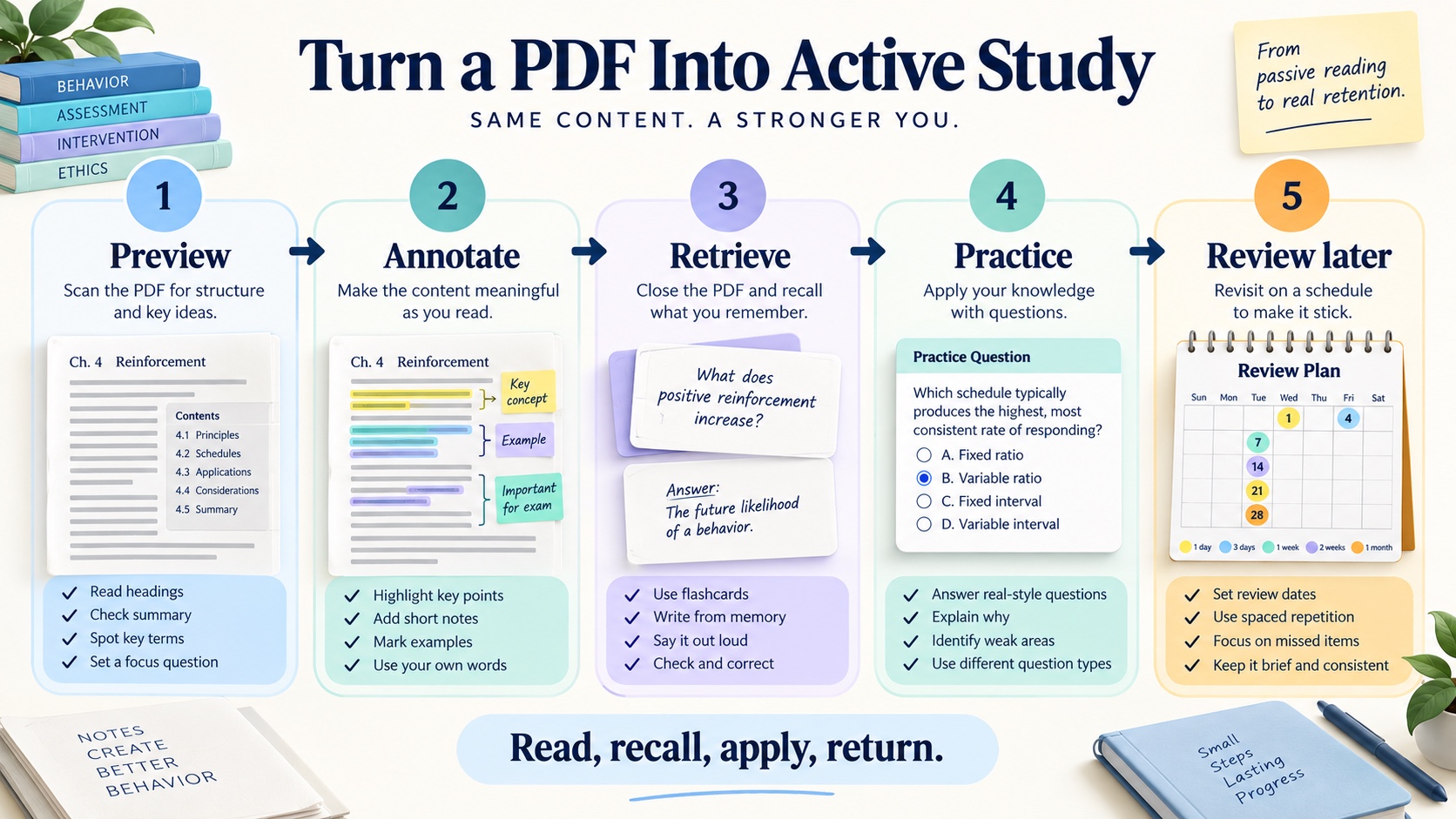
Use the PDF in a five-step loop:
- Preview: scan the headings and choose one small target.
- Annotate: mark a definition, example, and question in your own words.
- Retrieve: close the file and write or say what you remember.
- Practice: answer a question or apply the concept to a bounded scenario.
- Review later: return after a delay and test the same idea again.
This is where a downloadable guide becomes part of a learning system rather than a digital stack of pages. General learning research supports practice testing and distributed practice as useful study techniques, but those findings do not create BACB requirements or guarantee an examination result. Use the free questions area, flashcards, notes, or an app review session to make the retrieval step concrete.
Using free ABA PDFs safely
Free can be a strong starting point, especially when you are exploring the field or building a first study routine. Treat a free PDF like any other resource: identify the source, check the intended audience, compare current terminology, and inspect how the file handles practice and explanations. Do not assume that “free” means official, complete, or current.
Also pay attention to privacy and download behavior. A resource should not require unnecessary personal information or present unrelated software as a condition of reading an educational file. If a download contains copied exam items, claims to provide secured or leaked questions, or promises a guaranteed pass, do not use it as a trusted study source. Use the current BACB pages to verify official information and choose educational resources that explain their limits.
ABA Study Online’s free materials can serve as a discovery layer for concepts, questions, and tools. The website is not the BACB and its educational material is not an official examination document. That boundary makes the resource easier to use honestly: learn the concept, check the official scope, practice the decision, and identify what still needs review.
Common PDF study mistakes
- Choosing by page count: a long PDF can still have weak explanations or poor organization.
- Highlighting everything: use marks to identify definitions, contrasts, examples, and questions—not to color the entire document.
- Mixing tracks without labels: keep general ABA, RBT, BCaBA, and BCBA material distinct when requirements or scope differ.
- Ignoring source dates: check current official documents when a claim concerns an exam, credential, rule, or transition.
- Reading once and stopping: retrieval and delayed review are what make the file useful after the first pass.
- Trusting “official” language: look for the actual authoritative source rather than a badge or headline.
- Using a PDF as clinical direction: educational examples do not replace assessment, supervision, consent, or an individualized plan.
A simple printable routine
Print or save one page for each study session:
- Target: write the concept, task, or decision you will study.
- Definition: explain it in one or two sentences.
- Contrast: name the closest concept and how it differs.
- Example: create a bounded scenario that shows the controlling feature.
- Practice: answer one or more questions and write the rationale.
- Next review: set a date or condition for retrieving the idea again.
Keep the page next to the PDF, then store the question and error record in a place you will actually revisit. A website article can introduce the idea, a PDF can provide a stable reference, a practice set can reveal uncertainty, and an app or notebook can make the next return easier. Each format has a different job.
ABA study guide PDF FAQ
Where can I find a free ABA study guide PDF?
Start with a trustworthy resource library and inspect the source, intended audience, date, scope, and practice quality. Free access does not establish that a file is official or current. Compare certification-related claims with the current BACB source.
Is an ABA study guide PDF enough for RBT, BCaBA, or BCBA study?
Usually not by itself. A PDF can support explanation and reference, but effective preparation also needs current scope, retrieval, application, error review, and a plan that fits the relevant track. Check the current BACB content outline and examination information.
Should I print an ABA study guide PDF?
Print it if paper annotation helps you notice distinctions and return to them. Keep a searchable digital copy when you need quick lookup or accessibility tools. The best format is the one you will actively use and revisit.
How do I know if a PDF is outdated?
Check its revision information, terminology, cited documents, and claims about exam structure or requirements. Then compare those claims with current BACB pages. If the file has no source, date, or clear audience, treat it as an unverified note rather than a trusted guide.
Sources and boundaries
- BACB About Behavior Analysis
- BACB Test Content Outlines
- BACB Examination Information
- Dunlosky et al. (2013), effective learning techniques review
- Carpenter, Pan, and Butler (2022), spacing and retrieval practice review
- ABA Study Online free materials, learning resources, free questions, app review, and teaching tools