
ABA Study Group: How to Study Applied Behavior Analysis Together
Searching for an ABA study group can mean a few different things. You might be looking for classmates preparing for an RBT, BCaBA, or BCBA path. You might want a recurring online discussion group. Or you may simply need a better way to review difficult behavior-analysis concepts with another learner. In each case, the group works best when it has a clear learning job—not when everyone brings a different list of terms and hopes conversation will somehow become studying.
A useful ABA study group is a small, structured review routine. Each person prepares one target, explains what they understand, works through an application scenario, and leaves with one specific next step. The group can support learning, but it does not replace current BACB requirements, supervised experience, coursework, an official examination, or individualized clinical direction. Use the current BACB content outlines and examination information for official boundaries.
Table of Contents
Short answer: what makes an ABA study group useful?
The most useful group has a narrow agenda, active participation, and a visible connection between concepts and decisions. A session might focus on one measurement distinction, one assessment question, or one set of ethical boundaries. Members should explain their reasoning rather than only announce an answer. That small difference turns a meeting from passive review into a chance to notice confusion, compare examples, and correct an inaccurate rule before it becomes a habit.
Keep the group small enough for everyone to contribute. Three to five committed learners is often easier to manage than a large chat where a few people do all the talking. A larger group can still work, but it needs roles, time limits, and a shared document. The goal is not to create a social ranking or declare who is “the expert.” The goal is to make the reasoning visible and give each learner a way to practice.
What to do before the meeting
Choose one target
Pick one concept, domain, or decision rule for the session. “Study ABA” is too broad for a 45-minute meeting. “Differentiate event recording from interval recording” or “practice identifying the function suggested by a brief scenario” gives the group something it can actually complete. A target can come from a Theory Block, a missed practice question, a flashcard set, or a section of the applicable BACB content outline.
Bring a short preparation note
Each member can bring three items: a plain-language definition, one example, and one question. If the concept has a common confusion, write that down too. Preparation does not need to be a polished presentation. It simply prevents the meeting from spending its first 20 minutes deciding what the topic means.
Separate official facts from group explanations
Study groups are excellent places to compare understanding, but a confident explanation is not automatically an official rule. When a question concerns eligibility, supervision, examination format, certification maintenance, ethics, or a current transition, check the BACB source directly. A group note can summarize a source, but it should keep the source link and date of review instead of presenting memory as policy.
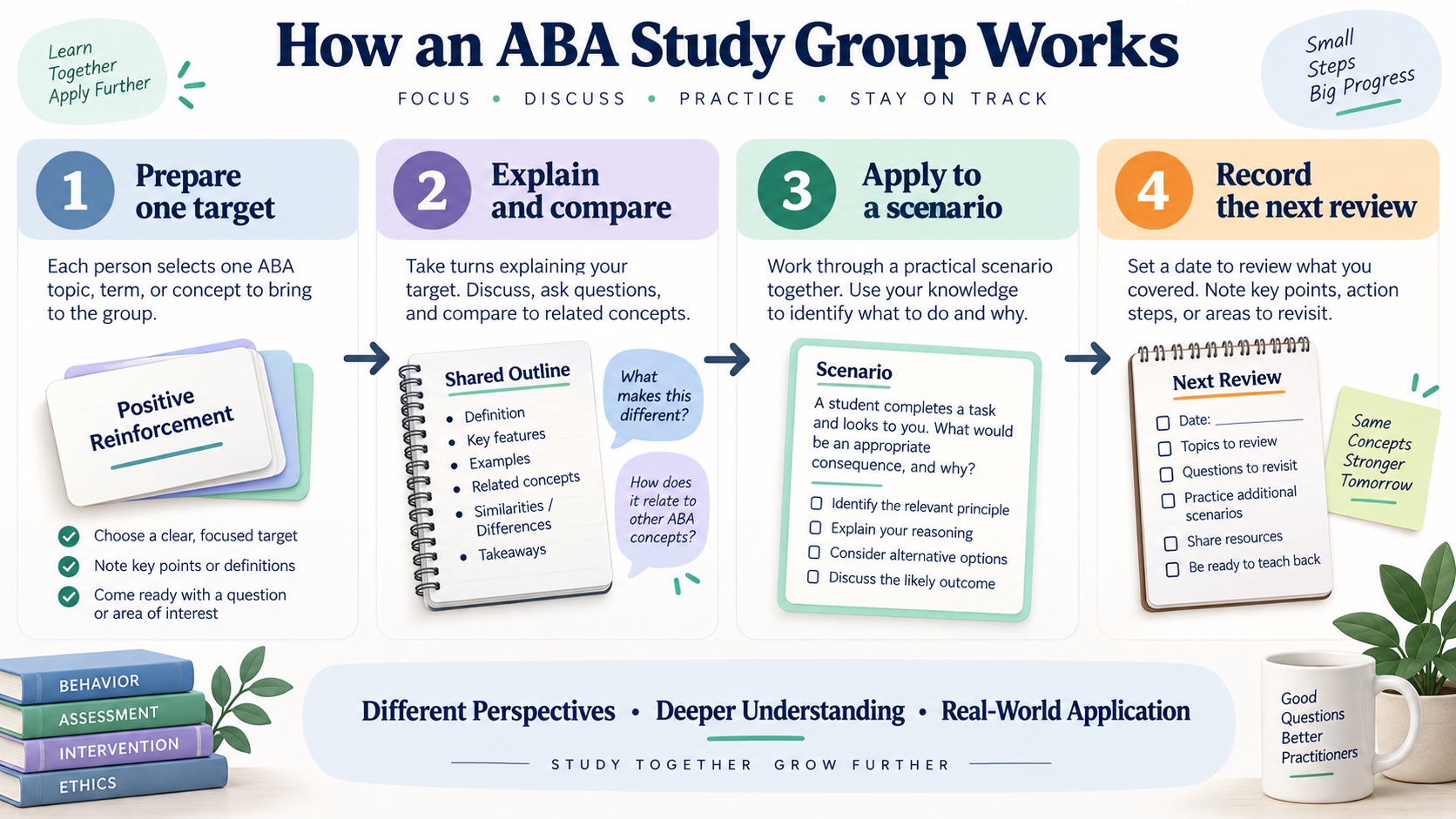
A four-part ABA study-group meeting
1. Open with the target and a quick retrieval check
Start by naming the target and asking each person to retrieve something before looking at the notes. Someone might define the term, sketch a simple example, or answer one short question. This is not a performance contest. It is a quick way to reveal what the group already knows and where the explanation needs more care.
2. Explain and compare
Give each member a turn to explain one part of the concept. Ask what features are essential, what features are merely common, and how the idea differs from a nearby term. For example, a group discussing measurement can compare what is counted, when the observation begins and ends, and what kind of question each measure can answer. The group should record the distinction in plain language rather than copying a paragraph that no one can use.
3. Apply the concept to a bounded scenario
Use a short scenario that contains enough information to support a decision. Ask: What evidence matters? What is still unknown? Which answer is strongest, and why? If the scenario involves a client, student, or supervisee, keep the discussion educational and avoid pretending that a brief prompt can replace assessment, supervision, consent, or a treatment plan. The point is to practice reasoning, not to give individualized clinical advice.
4. Close with the next review
End by writing down one takeaway, one unresolved question, and one date or condition for review. A learner might return to the concept after two days, complete ten related questions, or bring a new example to the next session. Distributed review and retrieval practice are more useful when they become scheduled behaviors instead of vague intentions. If you need a short individual follow-up, the free question area or the ABA Study Online app can provide a place to revisit concepts between meetings.
Questions that deepen understanding
Good questions make the group explain how it knows, not just what it remembers. Try prompts such as:
- What is the smallest definition that still preserves the important features?
- What is a tempting but incorrect answer, and what makes it less accurate?
- What would we observe or record if this concept were present?
- Which detail in the scenario changes the decision?
- How would the example look different in another setting or with another learner?
- What information is missing, and who would be responsible for obtaining it?
- Which current official source should we check before treating this as a rule?
Rotate the role of question-asker. If one person always teaches and everyone else listens, the group may feel productive while giving most members too little retrieval practice. A short teach-back—where a learner explains the idea as if helping a new classmate—can expose gaps without requiring a formal presentation.
How to keep RBT, BCaBA, and BCBA study separate
General ABA discussion can bring learners together, but the group should label track-specific work clearly. RBT study can emphasize foundational concepts, measurement, prompting, reinforcement, documentation, and working within assigned procedures and supervision. BCaBA study may require more attention to assessment, intervention, supervision, collaboration, and the boundaries of the assistant-level role. BCBA study may involve broader analysis, experimental design, assessment, intervention, ethics, supervision, and leadership reasoning.
These are learning directions, not a substitute for a current content outline. Keep separate folders or headings for RBT, BCaBA, and BCBA study so a term from one track does not quietly become a requirement for another. If the group includes mixed tracks, begin with a shared foundation and then split the application questions or follow-up tasks.
Common study-group mistakes
- Trying to cover everything: broad agendas create shallow conversation and no clear review target.
- Reading aloud for the whole meeting: listening alone does not show whether a learner can retrieve or apply the idea.
- Arguing from memory: current BACB rules and examination details should be checked against official sources.
- Letting one person become the answer key: use explanations, sources, and scenario evidence rather than status.
- Skipping the rationale: an answer without the reason behind it is difficult to transfer to a new question.
- Turning a study group into clinical consultation: individualized care decisions belong within appropriate supervision, assessment, consent, and professional boundaries.
- Ending without a next action: a friendly conversation becomes a learning routine only when someone knows what to review next.
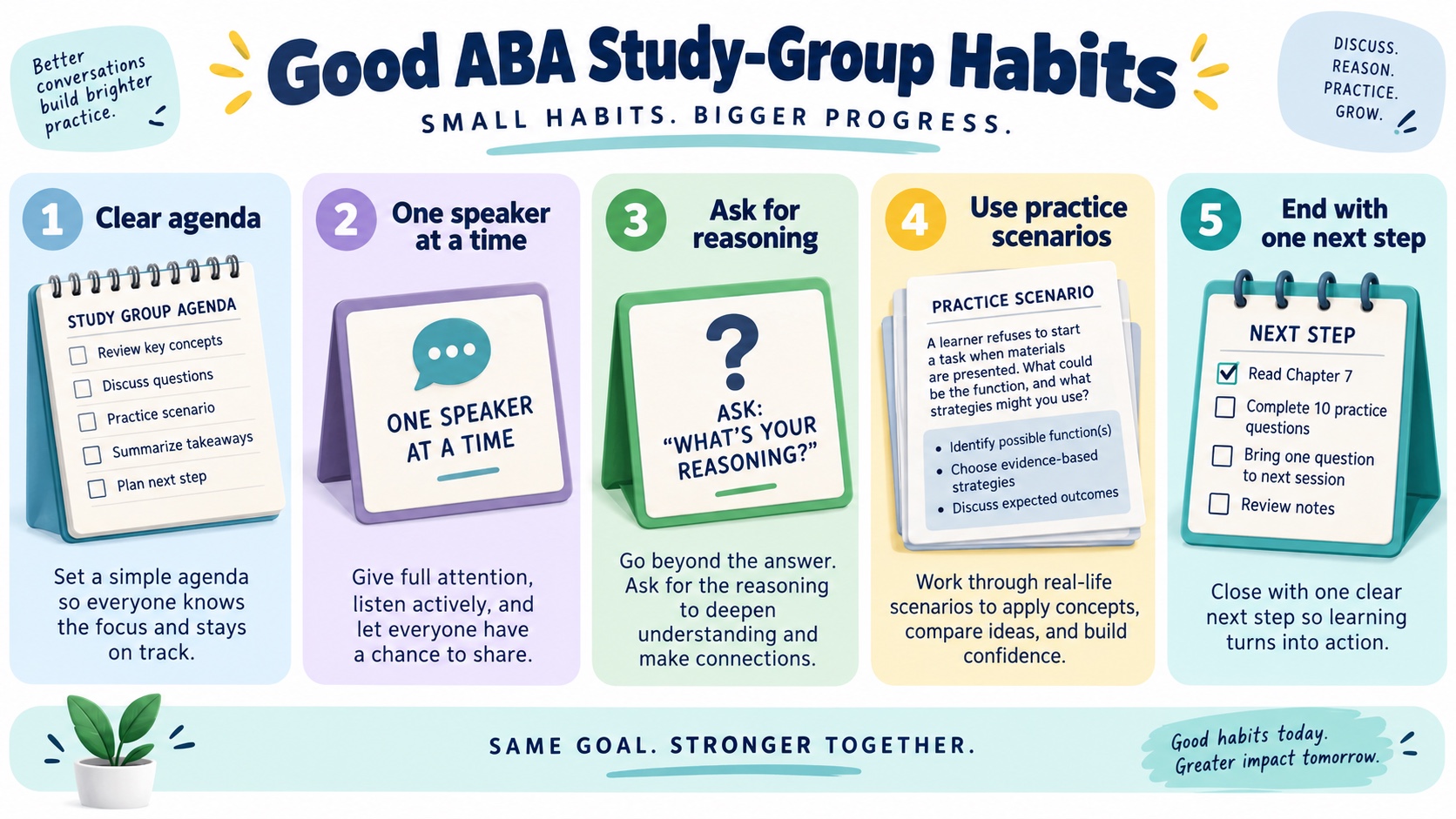
A simple weekly routine
Try a repeatable 45-minute format once or twice per week:
- Five minutes: name the target and complete a retrieval warm-up.
- Ten minutes: compare definitions, examples, and common confusions.
- Fifteen minutes: work through two or three bounded practice scenarios.
- Ten minutes: explain the reasoning and verify any official-rule question.
- Five minutes: record takeaways, open questions, and the next review.
Change the target each meeting, but keep the rhythm familiar. Over time, the group can build a shared index of concepts, source links, practice errors, and examples. That index is most useful when it shows uncertainty honestly. “Needs another example” is better than a neat note that conceals a misunderstanding.
ABA study group FAQ
How many people should be in an ABA study group?
There is no official BACB group-size rule for ordinary peer study. A small group of three to five often makes it easier for everyone to explain, practice, and ask questions. Larger groups need clearer roles and time limits.
Can an ABA study group replace a course or supervision?
No. A peer study group can support review and reasoning, but it does not automatically provide required coursework, supervised experience, competency assessment, ethical oversight, or certification eligibility.
Should an ABA study group use practice questions?
Yes, if questions are used to explain reasoning rather than chase a score. After each item, identify the controlling evidence, why the alternatives are weaker, and what concept needs another example. Keep official examination information separate from unofficial practice materials.
Can RBT, BCaBA, and BCBA learners study together?
They can share foundation topics, but track-specific content should be labeled and reviewed against the current BACB content outlines. Mixed groups work best when they split the application task after the shared concept is clear.
Sources and boundaries
- BACB Test Content Outlines
- BACB Examination Information
- BACB About Behavior Analysis
- Dunlosky et al. (2013), effective learning techniques review
- Carpenter, Pan, and Butler (2022), spacing and retrieval practice review
- ABA Study Online learning resources, free questions, app review, and teaching tools