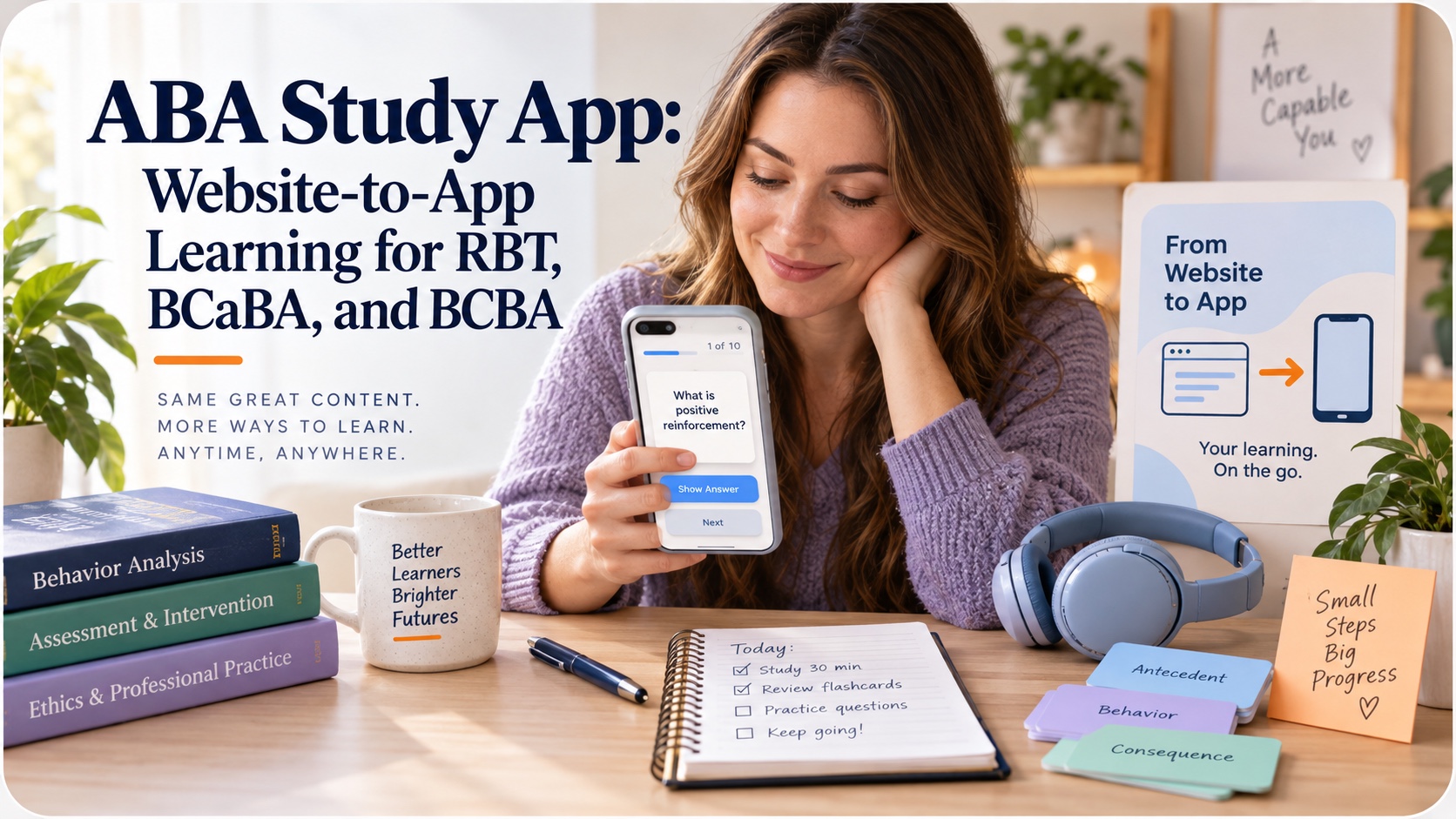
ABA Study App: Website-to-App Learning for RBT, BCaBA, and BCBA
When someone searches for an ABA study app, they may want flashcards for a short break, practice questions on a phone, audio review during a commute, or a clearer way to organize RBT, BCaBA, and BCBA study. The best fit depends on the learning job. An app should not simply place a large catalog on a small screen; it should help you retrieve a concept, apply it to a decision, review the rationale, and know what to return to next.
ABA Study Online is designed as a connected system. The website is the discovery and long-form resource layer: theory blocks, free questions, definitions, teaching tools, resources, and separate mock-exam pages. The app is the repeatable study companion: Today, Learn, flashcards, section-by-section practice, audio review, progress, and the shared tools library. This division keeps the app focused without pretending to replace BACB requirements, coursework, supervision, an official examination, or certification decisions.
Table of Contents
Short answer: what should an ABA study app do?
A practical ABA study app should help you:
- choose one clear concept, task, or question type;
- retrieve information before rereading it;
- practice a scenario or a focused section;
- read an explanation that identifies the controlling evidence;
- save an uncertain or missed item for another pass;
- see progress without confusing activity with mastery;
- return later through spaced review, audio, or a short next session.
It should also make its boundaries obvious. A study app is not automatically an approved training course, an Initial Competency Assessment, an official BACB question bank, a supervisor, or a certification application. The current BACB content outlines and handbooks control certification and examination requirements.
Why the website and app have different jobs
Long-form discovery and short repeatable practice solve different problems. A website page can explain a difficult distinction, show a full example, link to sources, and introduce a learner to a topic through search. An app can make the next return easier: open Today, review a few cards, answer a section set, listen to a short explanation, and record what deserves another pass.
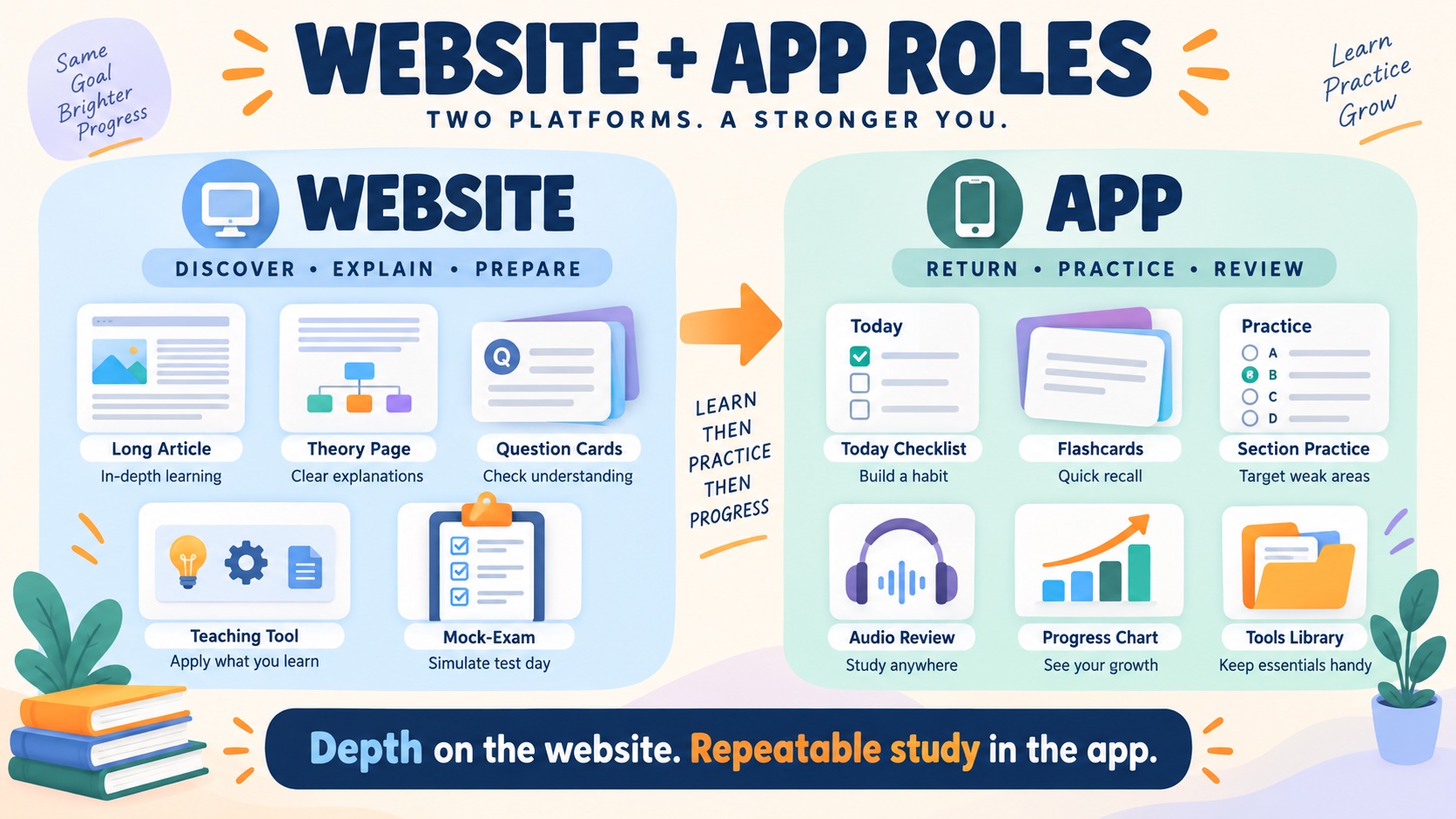
That does not mean a learner must choose one forever. A useful rhythm can begin on the website, move into the app, and return to the website when the concept needs a deeper explanation. For example, you might read a Theory Block about measurement, use the app to retrieve key distinctions, answer a short practice set, then return to a resource page to inspect a graph or definition more carefully.
General learning research supports design choices such as retrieval practice, spacing, and feedback. Those principles can make review more deliberate, but they are not BACB rules and they do not guarantee a result. The right app is the one that helps you use the principles consistently in your actual schedule.
What belongs in the app
Today: a clear starting point
Today should answer a simple question: what is the next useful action? It can surface saved items, a small review set, an audio episode, or a progress check without forcing you to browse the entire catalog. A short next step is especially useful when you have only a few minutes or are returning after a busy day.
Learn: concepts organized by track
Learn is the place to review concepts and flashcards organized around RBT, BCaBA, and BCBA paths. The organization should help you locate the right level without implying that every learner follows the same credential route. General ABA concepts can provide a foundation, while track-specific content keeps terminology and examination boundaries clear.
Practice: section by section
Practice should let you work on a focused topic rather than immediately starting a full mock. A useful item gives you a chance to answer, read the rationale, and identify what to revisit. If you need a longer simulation, the website’s mock-exam destination can serve a different purpose; the app’s core job is the repeatable repair loop.
Listen: audio review without a screen
Audio can turn a commute, walk, or household task into a review opportunity. It should be a supplement, not a substitute for applied practice. After listening to a concept explanation, return to a card or question that asks you to use the idea in a scenario.
Progress: information for the next decision
Progress should show what you have reviewed and where uncertainty remains. A completed session is not proof of mastery, and a low percentage is not an official score. The most useful progress view connects activity to a next action: revisit a saved mistake, practice a weak section, or schedule a delayed retrieval session.
Tools: concrete study and teaching support
The shared tools library connects abstract concepts to practical materials. Teaching tools such as a visual schedule, First–Then board, token board, ABC data sheet, or session notes template can make a concept more concrete. They are educational resources, not a replacement for individualized clinical direction or an authorized treatment plan.
The small-session study loop
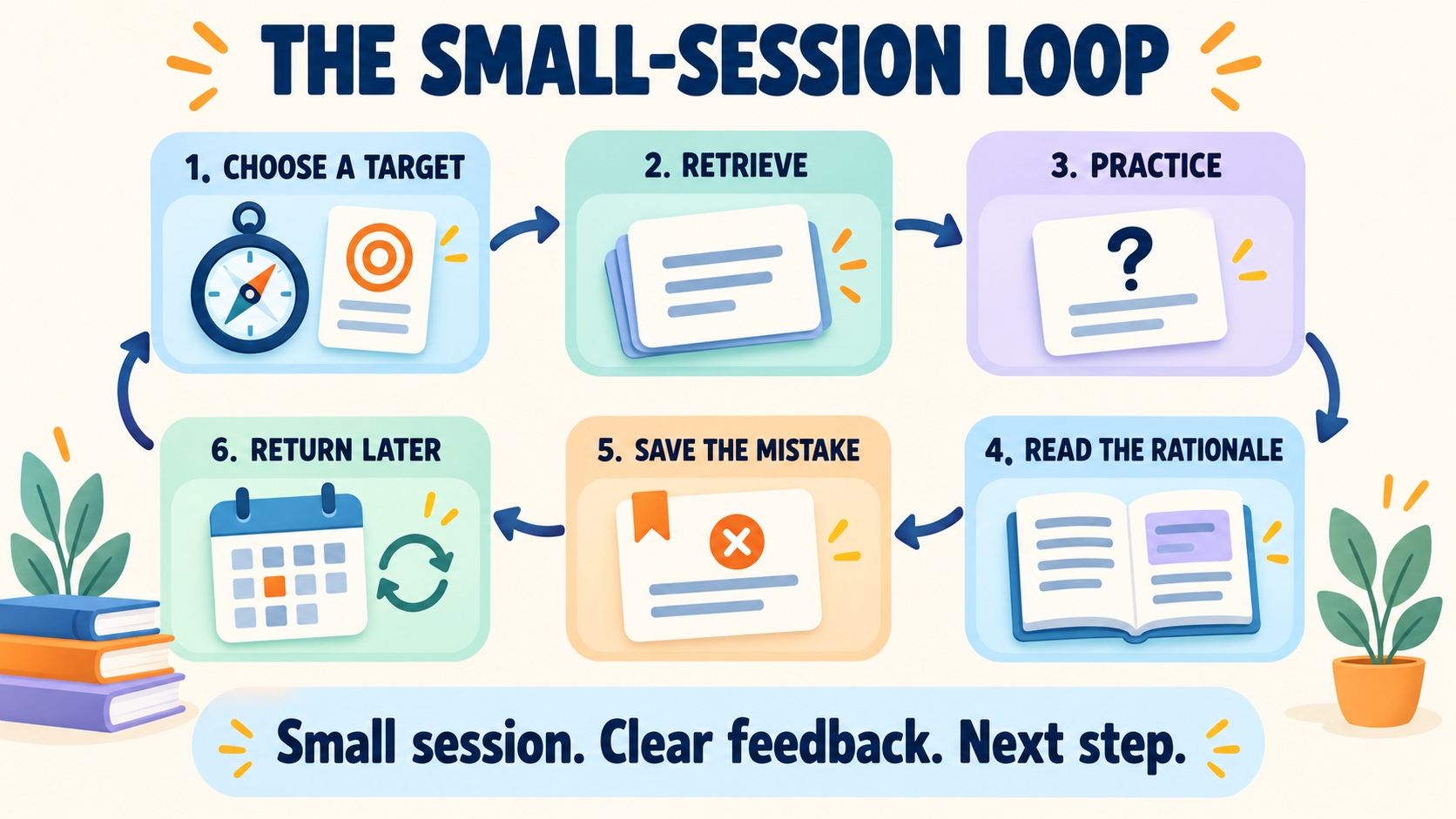
A good app routine does not need to be dramatic. Try this six-step loop:
- Choose one target: select a domain, term distinction, or error pattern.
- Retrieve first: answer a flashcard or explain the idea before opening the explanation.
- Practice a decision: complete a short section set or scenario.
- Read the rationale: identify the evidence that makes one answer stronger than the alternatives.
- Save the mistake: record an uncertain answer or a concept that needs another example.
- Return after a delay: use Today, audio, or a later card set to retrieve it again.
Use the length that you can repeat. A 10-minute session with real retrieval and review is more informative than an ambitious plan you abandon. When a concept remains unclear, return to the longer website explanation instead of forcing another round of shallow cards.
How the loop fits each track
RBT learners may use short sessions to distinguish measurement, prompting, reinforcement, documentation, and ethical boundaries. A practical question should keep the RBT role within assigned procedures and supervision rather than implying independent clinical decision-making.
BCaBA learners may need to connect assessment, intervention, supervision, generalization, and collaboration. Use the app to review distinctions, then return to a detailed page or source when a scenario involves scope, documentation, or fieldwork boundaries.
BCBA learners may use section practice and error review to work through measurement, experimental design, assessment, intervention, ethics, and supervision reasoning. The current BACB examination information and BCBA TCO—not an app dashboard—define the official exam context.
General ABA learners can start with definitions, Theory Blocks, free questions, audio, and practical tools before choosing a certification track. The app should make that exploration approachable without labeling general study as certification eligibility.
What stays on the website
The website remains important because it is the searchable front door. Use it for:
- long-form concept explanations and Theory Blocks;
- free question previews and written rationales;
- current-source articles and examination route pages;
- the full mock-exam destination for RBT, BCaBA, and BCBA products;
- teaching tools, resources, definitions, and app-discovery pages.
The full mock exam is intentionally separate from the app’s core release. That boundary keeps a timed website simulation from being confused with the app’s day-to-day learning loop. You can use both: the website mock gives you a longer practice event, and the app gives you a place to repair the decisions revealed by that event.
Common ABA study app mistakes
- Choosing by question count: quantity does not prove current coverage or explanation quality.
- Confusing an app with a course: a study tool does not automatically provide required training, assessment, supervision, or certification.
- Using activity as a score: sessions completed and official exam performance are different measures.
- Skipping rationales: the reason behind the answer is where applied learning happens.
- Studying only one track: RBT, BCaBA, and BCBA content paths should remain clearly labeled.
- Putting every feature in one loop: use the website for depth and mock exams, and the app for repeatable practice and review.
- Believing pass promises: no app can guarantee BACB eligibility or an exam result.
ABA study app FAQ
What is the best ABA study app?
There is no universal best app. Compare current-source alignment, track separation, explanations, error review, audio or accessibility options, progress clarity, and whether the routine fits your actual study time.
Can an ABA study app replace a course?
Not automatically. A study app can support learning and practice, but it does not replace any current BACB-required training, competency assessment, application, examination, supervision, or employer requirement unless the official evidence for a specific program says otherwise.
Does ABA Study Online put mock exams in the app?
Mock exams remain a separate website destination. The app’s core loop focuses on Today, Learn, flashcards, section practice, audio review, progress, and Tools. That separation lets a learner use a mock as a diagnostic and then return to focused repair.
Can I use the app for RBT, BCaBA, and BCBA study?
The system is organized around separate track paths so you can choose the content that fits your goal. Always verify current official requirements and keep track-specific terminology separate; the app is a study companion, not a certification authority.
Sources and boundaries
- BACB Test Content Outlines
- BACB Examination Information
- BACB About Behavior Analysis
- Dunlosky et al. (2013), effective learning techniques review
- Carpenter, Pan, and Butler (2022), spacing and retrieval practice review
- ABA Study Online app, Theory Blocks, free questions, mock exams, and teaching tools