ABA Rocks Practice Exam: Use It as an RBT Study Tool
If you searched for an ABA Rocks practice exam, you probably want to start practicing quickly and decide whether to take a full form or a smaller section quiz. The public ABA Rocks site presents free RBT practice exams, section-wise quizzes, and related study tools. That makes it convenient to begin, but the most useful result is not a percentage alone. It is a record of which concepts you can apply, which ones you guessed, and what you should repair next.
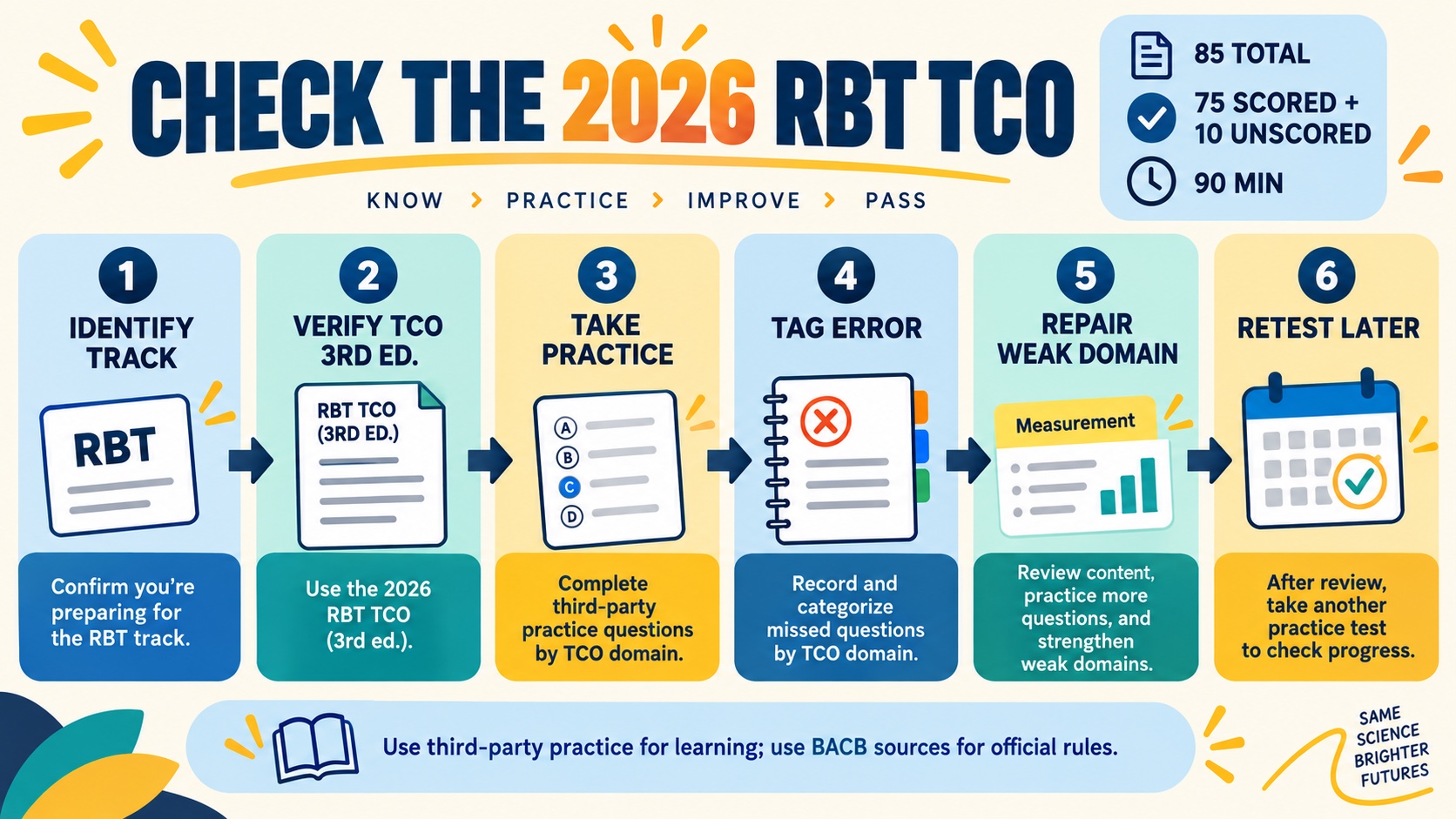
This guide focuses on using the practice experience—not treating it as official BACB content. The current RBT examination is based on the RBT Test Content Outline (TCO), 3rd edition, beginning in 2026. Use the official outline and Handbook to check the exam boundary, then use third-party questions for deliberate practice and feedback.
Table of Contents
Quick answer: which practice format should you use?
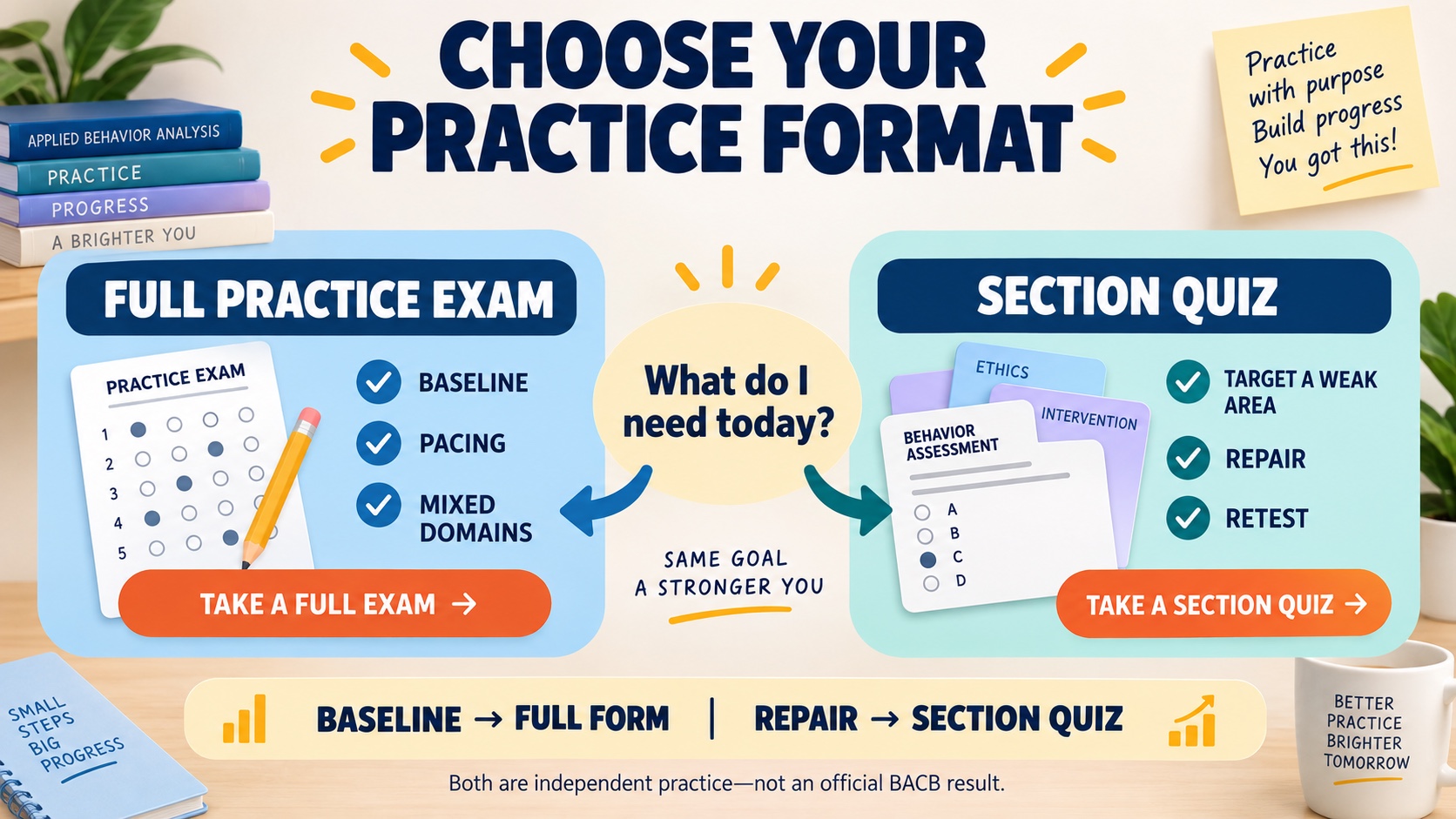
Use a full practice exam when you need a baseline, want to rehearse switching among content areas, or are checking pacing. Use a section quiz when you already know where the problem is and want a smaller repair session. A full form can tell you that something is weak; a section quiz can help you investigate what that “something” is.
A simple sequence works well:
- Take one full form under consistent conditions and record your confidence before each answer.
- Sort missed or guessed items by topic and error type.
- Use the matching section quiz or a short original drill for one weak area.
- Read the explanation and verify rule-based claims against the current BACB sources.
- Return later with a mixed or timed set rather than immediately repeating the same questions.
That sequence keeps the practice exam in its proper role. It gives you repeated contact with the questions while your official documents and training materials remain the reference point for what the RBT role and examination actually require.
What ABA Rocks publicly offers
The current ABA Rocks landing page presents four full-length RBT practice exams, six section-wise quizzes, and a large set of practice questions. The section labels shown publicly include data collection and graphing, assessment, behavior acquisition, behavior reduction, documentation, and professional conduct or ethics. The provider also describes free access and a no-login start.
Those details describe the public provider experience, not a BACB endorsement. The available form, labels, question count, explanations, and update language can change. Treat the live page as the source for what ABA Rocks currently displays, and treat the BACB Handbook and TCO as the sources for certification and examination rules.
The public practice forms also display answer explanations. Use them actively: before opening the explanation, write why you chose your answer and how confident you were. Then ask whether the rationale identifies the decisive cue and explains the distractors. If it only says which option is correct, keep your own explanation and cross-check the concept elsewhere.
Do not copy or publish the questions as if they were official examination items. A responsible study session keeps third-party questions in the role of original practice material. It also avoids the tempting shortcut of searching for “real” or “leaked” items. Secure examination content is not a legitimate study resource.
The current RBT exam boundary
The official RBT TCO, 3rd edition, describes content beginning in 2026. It organizes 43 tasks across six domains:
| Current domain | Published scored-question share | Study signal |
|---|---|---|
| A. Data Collection and Graphing | 13 / 17% | Measurement, graphs, calculation, trends, and data reliability |
| B. Behavior Assessment | 8 / 11% | Preference, skill-strength, and functional-assessment participation |
| C. Behavior Acquisition | 19 / 25% | Teaching, prompting, reinforcement, chaining, shaping, and generalization |
| D. Behavior Reduction | 14 / 19% | Implementing assigned reduction procedures and monitoring safety |
| E. Documentation and Reporting | 10 / 13% | Objective notes, communication, incident reporting, and data integrity |
| F. Ethics | 11 / 15% | Confidentiality, dignity, scope, boundaries, and supervision |
The current Handbook describes an RBT examination with 85 multiple-choice questions: 75 scored and 10 unscored, four answer choices with one correct answer, and 90 minutes. The six domain percentages are planning signals, not separate pass marks. Your official result is based on overall performance.
This is why an older page can feel familiar and still need a check. ABA Rocks’ public practice-test guide has included older 2nd-edition language in its description. That does not automatically make every question useless; it does mean you should not use old labels as your only 2026 exam map. Compare the exact page you are using with the current 3rd-edition TCO.
A six-step practice workflow
1. Set the purpose before you click
Write one sentence: “Today I am checking pacing,” “Today I am diagnosing measurement errors,” or “Today I am practicing ethics and scope.” A purpose keeps a quiz from becoming a number-collecting habit.
2. Choose consistent conditions
For a baseline, record the date, device, whether you used notes, and whether you used a timer. For a learning session, it is fine to pause and look things up—but label that session as learning, not as a readiness test.
3. Tag confidence before feedback
Mark each response as confident, uncertain, or guessed. A confident error often points to a false contrast or a misleading rule. A guessed answer may simply need more retrieval practice. The tags make your score more informative.
4. Classify the error
Use a small set of labels: missing concept, confused contrast, missed cue, data-reading error, role or ethics boundary, careless reading, or pacing. Do not write “I am bad at ABA.” Write the smallest error that can be repaired.
5. Repair one pattern
Pick a targeted action: define two terms in your own words, draw a graph pattern, explain why a prompt should be faded, compare two measurement procedures, or reread the relevant official guidance. Then answer a few new items rather than only reviewing the one you missed.
6. Retest after a delay
Return later with a section quiz or mixed set. An immediate retake can measure short-term memory of the answer. A delayed retest gives better evidence that the distinction is becoming usable.
How to interpret your result
A score is an observation, not a verdict. Compare scores only when the conditions, form length, topic mix, and review rules are reasonably similar. A higher score after an immediate retake may show that you remembered the options; it may not show that you can apply the concept in a new scenario.
Look for three signals:
- Accuracy: Which domain or procedure produced the most missed items?
- Confidence: Which errors were made confidently, and which were guesses?
- Transfer: Can you solve a new item after reviewing the explanation?
Do not turn a third-party percentage into an unofficial passing line. The BACB does not endorse specific study guides or guarantee a result from purchasing or using study materials. Use the score to decide what to study next, and use official sources for exam rules and certification decisions.
Common mistakes to avoid
Taking full forms every day. Full exams are useful, but repeating them without repairing errors creates fatigue and familiar-answer effects. Alternate baseline, targeted section work, and delayed mixed practice.
Using the site as the blueprint. A practice platform can organize questions differently from the current BACB TCO. Open the 2026 outline first, especially if the page you are using includes older task-list wording.
Studying only the largest-looking section. Behavior acquisition has the largest published share, but data, ethics, documentation, and assessment still matter. Use the six-domain map to prevent blind spots.
Ignoring explanations because the score is high. The explanation is where a question becomes instruction. Check why the correct option fits and why the closest distractor does not.
Confusing practice confidence with certification readiness. Readiness includes current knowledge, application, pacing, and the official requirements that govern your exam. A free practice result cannot decide those for you.
FAQ and official sources
Is the ABA Rocks practice exam free?
The public ABA Rocks pages present free practice exams and section quizzes with a no-login start. Check the live page for the exact forms and access conditions because provider pages can change.
Is ABA Rocks an official BACB practice exam?
No. It is a third-party study resource. Use the BACB Handbook and current RBT TCO for official exam and certification information.
Does an ABA Rocks score predict whether I will pass?
No. It is evidence from one independent practice experience. Use it to choose a repair task, not as an official passing prediction.
Should I use the full exam or a section quiz first?
Use a full form when you need a baseline or pacing rehearsal. Use a section quiz when you already have a specific weak area and want targeted practice.
Can I use ABA Rocks with an app?
Yes. A sensible combination is a third-party full or section practice form for variety, official documents for the current boundary, and an app or error log for spaced review. Keep each tool’s role clear.