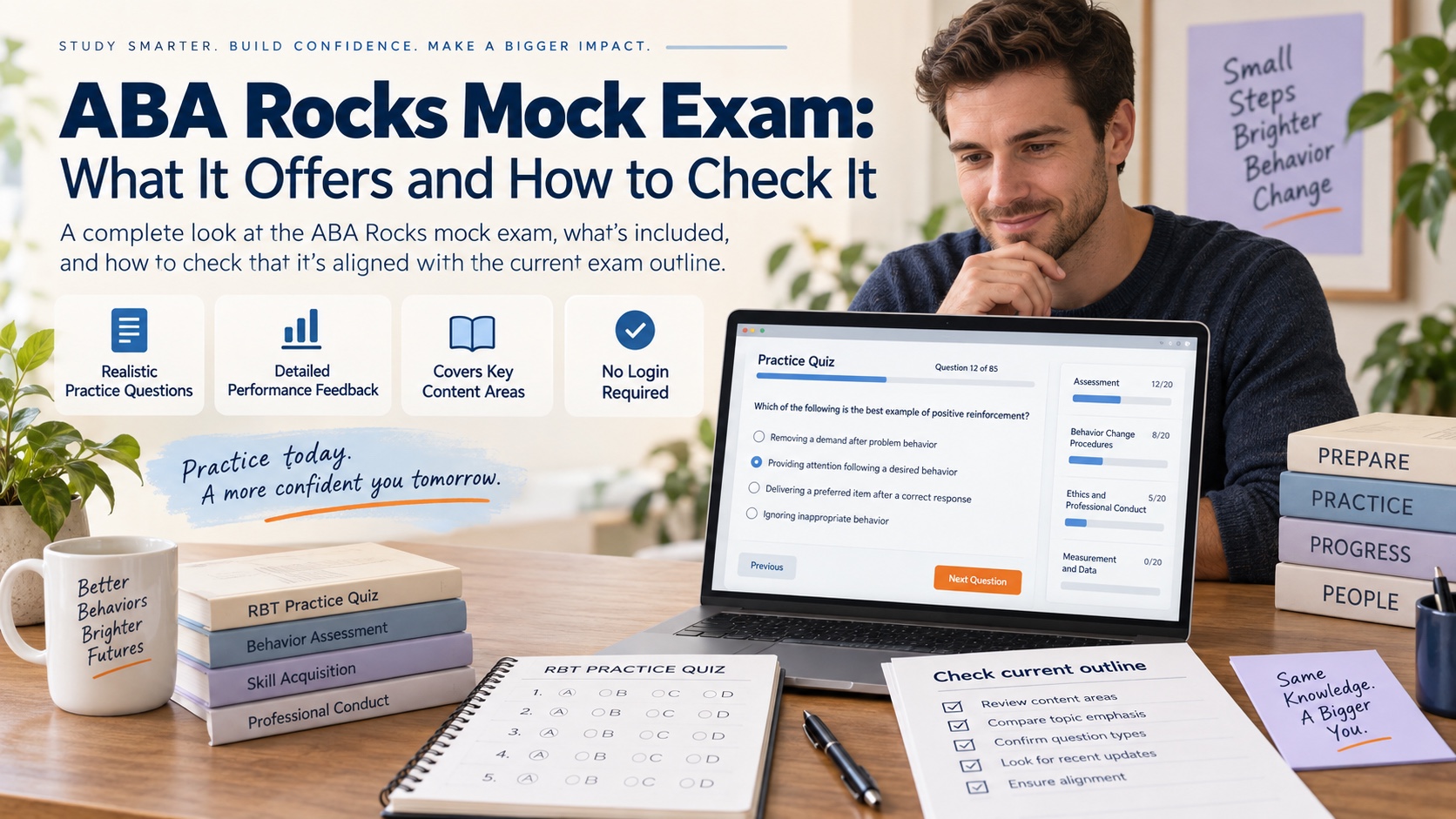
ABA Rocks Mock Exam: What It Offers and How to Check It
If you searched for an ABA Rocks mock exam, you may be looking for a free way to rehearse RBT or broader ABA concepts before paying for a study product. You may also want to know whether the quizzes are full length, whether you need an account, and whether the questions reflect the current certification outline.
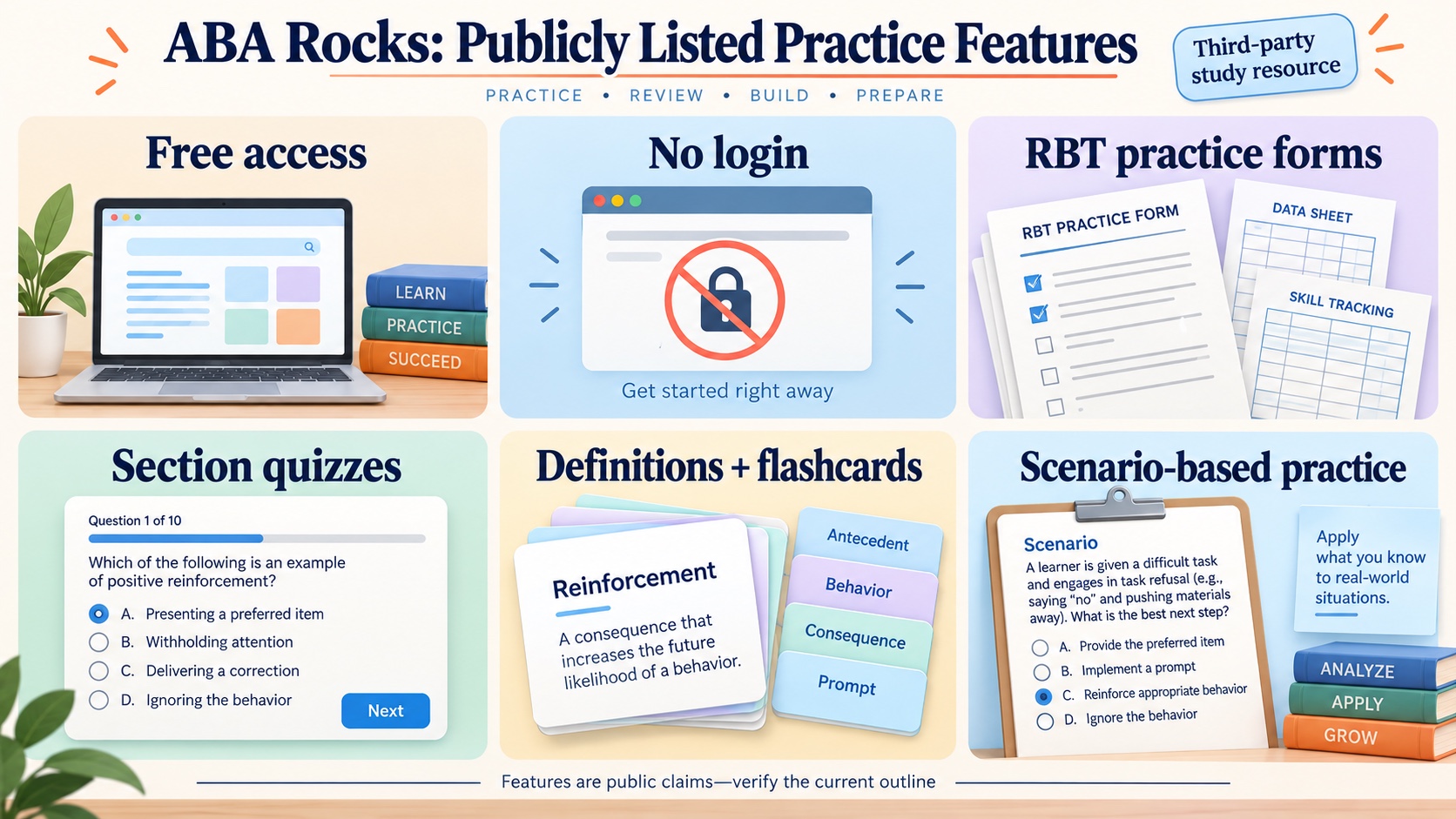
ABA Rocks publicly presents free online quizzes, practice-exam forms, section practice, flashcards, and definitions. That makes it easy to start. The part that deserves more attention is freshness: a third-party practice page can be useful and still require an edition check. This guide separates the provider’s public feature claims from the current BACB boundary so you can decide how to use the resource without treating it as an official examination.
Quick answer: what ABA Rocks publicly offers
ABA Rocks’ public pages describe a free, no-login collection of ABA study resources. The visible quiz area includes RBT practice-exam forms, shorter section quizzes, and questions connected to competency goals. The landing page also describes several full-length RBT practice exams, section-wise quizzes, definitions, flashcards, and scenario-based practice. The exact presentation can change as the site is updated, so read the live page for the current list before planning a long study session.
The most accurate description is “third-party practice resource.” It is not the BACB examination, it does not issue certification, and a result on the site is not an official score. The provider’s public pages also tell readers to cross-check official BACB materials. That is the right habit for any free mock exam, including one that feels convenient or familiar.
Publicly listed features and formats
The public ABA Rocks pages suggest several ways to use the resource. Think of them as different study modes rather than proof that every page has the same blueprint or review depth.
| Publicly visible feature | Useful question to ask | Boundary to keep |
|---|---|---|
| RBT practice-exam forms | Does the form give enough items to rehearse pacing and endurance? | A form can resemble a test without being official or current. |
| Section-wise quizzes | Can you isolate a weak content area after a baseline? | A section quiz is repair practice, not a complete readiness measure. |
| Definitions and flashcards | Can you retrieve a term and then apply it to a scenario? | Recognition of a definition is not the same as competent application. |
| Free access and no login | Can you start quickly without giving up an account or payment? | Free access does not guarantee current content, explanations, or privacy terms. |
| Untimed quiz behavior on the public page | Should you use it for concept practice first? | Untimed practice does not rehearse official time pressure. |
| RBT and broader ABA coverage | Which track does this exact quiz serve? | Do not use a BCBA-oriented item or a general ABA definition as an RBT requirement. |
What the mock exam does not mean
A mock exam is a learning instrument, not an authority. The distinction matters because “mock,” “practice,” and “exam prep” can sound more official than they are. ABA Rocks is an independent resource. The BACB’s own materials remain the source for certification eligibility, application steps, examination administration, ethics requirements, and the current test content outline.
A quiz score also does not tell you that you will pass. It reflects the questions you saw, the wording used, the answer key, the conditions of that attempt, and what you already recognized. A high score may show that you handled that form well. A low score may reveal unfamiliar vocabulary, a pacing problem, or a mismatch between the resource and your current track. Neither result replaces a review of the official requirements.
Do not assume that an item is official because it uses BACB terminology, or because it resembles a question you expect to see. Secure examination content should not be copied, reconstructed, or presented as leaked material. A responsible practice resource creates original questions and makes its relationship to the BACB clear.
How to check the current RBT outline
This is the most important step for the current ABA Rocks search. The BACB’s RBT page and handbook are the starting points for role, certification, and maintenance information. The RBT 3rd Edition Test Content Outline is the source for the current examination scope. A page that still uses older task-list language may remain useful for a concept, but it should not be treated as a complete current exam map without further checking.
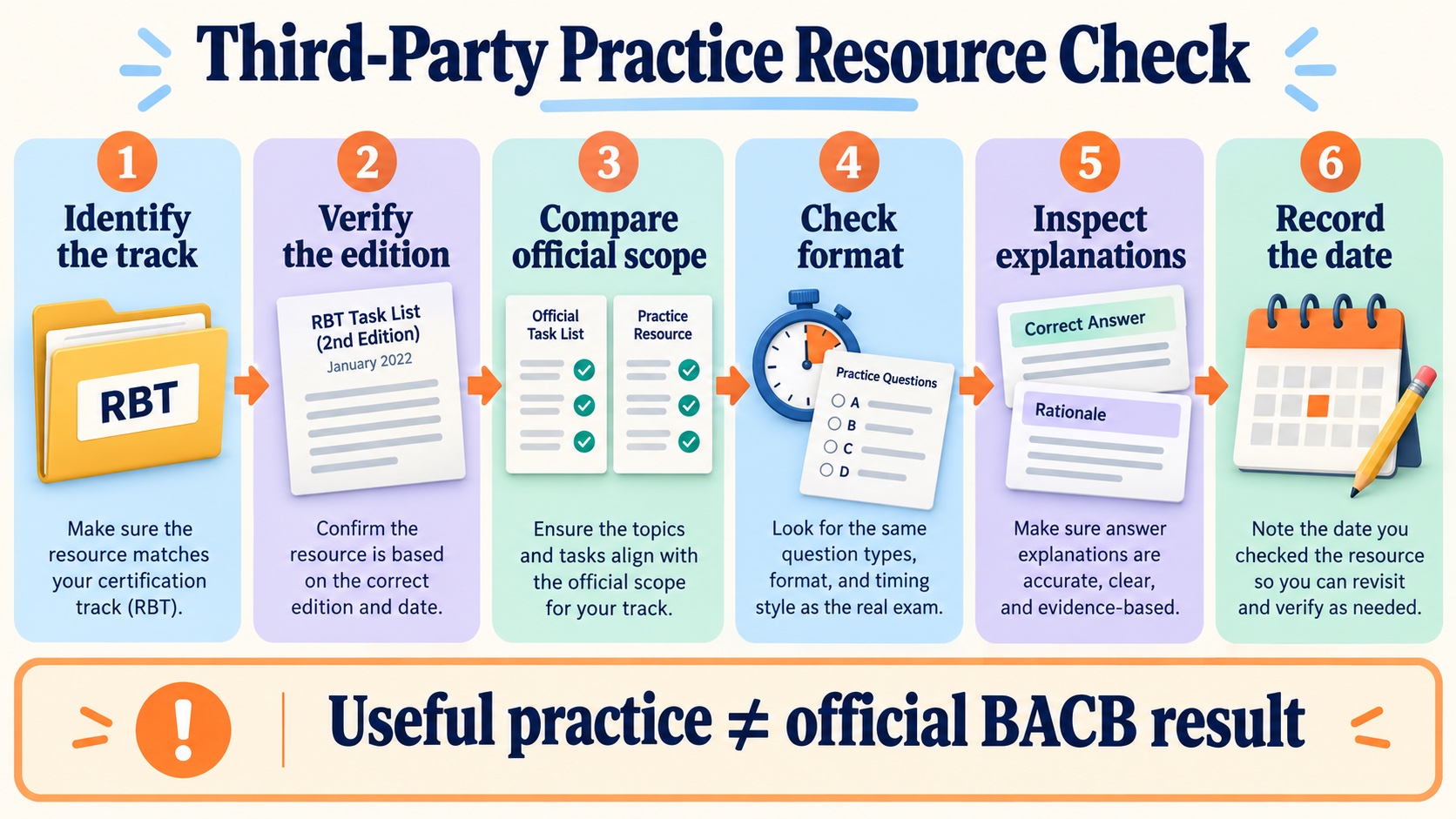
- Identify the track. Confirm that the quiz is RBT practice if you are preparing for the RBT examination. Do not combine it with BCaBA or BCBA coverage just because the site uses the broader ABA label.
- Read the edition language. Look for a current outline edition, revision date, and domain names. If a page names an older task list, record that as a limitation rather than silently treating it as current.
- Compare the scope. Open the official RBT TCO and check whether the quiz’s categories, examples, and terminology map to the current outline.
- Check the format claim. Question count, timing, answer choices, and section weighting should be compared with official examination information. Similar numbers do not prove identical content.
- Inspect the review. A correct answer without an explanation may help you score a point but may not help you repair reasoning. Look for explanations that distinguish the best answer from plausible distractors.
- Record the date. Save the page date or your own check date. That makes it easier to revisit the resource when the BACB publishes a new handbook or outline.
This check does not mean you must reject every older resource. It means you should assign it the right job. An older quiz can be a vocabulary warm-up or extra scenario practice; it should not be your only source for current eligibility, examination format, or professional requirements.
When a provider updates a resource, look for more than a new title. A meaningful update should identify the outline or handbook being used, revise domain labels where needed, and explain whether older forms remain available. If the page gives no revision signal, keep your confidence modest: use the questions for retrieval practice, mark uncertain items, and verify any rule-based answer against the current BACB source. This keeps a convenient quiz from quietly becoming an outdated study map.
A practical way to use the quizzes
Start with a purpose. If you are learning a new concept, use a short section quiz without a timer. If you want a baseline, choose a longer form and record the date, conditions, and confidence before each answer. If you want a pacing rehearsal, use a timer you control and avoid checking answers until the planned review point.
After the attempt, do not record only the percentage. Make four columns: topic or domain, what you chose, why you chose it, and what you will do next. Add a confidence tag before reading the answer. A wrong answer with high confidence needs a different review from a wrong answer where you already knew you were guessing.
Choose a small repair action for each pattern. You might reread one definition, draw a measurement example, compare two procedures, answer three new scenarios, or explain the distinction aloud. Then return later with mixed questions. Immediate retakes can feel encouraging because memory is still warm; a delayed retry gives you better information about whether the concept became usable.
ABA Study Online’s RBT learning path, free RBT questions, ABA definition search, and app review loop can serve as companion destinations. They are independent study resources, not substitutes for the current BACB handbook or a certification decision.
Who may find ABA Rocks useful?
ABA Rocks may be useful for a learner who wants a quick, low-friction way to see more scenarios, practice terminology, or sample a section before building a longer plan. The no-login format can make it easy to begin on a phone or computer. It can also be helpful when you need extra questions after you have already learned the underlying concept elsewhere.
It may be a weaker fit as a sole study system if you need a clearly dated current-edition blueprint, detailed error analytics, a structured progress history, or a guided sequence from concept learning to spaced review. In that case, combine a free mock with the official source documents and a record of your own errors. The tool’s convenience should reduce friction, not reduce verification.
FAQ
Is the ABA Rocks mock exam free?
ABA Rocks publicly presents free online quizzes and practice resources. Check the live page for the current forms and access conditions because provider pages can change.
Does ABA Rocks require an account?
The public landing page describes access without a login or registration. Confirm the current page before relying on that detail for a specific quiz.
Is ABA Rocks an official BACB practice exam?
No. It is a third-party study resource. Use the BACB handbook, examination information, and current test content outline for official certification and exam rules.
Does ABA Rocks match the current RBT exam?
Do not assume a complete match. The public RBT copy has referenced older task-list language, so compare the resource with the current RBT 3rd Edition TCO before using it as your main exam map.
Can an ABA Rocks score predict whether I will pass?
No. Use the result to identify concepts, question types, and confidence patterns for review. It is not an official score or a pass prediction.
Sources and next steps
- ABA Rocks public quiz page
- ABA Rocks public landing page
- BACB Registered Behavior Technician overview
- BACB RBT Handbook
- BACB RBT Test Content Outline, 3rd edition
- BACB examination information
- BACB terms of use and trademark boundary
- ABA Study Online RBT learning path
- ABA Study Online RBT practice questions