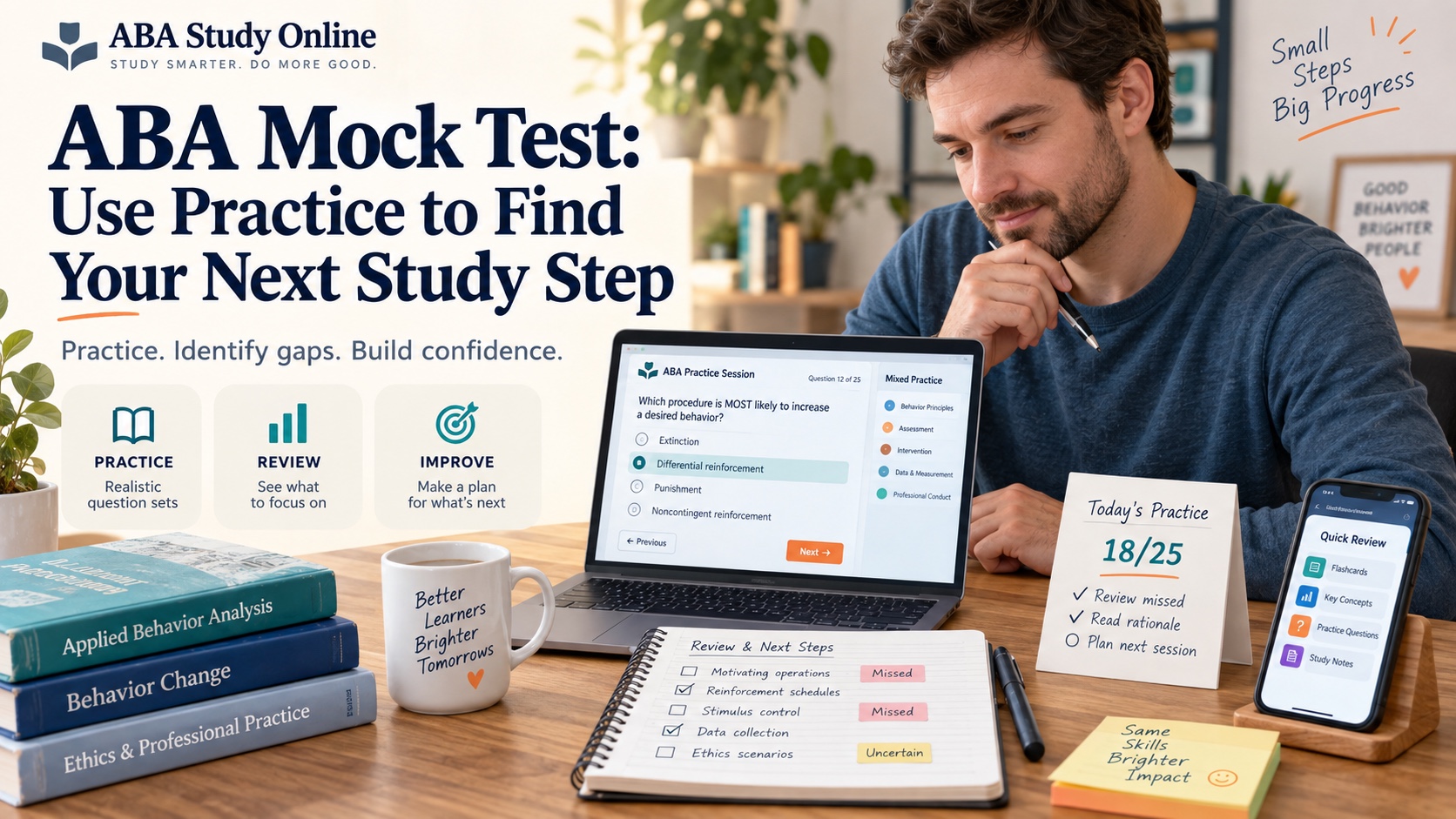
ABA Mock Test: Use Practice to Find Your Next Study Step
If you are searching for an ABA mock test, you may want a quick way to see whether your concepts are ready. The useful part is not the score alone. A good practice session shows which ideas you recognize, which distinctions blur together, and which question types deserve another look.
There is one important boundary at the start: ABA is a field, not one universal certification exam. RBT, BCaBA, and BCBA candidates study different current requirements and test content. A general mock test can warm up your reasoning, but it is independent educational practice—not official BACB content, secure exam content, or a pass predictor.
Table of Contents
What does “ABA mock test” mean?
People use the phrase in several ways. They may mean a mixed set of applied behavior-analysis questions, a timed rehearsal for a certification exam, or a short quiz that checks one topic such as measurement, reinforcement, assessment, or ethics. Those are different practice jobs.
Before you begin, name the job in one sentence:
- Learn: I want to understand a new concept with feedback.
- Diagnose: I want to find the concepts I keep missing.
- Rehearse: I want to practice pacing after I already know the material.
- Return: I want a short review that keeps the ideas active.
If you are learning, an untimed set with detailed rationales is usually more useful than a full-length simulation. If you are rehearsing, changing answers after every question can hide the pacing problem you are trying to observe.
Choose the right track before you practice
The BACB maintains separate certification information and test content outlines for RBT, BCaBA, and BCBA candidates. The official test content outline page is the right place to check which document applies to your goal. The BACB’s about behavior analysis page can help with the broader field, but it is not a replacement for a certification-specific outline.
Use a general ABA mock test for vocabulary, concept discrimination, and applied reasoning. Then switch to the appropriate track when your next step is exam preparation. For example, an RBT learner may need practice connected to the current RBT outline, while a BCBA learner needs a different level of analysis and a different exam boundary. Do not judge one track by another track’s percentage.
This distinction also helps families, educators, and new learners use practice honestly. You can study reinforcement, measurement, prompting, assessment, and ethical decision-making without presenting the activity as a professional credentialing exam. If a learner later chooses a certification route, the general practice history can still reveal useful vocabulary gaps; it simply needs to be followed by track-specific study and the current official requirements.
The five-step mock-test study loop
1. Take a short set
Start with a manageable number of questions. A short set gives you enough information to see a pattern without turning one tired session into a verdict about your ability. Read the full scenario, identify the task, and choose the best answer before looking for clues in the explanation.
2. Tag each miss
Do not write only “wrong.” Add a tag such as concept, measurement, scenario reading, procedure discrimination, ethics, or careless reading. You can also mark “uncertain” when you guessed correctly. A lucky answer is not the same as a mastered concept.
3. Read the rationale
A rationale should explain why the correct option fits the information in the scenario and why the tempting alternatives do not. Ask, “What detail changed the answer?” Maybe the question required an observable definition, a particular measurement dimension, a replacement behavior, or a response within a technician’s role.
4. Review the smallest useful gap
Choose one small repair target. If you missed three questions about duration, review duration and contrast it with frequency or latency. If you missed a scenario because you inferred a function from too little information, practice separating observation from interpretation. A narrow target makes the next session easier to evaluate.
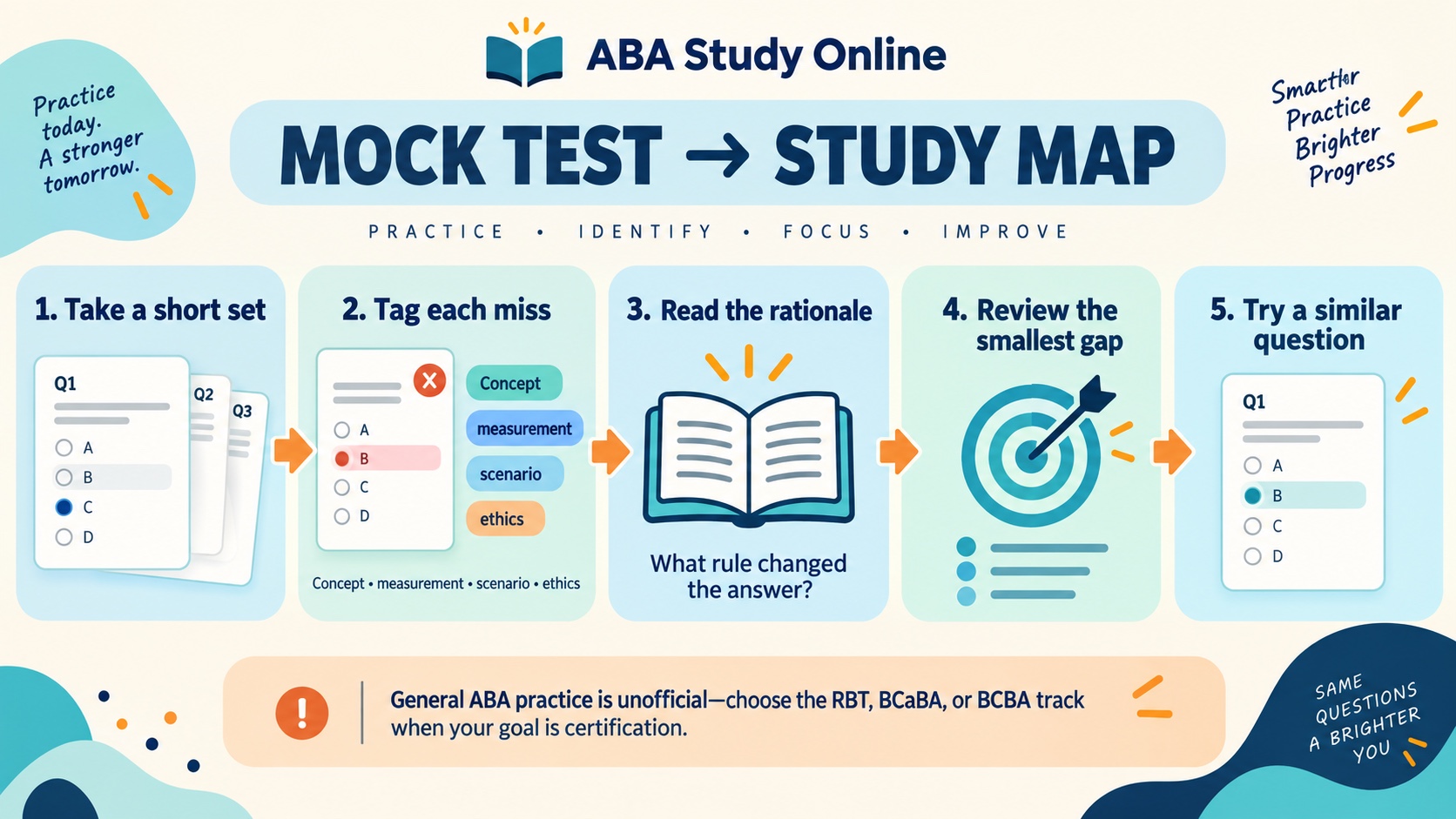
5. Try a similar question
Finish the loop with a new scenario. The goal is not to memorize the wording of the first question. It is to see whether you can use the distinction in a slightly different context. If the second question still feels unclear, shrink the review target again and seek a clearer explanation.
How to read a score without overreacting
A percentage is a snapshot of one set under one condition. It can tell you that the set felt easy or difficult, but it cannot tell you that you will pass an official examination. Independent practice questions do not share the BACB’s secure scoring process, and a provider cannot know which future questions will appear or how they will be scored.
Use three notes beside the percentage:
- Which domains or concepts produced the most uncertainty?
- Were the misses knowledge gaps, reading errors, or procedure distinctions?
- Did the same problem appear again after review?
Improvement is more meaningful when you can explain the change. A jump from 60% to 80% may reflect easier questions, guessing, or genuine learning. Your error tags and a similar follow-up set provide better evidence than the number alone.
Common practice mistakes
Taking full simulations too early
Long sessions can be useful for stamina, but they are inefficient when you still need to learn basic distinctions. Start short, repair gaps, and use timed practice later.
Collecting question counts instead of feedback
More questions do not automatically create more learning. If you never read the rationale or revisit the concept, you are mostly collecting exposure. Give feedback enough time to change your next decision.
Confusing general ABA practice with official content
A page that says “real exam questions,” “leaked items,” or “guaranteed pass” is not giving you a trustworthy study boundary. Use original questions and compare broad concepts with the official outline and handbook for your track.
Choose your next study step
If you want a general warm-up, begin with a short mixed set. If your goal is certification, move to the correct RBT, BCaBA, or BCBA learning path and use its current content outline. Try free practice questions to identify a gap, then use the ABA Study Online app for focused review, flashcards, and a return session. These are independent study tools, not official BACB questions or a promise of a result.
FAQ and official sources
Is an ABA mock test the same as a BCBA mock exam?
No. “ABA mock test” is a broad phrase. A BCBA practice page should be tied to the current BCBA track and content outline, while a general ABA set may be useful only for foundational concepts.
Should I time every ABA practice session?
No. Use untimed practice while learning and reviewing rationales. Add timing after you can explain the concepts and want to observe pacing.
Can a practice score predict my certification result?
No. An independent score is a study signal, not an official pass prediction. Use it to choose the next review target and continue checking the current BACB source for your certification track.
Official source: Start with the BACB’s test content outline hub, then open the current handbook and outline for the RBT, BCaBA, or BCBA track that matches your goal.