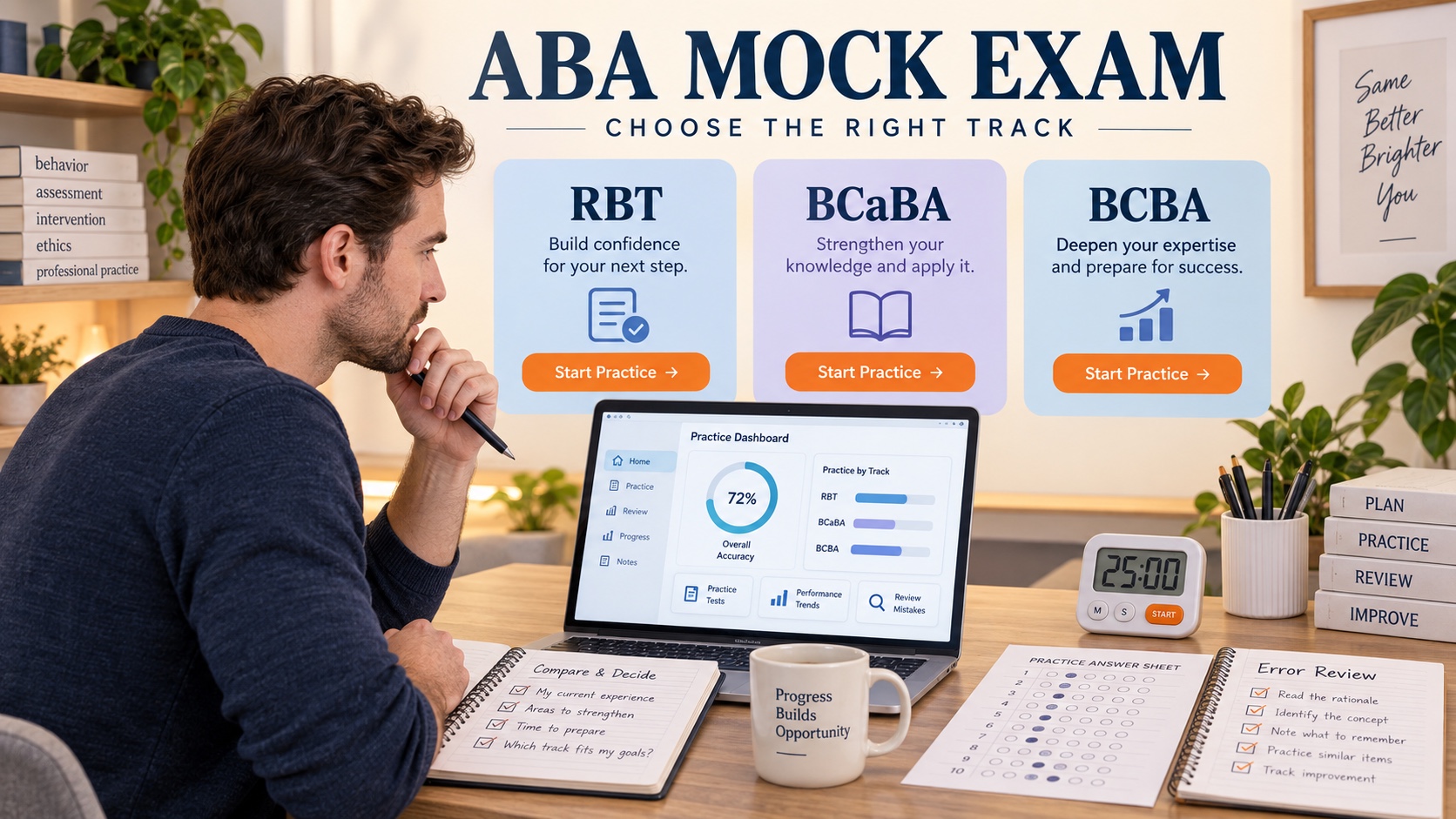
ABA Mock Exam: Choose the Right Track and Review Well
Searching for an ABA mock exam can lead to a common problem: “ABA” describes a field, but it does not identify one single certification examination. RBT, BCaBA, and BCBA candidates prepare for different roles, use different Test Content Outlines (TCOs), and take examinations with different question counts and time limits.
The first step is therefore not choosing the longest quiz. It is choosing the right track. This guide compares the current exam structure, shows how to create a useful mock session, explains what a score can and cannot tell you, and gives you a review loop for wrong answers. ABA Study Online practice materials are original study content. They are not official BACB examinations, secure item banks, or pass guarantees. Verify current requirements with the BACB Examination Information page and the correct track-specific TCO.
Table of Contents
Short answer: what an ABA mock exam should do
A good mock exam gives you a defined set of original questions, a clear track label, a stated time condition, and explanations that help you understand the decision. It should make you practice more than recognition. You need to read a scenario, identify the relevant concept or task, compare plausible distractors, and choose the answer that is best supported by the facts.
A mock is not valuable because it looks official. It is valuable when it creates useful evidence about your preparation. Before starting, write down whether you are practicing content, switching between topics, or rehearsing pacing. After finishing, record which questions you missed and why. That second step is what turns an online quiz into a study tool.
Choose RBT, BCaBA, or BCBA first
Use the certification track—not the broad word “ABA”—to choose your practice exam.
- RBT: entry-level behavior technician preparation focused on implementing procedures, measurement, documentation, reporting, and ethics within supervised practice.
- BCaBA: assistant behavior analyst preparation using the BCaBA TCO, with content that includes assessment, behavior-change procedures, intervention development and monitoring, ethics, and supervisory relationships.
- BCBA: graduate-level behavior analyst preparation using the BCBA TCO, with broader responsibilities that include assessment, intervention selection, supervision, management, ethics, and experimental design.
A question about implementing a prompting procedure may fit RBT practice, while a question about selecting and monitoring an intervention may be more appropriate for BCaBA or BCBA preparation. The wording can look similar, but the expected role and level of decision-making are not interchangeable.
Compare the current exam structures
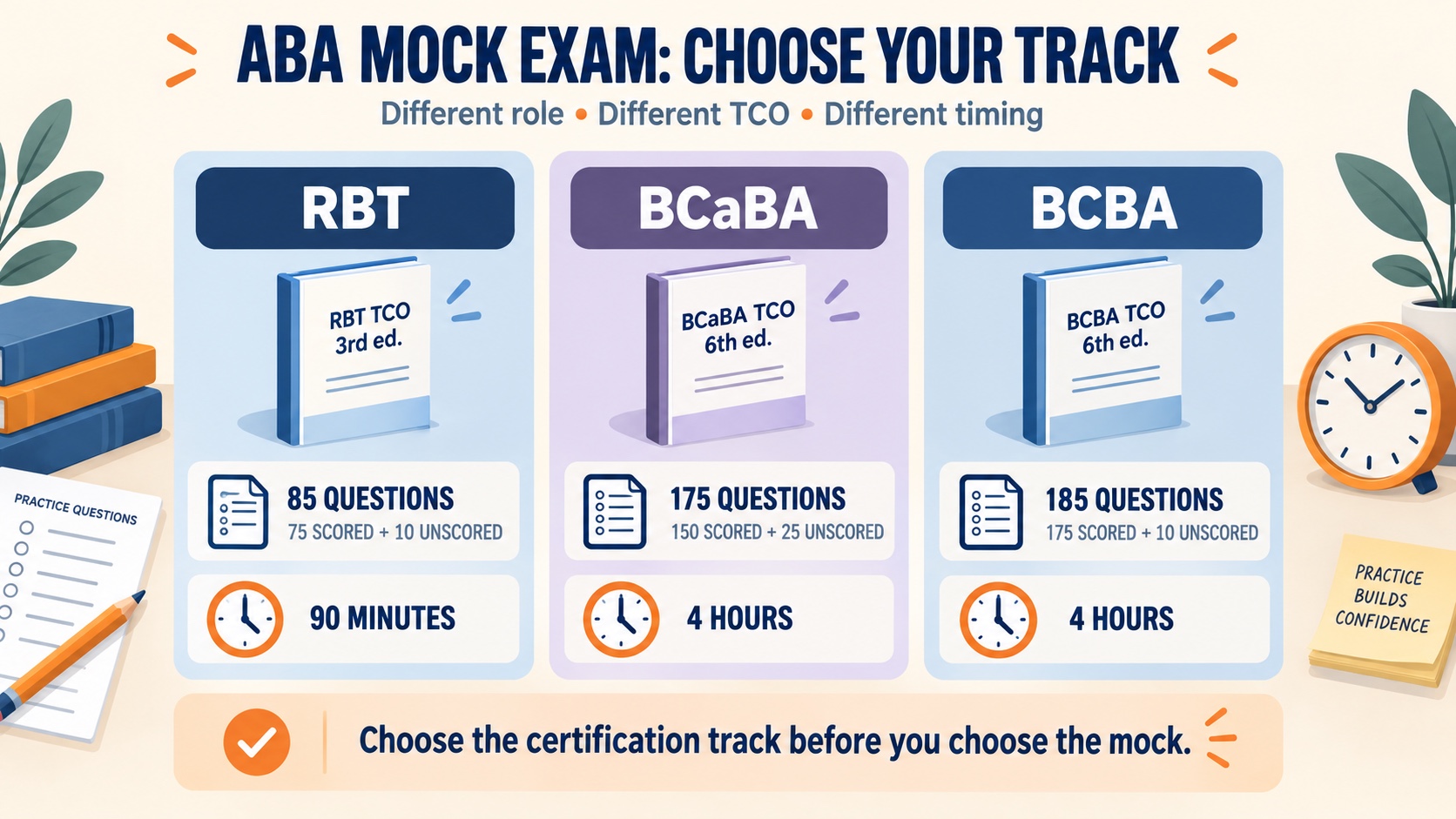
The current BACB examination information gives you a useful starting point for mock-session design:
| Track | Current outline | Total questions | Scored / unscored | Time |
|---|---|---|---|---|
| RBT | RBT TCO, 3rd ed., beginning 2026 | 85 | 75 / 10 | 90 minutes |
| BCaBA | BCaBA TCO, 6th ed., beginning 2025 | 175 | 150 / 25 | 4 hours |
| BCBA | BCBA TCO, 6th ed., beginning 2025 | 185 | 175 / 10 | 4 hours |
BACB examinations use multiple-choice questions with four answer choices and one correct answer, and current examination delivery is in person through authorized Pearson VUE sites. A practice website can help you rehearse reasoning and pacing, but it should not suggest that completing an online mock means you have taken the certification examination.
For RBT preparation, use the current 3rd-edition TCO and its six domains. For BCaBA and BCBA preparation, use the current 6th-edition TCO for the appropriate track. A question set that does not state its outline or track is difficult to evaluate, even if the questions sound familiar.
Check the quality of a mock resource
Before you spend time on a practice set, look for a few simple signals. The page should name the track, identify the TCO or version it is using, and explain whether the questions are original. It should tell you how the timer works and whether rationales appear after each item or at the end. Those details let you decide whether the set is for learning, mixed review, or a timed rehearsal.
Good explanations do more than reveal a letter. They identify the behavior-analytic distinction, point to the relevant fact in the scenario, and explain why the other choices are weaker. If a question depends on missing information, the rationale should say what cannot be concluded rather than rewarding a guess.
Be cautious with pages that use “official,” “guaranteed,” or “exact exam questions” without a current primary source. A trustworthy study resource can be useful without pretending to be the BACB. Clear limits are a quality signal, especially for high-stakes exam preparation.
Build a useful mock session
Choose the session type before you begin:
- Focused session: practice one TCO domain or one type of reasoning while learning a topic.
- Mixed session: switch among domains so you practice selecting the relevant concept from a new scenario.
- Timed rehearsal: use a defined question count and a time limit to practice pacing and attention.
You do not have to begin with a full-length simulation. A short 20- or 30-question set can be useful for learning. A longer session becomes more informative after you understand how to review it. The key is to label the conditions. Do not compare an untimed, open-book topic quiz with a timed, closed-book mixed set as if they measure the same skill.
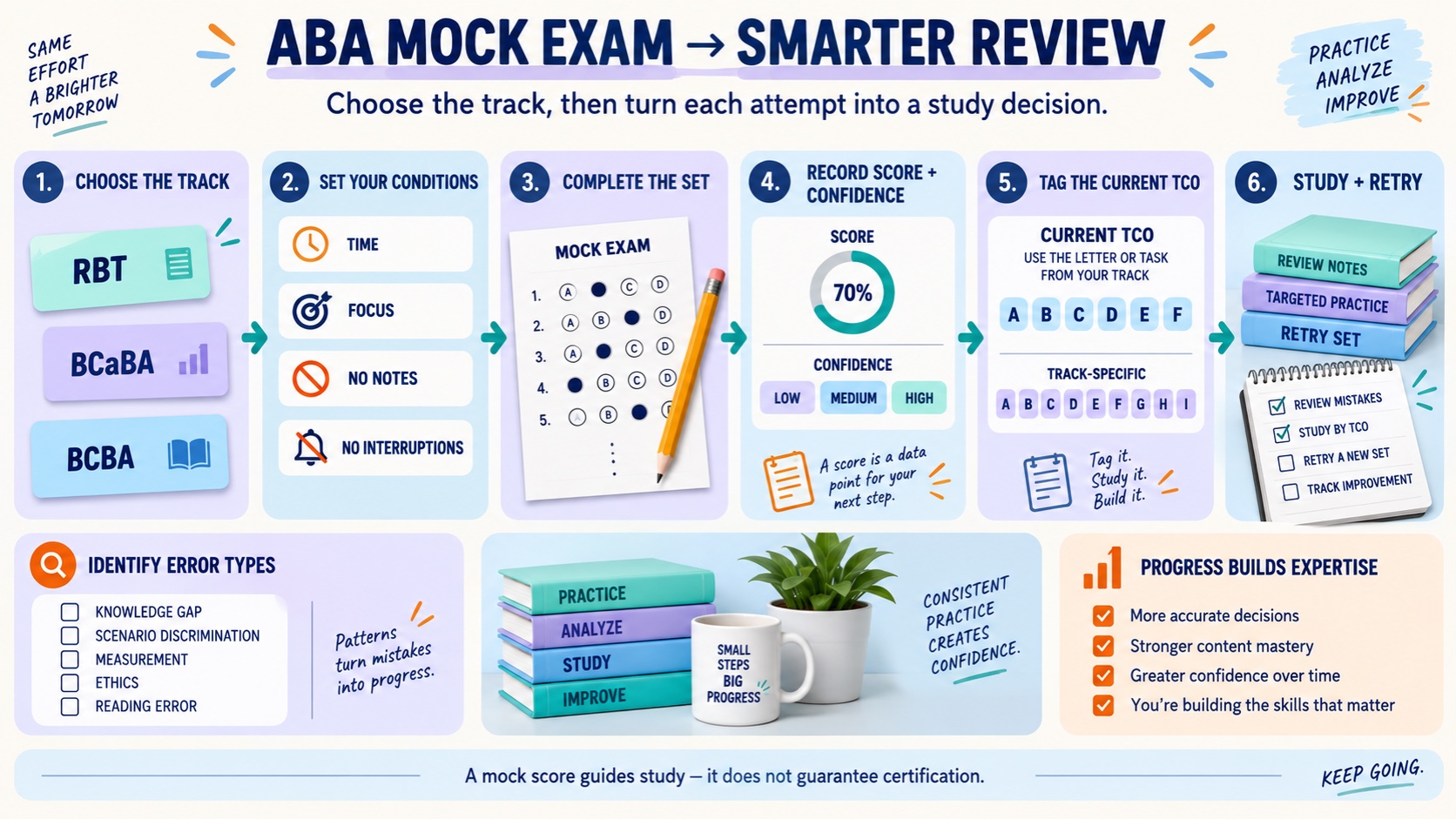
During the session, mark your confidence as low, medium, or high. A correct answer chosen with low confidence is a useful review item too. It may show fragile knowledge, guessing, or an explanation you cannot yet reproduce. If you are studying rather than simulating, commit to an answer first and then pause to read the rationale.
Review the result as study data
Use a four-part error log:
- Track and TCO area: identify the certification track and the relevant domain or task.
- Your choice: record the answer you selected and your confidence.
- Decisive cue: write the fact that makes the best answer stronger than the distractors.
- Next action: choose a short reread, worked example, flashcard, data exercise, or targeted retry.
Suppose an RBT learner chooses a punishment procedure because the scenario mentions a decrease in behavior. The review should return to the operation, the consequence, the stated plan, and the technician’s role—not simply label the answer wrong. A BCaBA or BCBA learner might need to examine a different decision point, such as whether the assessment information supports selecting or monitoring an intervention.
For measurement questions, ask whether you confused what is being measured with when or how it is measured. For ethics questions, identify the active boundary and the action within the practitioner’s role. For supervision questions, check whether your answer preserves role clarity, communication, feedback, and client welfare. A useful rationale explains the distinction that separates the correct option from the plausible distractors.
Common mock-exam mistakes
Using one test for every track. The role, TCO, question count, and expected decision-making level differ. Choose the track first.
Chasing an impressive percentage. A high score on familiar or repeated items may not show independent reasoning. Track new mixed scenarios and confidence as well as accuracy.
Ignoring explanations. A correct answer can still hide a weak distinction. Read why the other options fail under the facts given.
Studying only the missed letter. A small independent set may not represent a TCO task well. Use errors to choose additional study, but keep reviewing the full blueprint.
Calling a mock an official exam. Do not use BACB logos, imply endorsement, reproduce secure questions, or promise certification from completion. Clear labeling builds trust with learners.
Choose your next practice set
Once you know your track, choose a set that states its question count, time condition, TCO coverage, and explanation method. After the session, review the error log and schedule a targeted retry. The best mock-exam resource is the one that helps you make the next study decision more precise.
FAQ and official sources
Is there one official ABA mock exam?
No. “ABA mock exam” is a broad search phrase. RBT, BCaBA, and BCBA candidates prepare for separate certification examinations and current track-specific outlines.
How long should an ABA mock exam take?
Match the time to the track and the purpose. A learning set can be shorter; a timed rehearsal should use a clearly stated condition. Current BACB examination information lists 90 minutes for RBT and four hours for BCaBA and BCBA.
Can a mock-exam score predict a pass?
No. Independent question sets differ from secure BACB forms. Use the score to find review patterns, not to make a certification prediction.
Where should I verify the current outline?
Use the BACB Test Content Outlines page, then open the RBT, BCaBA, or BCBA outline for your track. Check the Examination Information page for current structure and delivery details.
Sources checked for this guide: Behavior Analyst Certification Board, Examination Information; RBT Test Content Outline (3rd ed.); BCaBA Test Content Outline (6th ed.); BCBA Test Content Outline (6th ed.); and the BACB Test Content Outlines page.