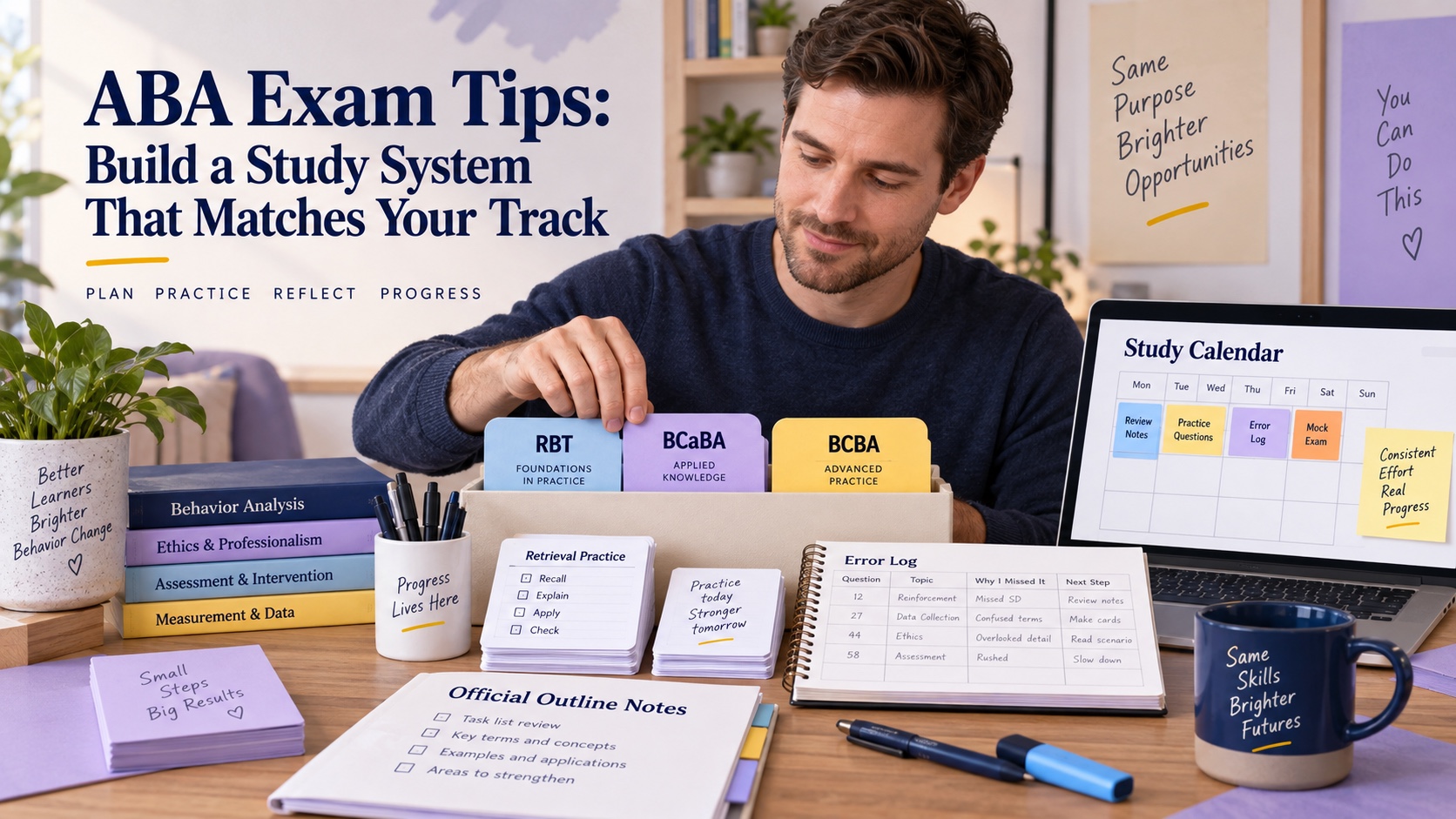
ABA Exam Tips: Build a Study System That Matches Your Track
The best ABA exam tips begin before you open a question bank: identify whether you are preparing for the RBT, BCaBA, or BCBA exam and read the current official outline for that track. Then use active recall, scenario practice, feedback, and spaced review to turn the outline into decisions you can explain. Reading the same chapter again can feel productive, but it does not show whether you can apply the concept.
This guide gives you a practical study system without promising a passing score or reproducing official exam questions. Requirements, outline editions, exam structures, and authorization instructions can change, so use the current BACB handbook and examination pages for the rules that apply to you.
Table of Contents
Start with the correct track
RBT, BCaBA, and BCBA exams share behavior-analytic vocabulary, but they do not have identical task maps, role boundaries, or exam depth. The current BACB outline index identifies the applicable outline for each track. A strong study plan names the credential at the top of every page and removes material that belongs to a different exam.
Eight study tips
- Make an outline map. Copy the domains or task headings from the official outline into a checklist. Mark what is new, familiar, or uncertain.
- Retrieve before rereading. Close the book and define the term, list the steps, or draw the relationship from memory before checking your notes.
- Practice discrimination. Study pairs that are easy to confuse, such as positive versus negative reinforcement, frequency versus rate, or a behavior definition versus an interpretation.
- Use scenarios. Ask what happened before, what is observable, what data are available, what decision is being made, and what action fits the role.
- Keep an error log. Record the task, your answer, the distractor that attracted you, and the reason the better answer fits the evidence.
- Space the review. Revisit a difficult task after a delay and test it in a new context instead of completing ten nearly identical questions in one sitting.
- Include ethics and scope. Practice confidentiality, consent, documentation, supervision, cultural responsiveness, and role boundaries as decisions rather than slogans.
- Plan the logistics. Check your authorization, appointment, identification, testing-center instructions, and current handbook before exam day.
The point of the list is not to create eight more things to worry about. It is to connect each study action to a decision. Retrieval shows what you can produce without notes. Discrimination shows whether you can tell similar terms apart. Scenarios show whether you can use the idea when the setting changes. An error log shows what to practice next, and spaced review shows whether the improvement lasts.
Keep your practice questions in three groups: learning questions that introduce a task, application questions that change the context, and check questions that test whether you can solve the task after a delay. A learner who only completes the first group may recognize familiar wording without understanding the underlying decision. Rotate the groups so your study plan measures transfer, not just recognition.
A useful weekly rhythm is simple. On the first day, map one domain and explain its key distinctions. On the next study day, answer short scenarios and correct the error log. Later in the week, mix that domain with another one so you must choose the relevant principle instead of following a predictable chapter order. At the end of the week, take a short closed-book check and schedule the items that still feel slow or uncertain. Adjust the rhythm to your work, supervision, and available energy; consistency matters more than an impressive plan you cannot repeat.
For technical topics, write the units and conditions before calculating or interpreting. For behavior-change procedures, identify the target behavior, consequence, motivating conditions, and measurement before choosing an answer. For ethics questions, notice who is affected, what information is missing, which role is responsible, and what documentation or consultation is required. These prompts keep your reasoning anchored to the scenario.
Finally, protect the quality of your feedback. Read the rationale, compare it with the current source, and rewrite the rule in your own words. If a question seems ambiguous, record the ambiguity instead of forcing a guess into your memory. Discuss persistent uncertainty with a qualified instructor or supervisor, especially when the issue involves scope, ethics, or a decision you would make in practice. That is part of studying responsibly today.
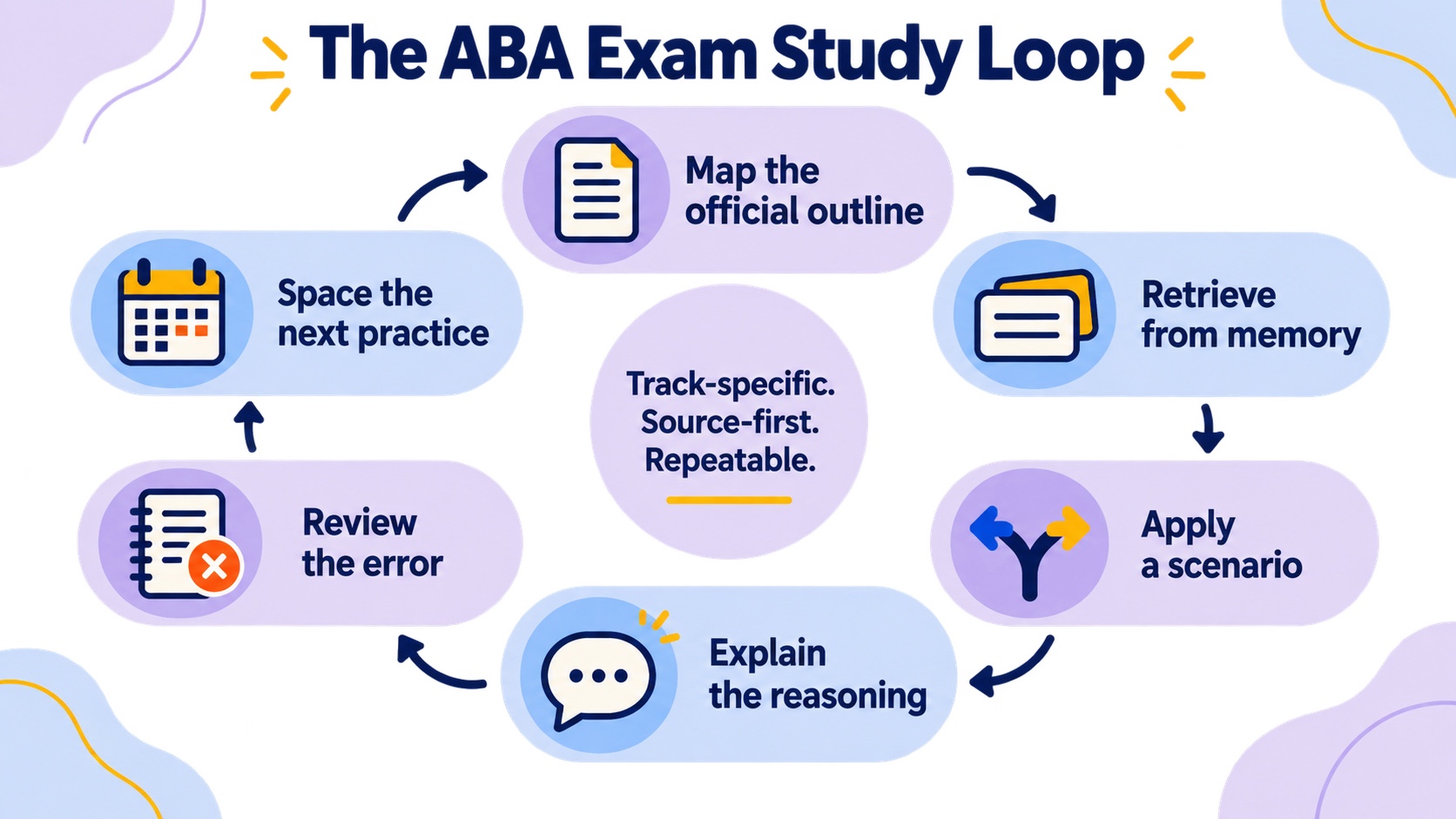
Use a repeatable review loop
Use one small unit at a time: choose a task, retrieve the definition or procedure, answer a new scenario, explain why the distractors are weaker, and schedule the next review. If you miss a question, do not only record the correct letter. Write the observable clue, the relevant distinction, and the rule or principle that supports the answer.
ABA Study Online practice questions can supply application prompts, while free resources can support concept review. Use them as study aids and compare the explanation with your current track outline. They are not official BACB questions, an authorization decision, or a pass guarantee.
Build a final-week plan
During the final week, reduce the number of new resources. Review your error log, rotate across domains, practice explaining high-confusion pairs, and complete a few timed blocks without turning every session into a panic test. Leave time for sleep, travel, identification, and appointment instructions. The last week should expose gaps and stabilize recall, not replace months of learning.
Make the last review block deliberately small. Choose one weak task, explain it aloud, answer one new scenario, and write the next action. If you cannot explain why an answer is better than its distractors, return to the official outline or training source. A calm correction is more useful than collecting another stack of unreviewed notes.
If your exam track has a current transition, such as the RBT 3rd-edition outline beginning in 2026 or the BCBA and BCaBA 2027 requirement changes, place the official source at the top of your plan. Do not let a publisher’s edition label or a social-media summary determine which content you study.
Common mistakes
- Using a BCBA study guide for an RBT or BCaBA exam.
- Rereading without closing the notes and retrieving the idea.
- Memorizing answers without explaining the observable evidence.
- Studying only the domains you like and ignoring ethics, measurement, or logistics.
- Trusting pass guarantees, leaked-question claims, or outdated outline versions.
FAQ and official sources
What is the best ABA exam tip?
Start with the correct current track outline, then practice retrieving and applying its tasks. A general tip is only useful when it maps to the exam and role you are actually pursuing.
Can exam tips guarantee that I will pass?
No. Study strategy can improve how you practice, but no article or product can guarantee an exam result.