ABA Exam Review: Choose the Right Track
“ABA exam” sounds like one test, but the current BACB system has three certification examinations: BCBA, BCaBA, and RBT. A useful ABA exam review therefore begins with a track decision. If you study from the wrong outline, a large question bank can create activity without moving you toward the examination you actually plan to take.
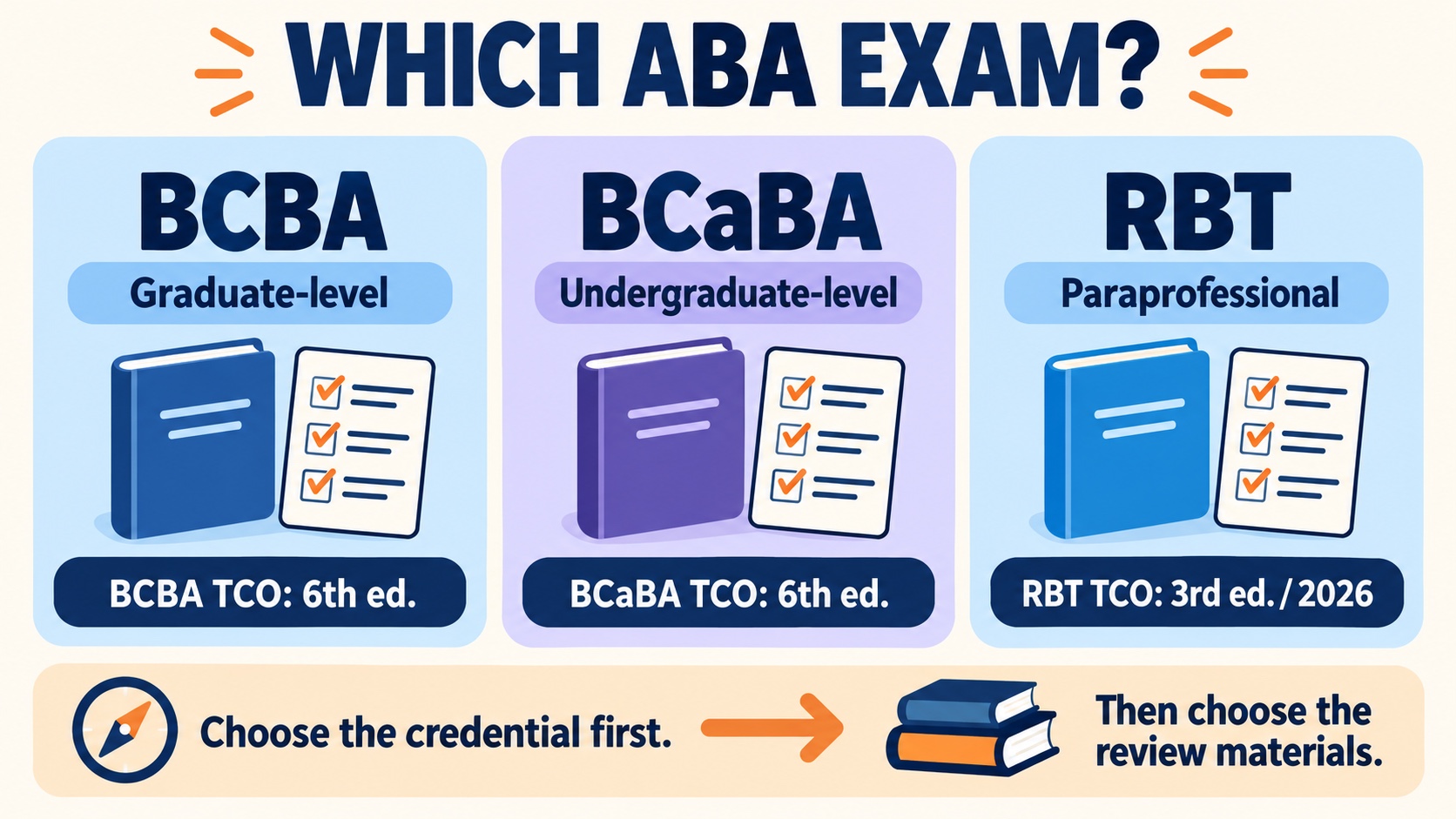
The current BACB examination information lists different time and question snapshots for each track, and the official content-outline page identifies separate editions: BCBA and BCaBA use the 6th-edition outlines, while the RBT Test Content Outline is the 3rd edition beginning January 1, 2026. This guide shows how to choose the right lane, review the current outline, use practice questions productively, and decide when a website mock exam or app review loop is the right next step.
Table of Contents
What “ABA exam” means
In everyday conversation, people use “ABA exam” as shorthand for a behavior-analysis certification exam. The BACB does not use that phrase as the name of one universal examination. It administers separate exams for three certification levels:
- BCBA: a graduate-level certification for professionals who may practice independently and provide supervision within the applicable requirements.
- BCaBA: an undergraduate-level certification for professionals who provide behavior-analytic services under BCBA supervision.
- RBT: a paraprofessional certification for technicians who practice under close, ongoing supervision.
That distinction changes the content map, the amount of scenario complexity, the application context, and the way you should interpret a practice result. A question about personnel supervision may be central to a BCBA review plan, while an RBT learner may need to focus on following a behavior plan, data collection, documentation, and ethics within the RBT role. A broad “ABA” label is not enough to decide what to study.
Choose the correct exam track
Before opening a review guide, answer three questions:
- Which credential are you pursuing? Write BCBA, BCaBA, or RBT at the top of the study plan.
- Which official outline applies to your exam? Use the current BACB outline and handbook, not a product’s generic “ABA” badge.
- What type of decision does the question require? Match the practice to your track’s role, scope, and expected level of responsibility.
If you are still deciding between credentials, review the eligibility requirements separately before buying preparation materials. A mock exam can show what you know; it cannot determine whether your degree, coursework, fieldwork, training, or application meets BACB eligibility requirements. The official BACB examination information page is a better starting point for the sequence than a commercial sales page.
Current exam format and outline editions
The current BACB examination-information snapshot gives a useful orientation:
| Track | Current outline | Time | Questions listed by BACB | Delivery |
|---|---|---|---|---|
| BCBA | BCBA TCO, 6th ed. | 4 hours | 185 | Computer-based, in person |
| BCaBA | BCaBA TCO, 6th ed. | 4 hours | 175 | Computer-based, in person |
| RBT | RBT TCO, 3rd ed., beginning Jan. 1, 2026 | 90 minutes | 85 | Computer-based, in person |
These are orientation facts, not a practice-score formula. The BACB explains that exams use multiple-choice questions with four answer choices and one correct answer, and that the passing decision is based on a criterion-referenced process. A third-party practice score is therefore a review signal, not an official result or a guaranteed prediction.
Use the current outline as a map of knowledge and skills. For BCBA learners, the 6th-edition outline organizes 104 tasks across nine domains, including philosophical foundations, concepts, measurement, experimental design, ethics, assessment, behavior change, interventions, and personnel supervision. The map helps you decide where to practice; it does not mean that each domain has its own published pass threshold.
What effective exam review is training
Review is not the same as rereading. A strong session trains at least five behaviors:
- Retrieval: recall a term, rule, procedure, or distinction without looking at the answer first.
- Discrimination: tell two plausible concepts apart when both appear in the same scenario.
- Application: connect the question’s facts to the relevant behavior-analytic decision.
- Explanation: say why the best answer fits and why the distractors do not.
- Transfer: revisit the idea later in a new context instead of recognizing the same wording.
For example, a measurement question is not solved by spotting the word “frequency.” Ask what the response looks like, whether every occurrence can be captured, what the observation window is, and what decision the data need to support. An ethics question is not solved by choosing the answer that sounds most polite. Identify the professional responsibility, the person affected, the scope boundary, and the action that follows the current code and supervision structure.
That way of reading makes a review page useful even when the exact practice item never appears on the examination. The aim is flexible reasoning, not memory for a sentence.
Use the same reading habit across several question families. For concepts and principles, define the terms in the scenario and identify the contingency or process being described. For measurement and assessment, ask what information is available, what the response definition permits, and what decision the data should support. For ethics and professional practice, identify the role boundary, the people affected, the relevant source, and the safest next action. This keeps “review” connected to the kind of decision the exam asks you to make rather than to a stack of isolated flashcards.
A four-step review loop
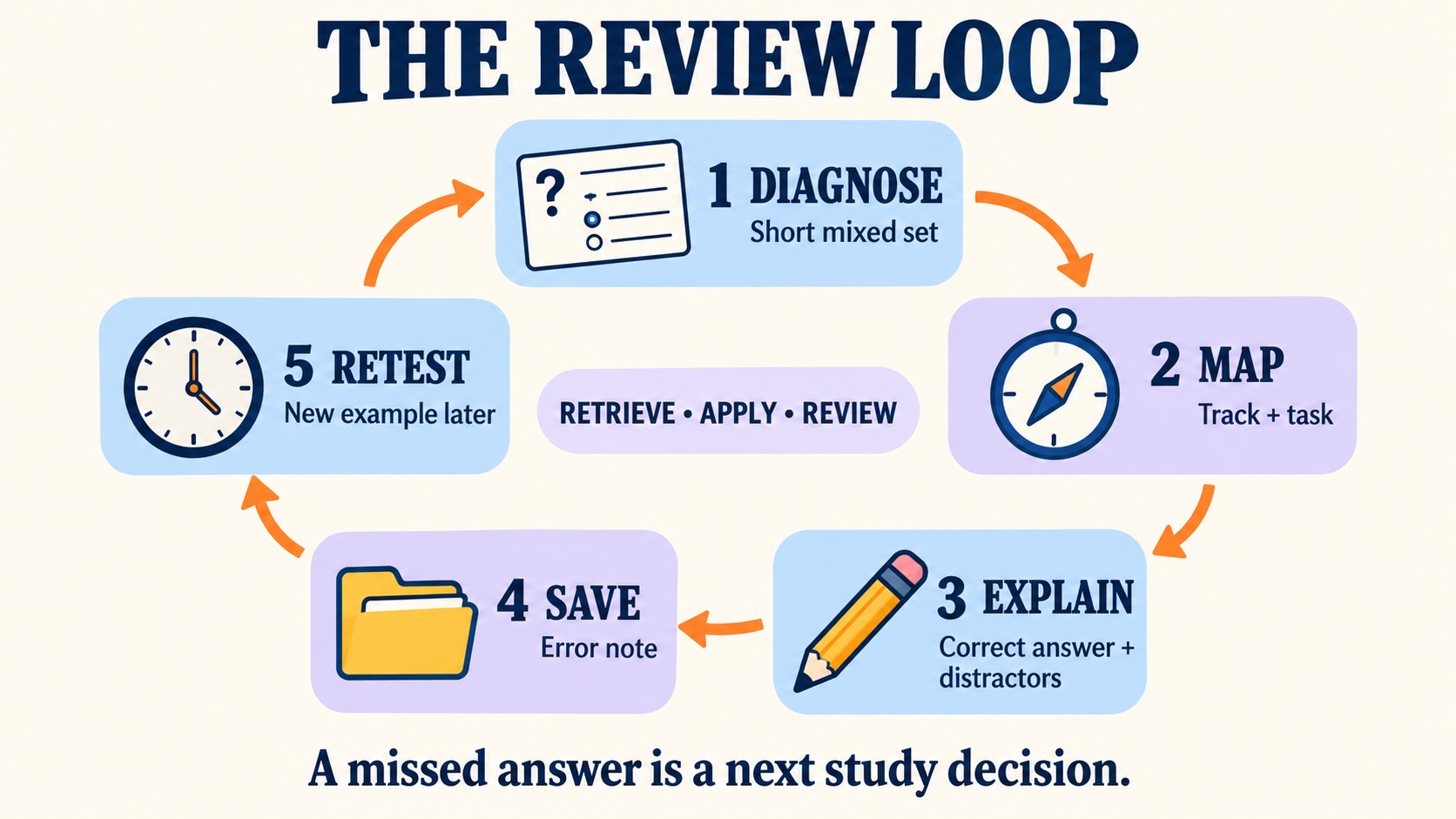
Use the same small loop after each practice set. Consistency makes it easier to see whether a low result came from a knowledge gap, a discrimination problem, or a process mistake.
- Diagnose before studying. Complete a short mixed set. Mark confidence before viewing the answer: sure, uncertain, or guess.
- Map the item. Record the track, domain or content area, and the task type. Do not just write “wrong.” Write what decision the item tested.
- Review the rationale actively. Explain the correct choice in your own words, then name the fact that makes each tempting distractor less suitable.
- Schedule a retest. Return after a delay with a new example. If the same distinction fails again, send it back to a theory block, glossary entry, or targeted question set before attempting another full mock.
Keep the error log small enough to use. A useful row might say: “BCaBA, measurement, chose duration when the scenario asked for count per opportunity; revisit response definition and measurement match.” That is more actionable than a long list of item numbers with no explanation.
Choose the right practice destination
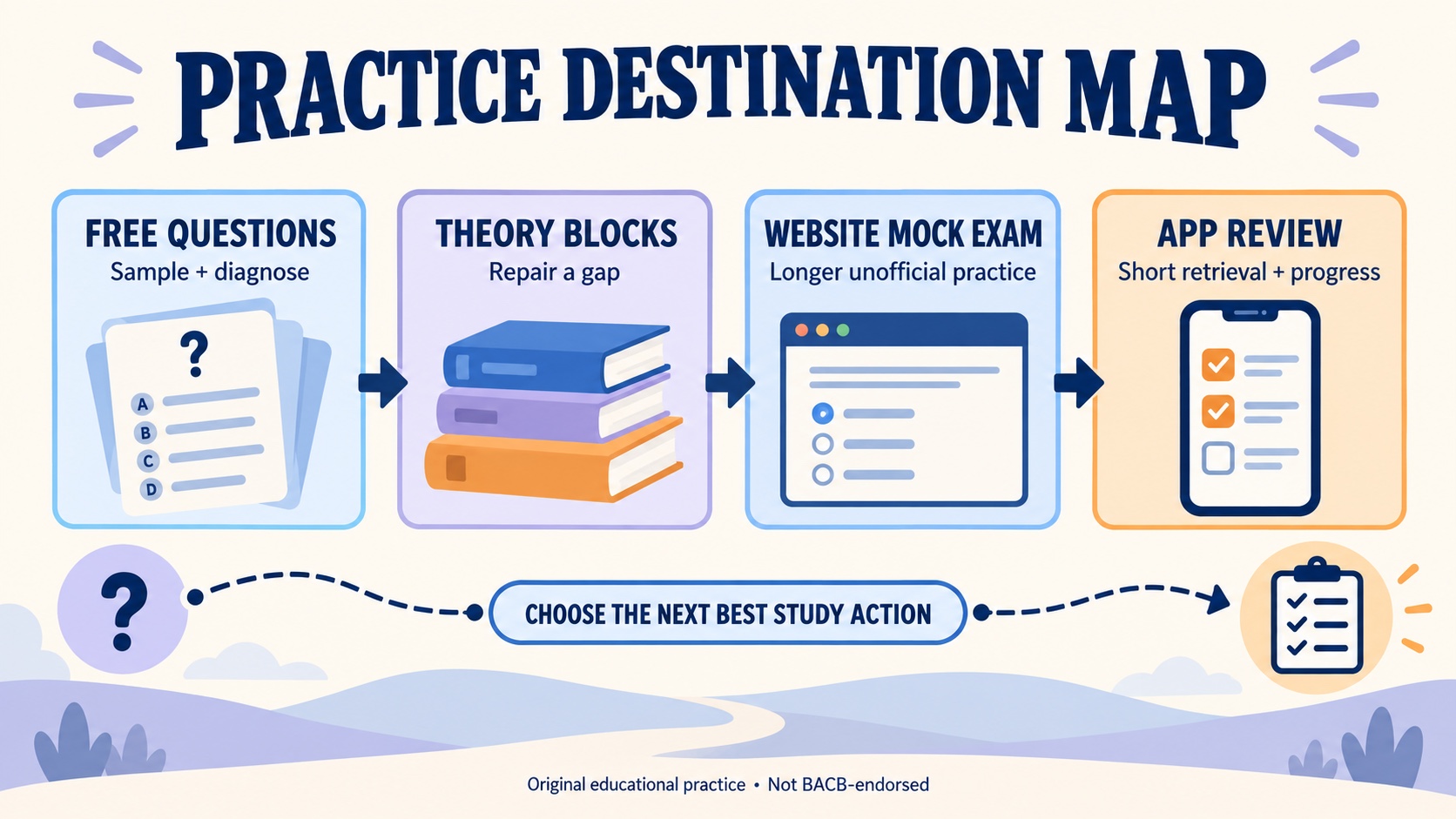
Different practice formats solve different problems. Choose the destination before you start so you do not judge every tool by the same standard.
- Free questions: useful for sampling wording, checking one concept, and finding the next gap without committing to a long session.
- Theory blocks and glossary: useful when the rationale exposes a missing definition, confusing distinction, or unclear rule.
- Website mock exam: useful for a longer mixed-domain or mixed-track simulation, pacing, flagging, and a more realistic review block. It should be clearly labeled as original and unofficial.
- App review: useful for short, repeatable sessions with flashcards, section practice, audio review, progress, and saved mistakes between longer practice blocks.
The sequence matters. If a diagnostic shows a weak concept, another full mock may simply reproduce the same error. Repair the concept, answer a few targeted questions, explain the distinction, and then return to mixed practice. A mock exam is a decision tool, not a substitute for learning the material.
A practical seven-day starter plan
This is a flexible review routine, not an official BACB schedule:
- Day 1 — Identify the track: save the current outline and write down the credential, examination date if known, and three study goals.
- Day 2 — Run a short diagnostic: answer a mixed set and label confidence before feedback.
- Day 3 — Repair one concept cluster: use a theory block or glossary entry, then answer targeted questions without looking at notes.
- Day 4 — Practice application: work through scenarios and explain the evidence that controls the answer.
- Day 5 — Review errors: revisit distractors, scope boundaries, measurement choices, or ethical steps that caused confusion.
- Day 6 — Take a timed set: practice pacing, flagging, and returning to uncertain items; do not interpret the result as a pass prediction.
- Day 7 — Plan the next loop: choose the two recurring errors, schedule the retest, and decide whether a longer website mock is useful now.
Common review mistakes
Studying a generic “ABA” bank
A mixed bank can be useful for orientation, but your main practice should identify the credential and current outline. Otherwise you may spend time on the wrong role or difficulty level.
Using an old edition without checking the boundary
Task-list language and examination outlines change. The current BACB page lists the BCBA and BCaBA 6th-edition outlines and the RBT 3rd-edition outline beginning in 2026. Save the official source and check it again when you schedule.
Chasing one mock score
One score is a snapshot of one set of questions. It may reveal a pattern, but it cannot establish an official readiness decision. Look for repeated performance across new examples and for better explanations in your error log.
Watching review videos passively
Video can introduce a topic, but pause to retrieve, predict, explain, and apply. If you never make a decision before the answer appears, you are mostly practicing recognition.
Treating a commercial product as official
Third-party questions, mock exams, apps, and review videos can be useful without being BACB materials. Keep the source label visible and do not use a product’s score, badge, or marketing language as an official claim.
Where to practice next
Once you know your track, start with a small, free action: choose the matching ABA practice questions, visit the relevant theory blocks, or search the ABA glossary when a rationale exposes a vocabulary gap. If your goal is a longer simulation, use the website’s clearly labeled free mock-exam preview before deciding whether a full mock is the right next step.
Ready for a longer practice block?
ABA Study Online keeps the full mock-exam experience on the website, where you can work through a longer original practice set and review the result. Then use the ABA Study Online app for short flashcards, section practice, audio review, progress checks, and saved mistakes between mock sessions.
FAQ and official sources
What is the ABA exam?
“ABA exam” is a common shorthand for a BACB certification examination, but the BACB has separate BCBA, BCaBA, and RBT exams. Choose the credential before choosing review materials.
Which exam outline should I use?
Use the current outline that matches your credential: BCBA Test Content Outline (6th ed.), BCaBA Test Content Outline (6th ed.), or RBT Test Content Outline (3rd ed., beginning January 1, 2026). Recheck the official page when your authorization and appointment are current.
Are ABA Study Online questions official BACB questions?
No. ABA Study Online practice questions, explanations, and mock exams are original, unofficial educational materials. They are designed to support review and should not be represented as BACB-endorsed or reproduced examination content.
Can a mock exam tell me whether I will pass?
No. A mock can show how you performed on that set and help identify recurring errors. It cannot guarantee an examination result or replace the current BACB application and examination information.
Should I use the website or the app?
Use the website for discovery, free previews, theory pages, and longer mock-exam practice. Use the app for repeatable short review through flashcards, section practice, audio, progress, and tools. The two destinations can work together, but neither changes the official certification requirements.