ABA Exam Review 6th Edition: Which Track Uses It?
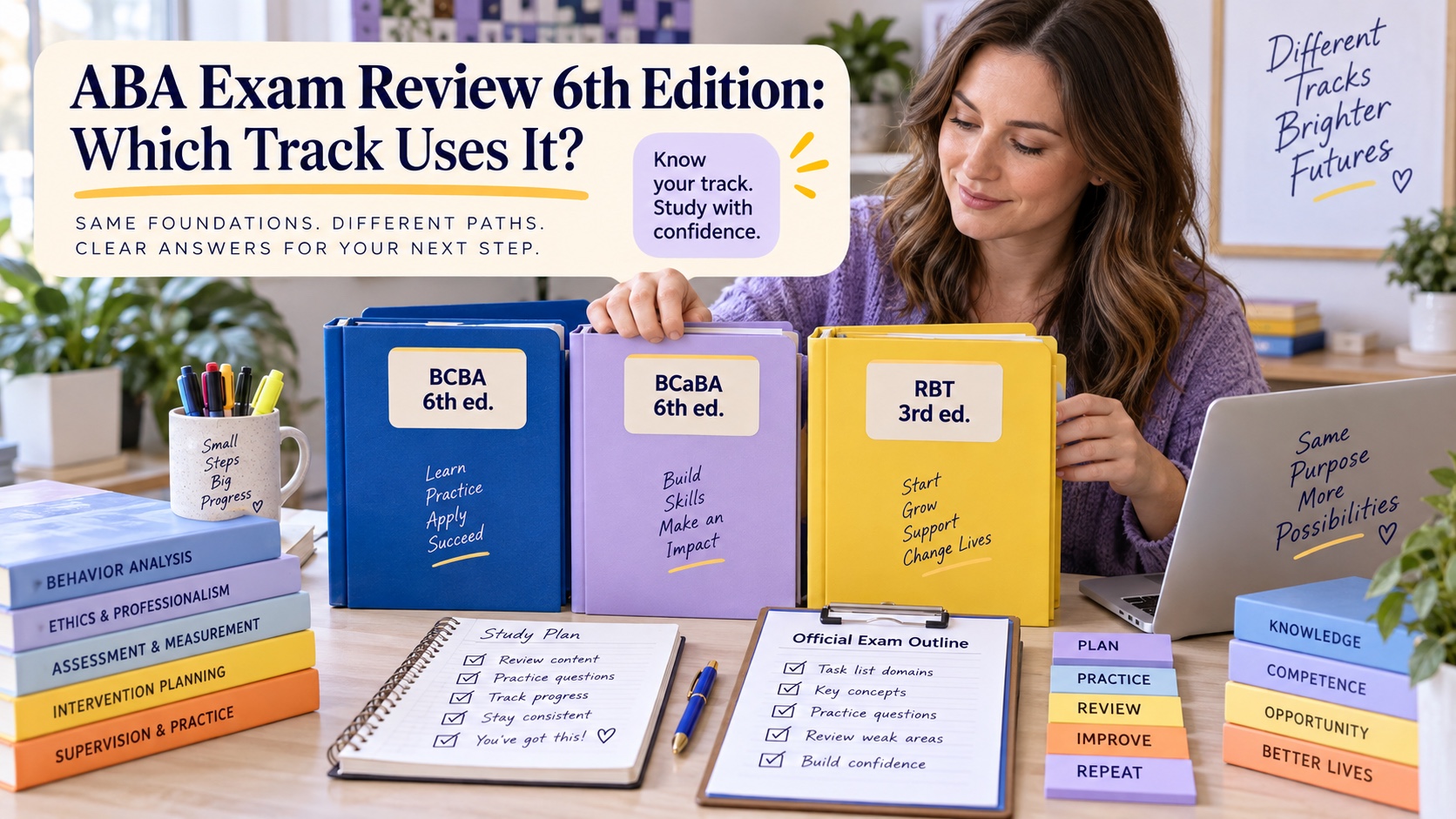
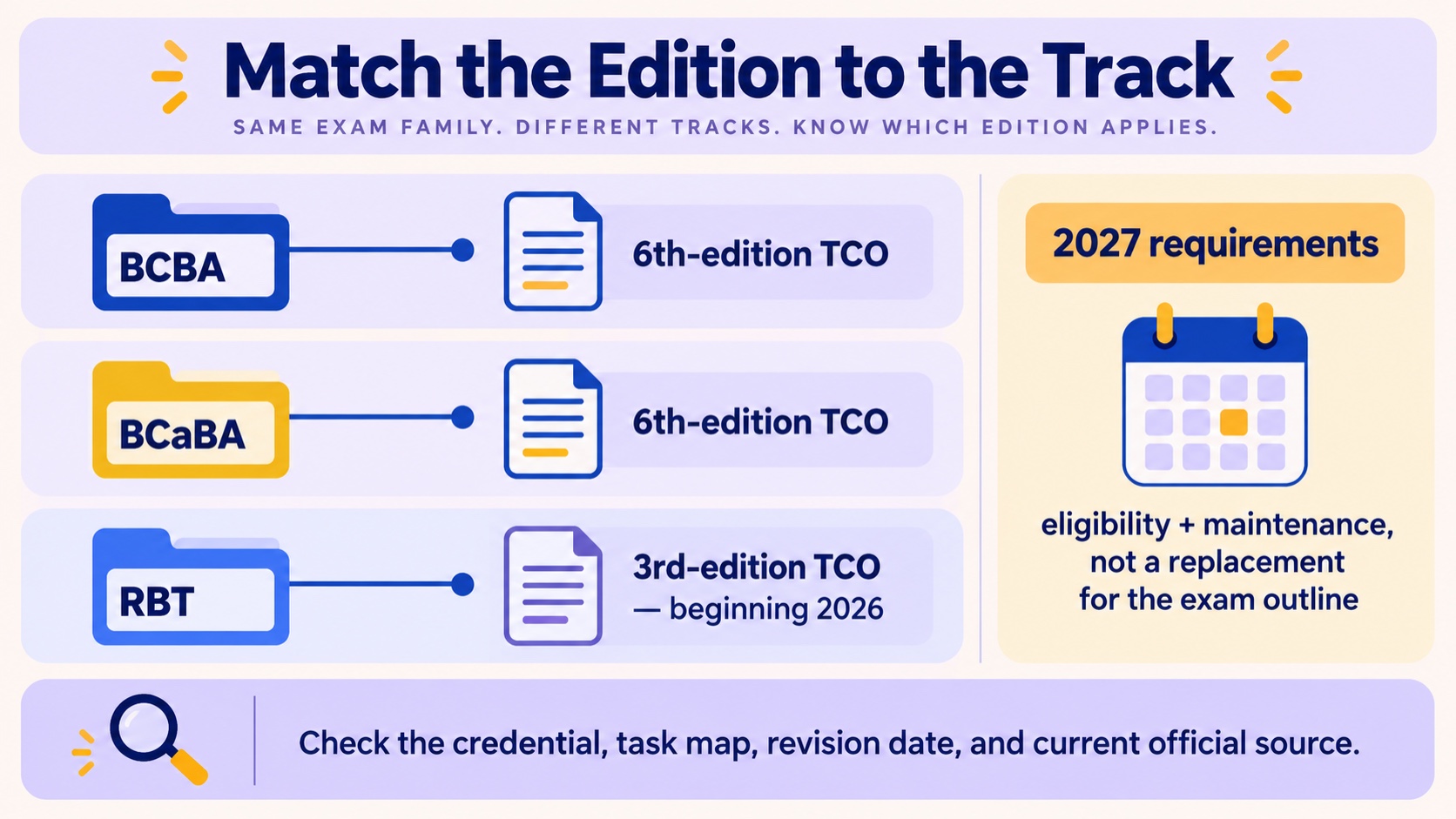
If you are searching for an ABA exam review 6th edition, first identify the certification track. The BCBA and BCaBA certification examinations use 6th-edition Test Content Outlines. The RBT examination is different: the BACB lists an RBT Test Content Outline (3rd ed.) beginning January 1, 2026. A review book with “6th edition” on its cover is therefore not automatically the right resource for every ABA exam.
There is a second source of confusion. The edition of an official exam content outline is not the same thing as the edition of a commercial study guide, and neither one is the same as the 2027 eligibility and maintenance requirements. This guide shows how to separate those labels before you build a study plan.
Table of Contents
The short answer by track
- BCBA: use the current BCBA Test Content Outline (6th ed.) as the official exam-content reference.
- BCaBA: use the current BCaBA Test Content Outline (6th ed.); it is a separate outline with different task emphasis and question distribution.
- RBT: use the RBT Test Content Outline (3rd ed.) for examination content beginning January 1, 2026, rather than a BCBA or BCaBA 6th-edition review.
The BACB outline page is the best starting point because it shows the current relationship between tracks. If a product page says only “ABA exam review 6th edition,” look for the named credential, outline link, publication date, and domain mapping before buying or studying.
What “6th edition” means
An official Test Content Outline describes the knowledge and skills represented on a certification exam. It is a blueprint and task map, not a question bank. The BCBA 6th-edition outline organizes 104 tasks into 9 domains and the BCaBA 6th-edition outline organizes 90 tasks into 9 domains. Those numbers help you understand scope, but they do not tell you that a third-party guide is endorsed or that every topic receives equal study time.
A commercial review guide may also call itself a “6th edition.” That label may describe the publisher’s revision history rather than the BACB document. Compare the guide’s references with the official outline. If its terminology, domain names, or task codes do not match, treat it as an older or supplemental resource until you verify the difference.
BCBA and BCaBA are not identical
Both the BCBA and BCaBA exams use 6th-edition outlines, but the certification roles and task maps differ. The BCBA outline includes domains such as personnel supervision and management at the behavior-analyst level. The BCaBA outline has its own domain wording and distribution. A combined resource can introduce shared concepts, but your study checklist should follow the outline for the credential you are pursuing.
The examination information page also lists different exam structures. Current BACB information describes the BCBA exam as 175 scored questions plus 10 unscored pilot questions, while the BCaBA exam has 150 scored questions plus 25 unscored pilot questions. These figures are useful for orientation, but your current handbook and authorization instructions control if anything changes.
How to check a review guide
- Find the credential. The cover and product page should say BCBA, BCaBA, or RBT—not only “ABA.”
- Match the official outline. Compare the domain names, task labels, edition, and effective date with the current BACB page.
- Check the revision date. A 6th-edition label without a publication or revision date is hard to evaluate.
- Separate explanation from official content. A helpful study guide is still a third-party aid; it is not an endorsed BACB publication.
- Look for boundaries. Avoid pass guarantees, leaked-question claims, and language suggesting that a purchase replaces training or the official outline.
Build a current study plan
Start with the official outline, then mark each task as new, familiar, or needing practice. Use a review guide to explain difficult concepts, but return to the outline to confirm coverage. Mix definition questions with scenario questions, data interpretation, ethics decisions, and explanations of why distractors are wrong. ABA Study Online practice questions can support that application loop, while free resources can give you another way to revisit terminology.
Give the largest study blocks to the domains that combine many tasks and require decisions, not only memorization. For a BCBA learner, that may mean rotating concepts and principles with measurement, assessment, intervention selection, ethics, and supervision. For a BCaBA learner, use the BCaBA task wording and role boundaries when you work through similar examples. The shared vocabulary is helpful, but the answer should still match the credential’s scope.
After each review block, close the guide and explain one task without looking. Then answer a fresh scenario that changes the setting, learner, or data display. If you can recognize a definition but cannot choose a defensible next step, mark that task for application practice. This turns an edition check into a useful study diagnosis rather than a purchase decision.
Keep a small source log with the official outline URL, the guide title and revision date, and the questions you still need to resolve. When a guide and the official outline disagree, the log helps you pause and investigate instead of memorizing two competing versions. It also makes future updates easier when BACB publishes a new outline or handbook.
Do not let a familiar cover create false confidence. A current guide should help you define, discriminate, interpret, and apply the tasks. It should also tell you what it cannot provide: official questions, a pass guarantee, or a substitute for the training and professional judgment required by the certification path. Use the edition label as a starting clue, then verify the substance behind it before making any final study purchase.
One practical test is to write the official domain beside every study session. If the session has no matching domain or task, label it supplemental and decide whether it supports your goal. This simple habit keeps broad ABA reading useful without letting it quietly replace track-specific exam preparation.
Keep 2027 requirements in a separate planning note. The 2027 BCBA changes concern eligibility and maintenance rules, fieldwork, supervision, and continuing education; they should not be used as a substitute for the exam’s current content outline. If your authorization or application period overlaps a new outline, read the current handbook and BACB instructions instead of relying on an old review schedule.
Common mistakes
- Using a BCBA 6th-edition guide for the RBT exam.
- Assuming BCBA and BCaBA 6th-edition outlines have identical task depth.
- Confusing a publisher’s “6th edition” with the official BACB outline.
- Using 2027 requirements pages as if they were exam-content blueprints.
- Trusting pass guarantees or “real questions” claims without official evidence.
FAQ and official sources
Is the ABA exam 6th edition for RBT?
No. RBT exam content beginning January 1, 2026 is listed under the RBT Test Content Outline (3rd ed.). The 6th-edition outlines belong to the BCBA and BCaBA exams.
Does a 6th-edition review book guarantee the current exam?
No. Verify the credential, task map, revision date, and current BACB outline. A commercial guide is a study aid, not an endorsement or guarantee.