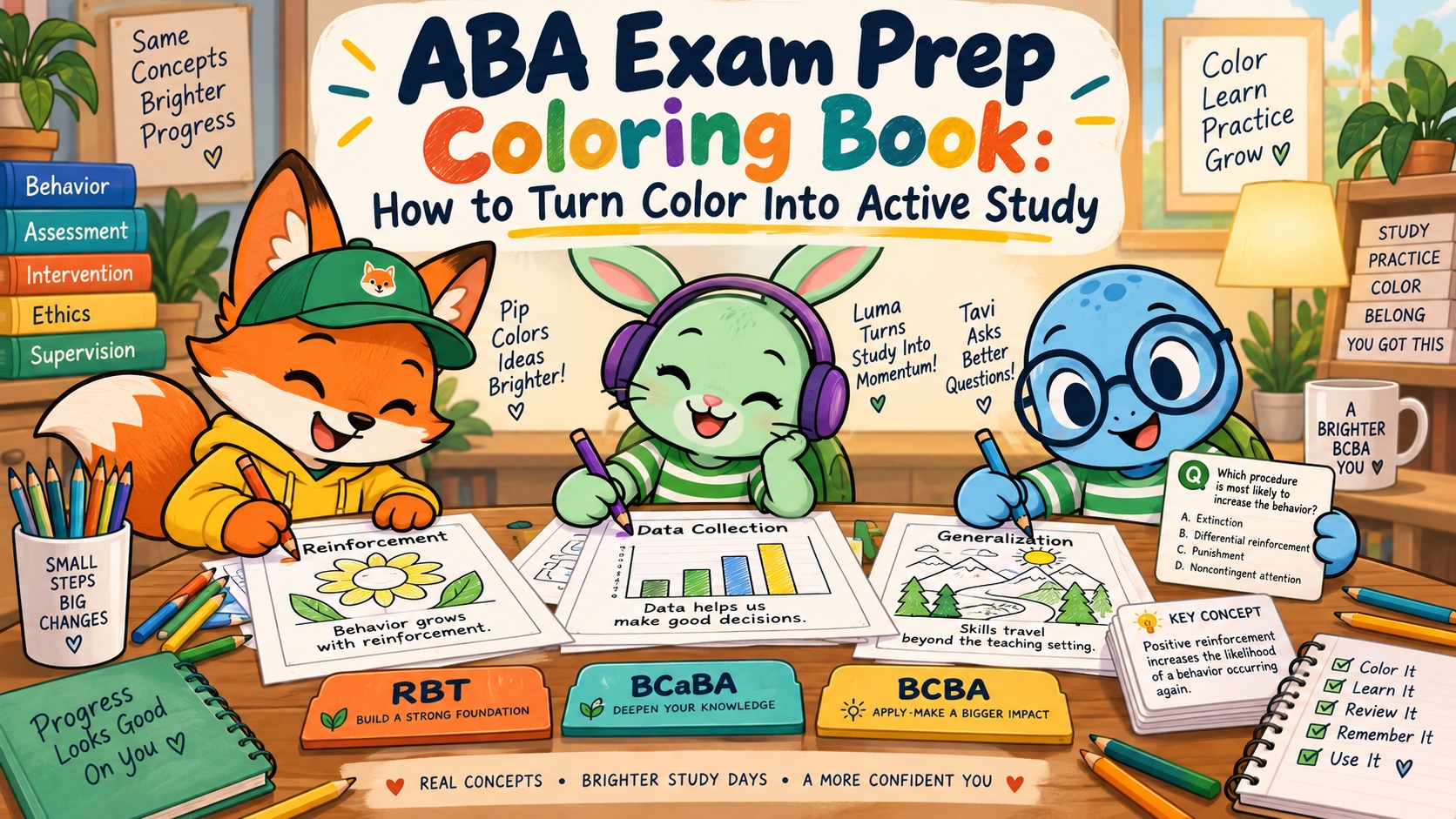
ABA Exam Prep Coloring Book: How to Turn Color Into Active Study
An ABA exam prep coloring book can make a long study session feel more approachable, but coloring alone is not exam preparation. The useful version is an active study tool: each page gives you a visual cue, a short definition, a distinction to explain, and a scenario to solve. The color helps you organize the information; retrieval and application show whether you understand it.
This guide explains how to design or use a coloring-based ABA study resource for RBT, BCaBA, or BCBA review. Because the exam tracks are different, start with the current track-specific BACB content outline. A coloring page should support that outline, not pretend to be an official exam document or guarantee a passing result.
Table of Contents
What a coloring book can and cannot do
Coloring can help you slow down, sort categories, mark relationships, and return to a topic later. It may be especially useful when a concept feels visually dense, such as the parts of an ABC observation, the steps in a prompting sequence, or the difference between measurement dimensions. It can also create a low-pressure first pass before you move into questions and explanations.
It cannot replace the current BACB outline, a training program, supervision, the competency assessment, active recall, or realistic scenario practice. A page that looks beautiful but never asks you to define, discriminate, calculate, interpret, or choose a next step is a craft activity—not enough exam preparation.
An effective ABA study page
Build each page around one teachable unit. A useful page includes:
- One title: name the concept in plain language.
- One visual structure: use a small flow, comparison, graph, or example scene.
- Three to five color roles: assign consistent colors to terms, examples, data, and boundaries.
- One “say it” prompt: explain the concept without reading the page.
- One scenario prompt: make a choice and explain why.
- One boundary: identify a common distractor, scope issue, or ethical caution.
For example, a measurement page might use navy for the behavior definition, teal for the recorded data, orange for the graph, and yellow for the interpretation question. The learner colors the page, closes it, defines the dimension, and then answers a short scenario about choosing a measurement system.
A good printable page also leaves room for the learner’s own words. Avoid filling every corner with tiny text. Give the learner a box for an example, a box for a nonexample, and a small “ask next” line. When a page is used in a study group, one person can explain the concept while another checks whether the example stays observable and within the correct professional role.
Keep RBT, BCaBA, and BCBA content separate
Use track labels on the cover and every page. An RBT page might focus on data collection, behavior acquisition, behavior reduction, documentation, and ethics. A BCaBA page may need more emphasis on supervised implementation, assessment, generalization, and supervision. A BCBA page can require deeper reasoning about measurement quality, assessment logic, intervention decisions, organizational practice, and ethics.
Do not merge all three tracks into one giant coloring book without clear tabs. Shared ABA vocabulary does not mean shared exam depth or identical responsibilities. The current official outline should determine what belongs in each section, while the coloring page remains a memory and discussion aid.
Parents, educators, and early learners can use simpler pages, but exam candidates need a source note and a reasoned answer. That distinction helps the same visual language serve different audiences without suggesting that a child-friendly illustration is an exam blueprint.
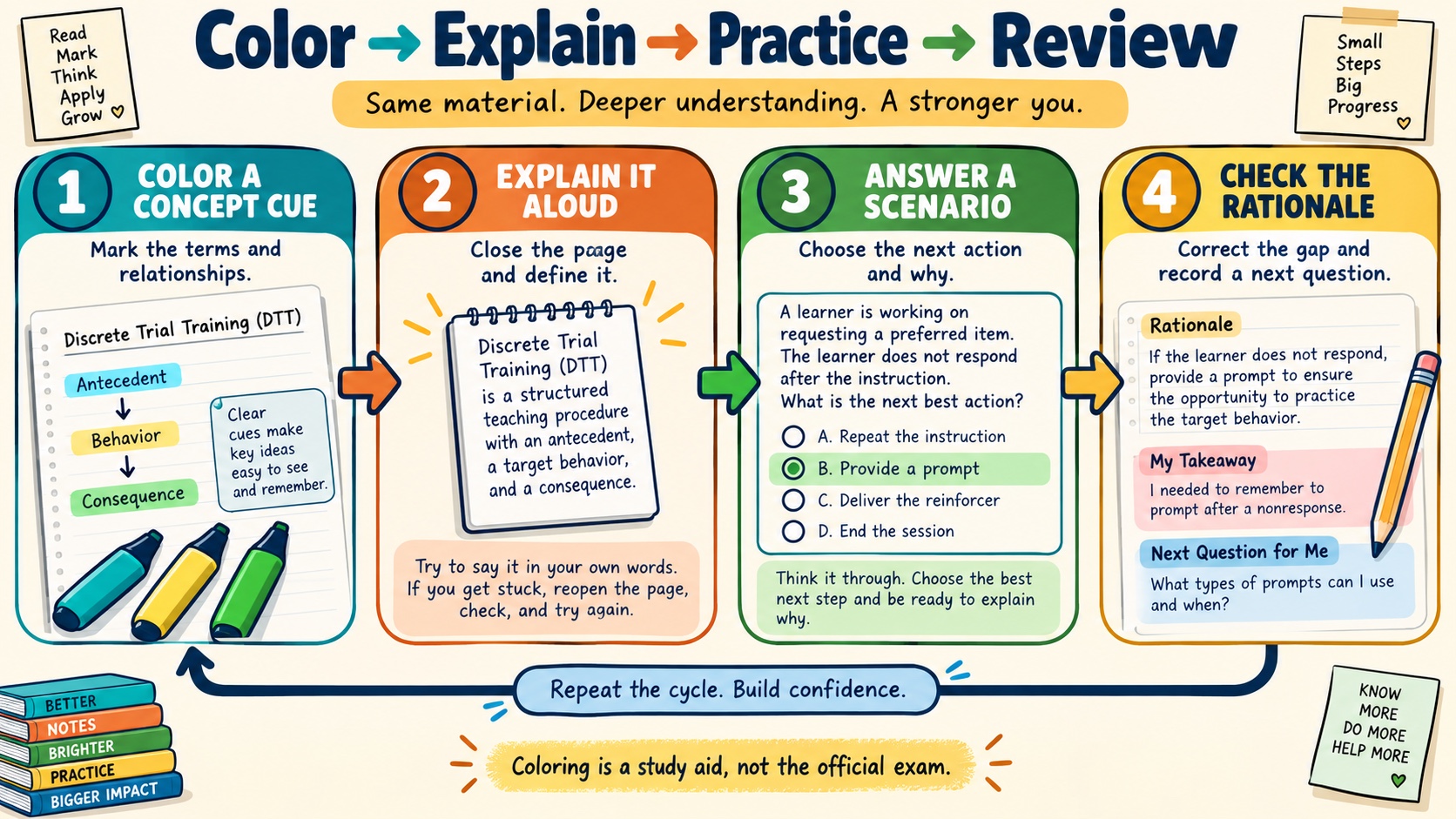
Use a color-to-application study loop
- Color a cue: mark the terms and relationships using the page’s color key.
- Explain it aloud: close the page and define the idea in your own words.
- Answer a scenario: choose what the learner, technician, assistant, or analyst should do next.
- Check the rationale: compare your answer with a source-supported explanation.
- Record the gap: write one question for your next study block or supervision conversation.
Keep the loop short. One page followed by one question is more useful than coloring ten pages without testing recall. ABA Study Online’s free practice questions can provide the application step, while the app can support repeated review. Neither a coloring page nor an app activity replaces the current official exam information.
Good topics for coloring-based review
- ABC observation: separate what happened before, the observable behavior, and what happened after.
- Measurement: compare frequency, duration, latency, interval measures, and rate with a clear example.
- Prompting and fading: show the direction of support and the plan for increasing independence.
- Reinforcement and preference: distinguish what follows behavior from what is simply liked.
- Skill acquisition: map task analysis, chaining, shaping, generalization, and maintenance.
- Ethics and documentation: mark dignity, confidentiality, scope, objective notes, and supervisor contact.
Choose topics from the learner’s missed questions, not only from the pages that are fun to decorate. The tool should make weak spots visible and create a reason to return to the source.
Review the page after a few days. Can you reconstruct the color key without looking? Can you explain why the nonexample is wrong? Can you answer a new scenario that uses the same distinction in a different setting? If not, revise the page or pair it with a stronger explanation rather than adding more decoration.
This delayed check matters because recognition is easier than recall. A familiar picture can feel understood while the underlying decision remains uncertain. Use the page to create retrieval, then use feedback to correct the explanation before the next review block.
Keep the final answer tied to evidence, scope, and the learner’s actual question, not only to the colors on the page.
That is what turns a printable coloring activity into a small, repeatable study routine that supports real recall.
When you choose a page set, match the level of detail to the learner’s next decision. A beginner may need a simple definition and one observable example. A candidate preparing for a more advanced track may need a comparison, a data display, a scenario, and a rationale that names the relevant boundary. That makes the coloring book flexible without making it vague. Keep the source and version date in the companion notes, then revise the page when the official outline or training expectations change.
Common mistakes
- Color without recall: add a closed-book explanation or question after every page.
- One page for every track: label the RBT, BCaBA, or BCBA depth clearly.
- Decorative definitions: include observable examples, boundaries, and decisions.
- Old exam language: compare terms with the current BACB outline before printing a large set.
- Promising a pass: a coloring book is a study aid, not an official exam product or guarantee.
FAQ and resources
Is a coloring book enough to prepare for an ABA exam?
No. Use it as a visual entry point, then add active recall, scenario practice, source review, and feedback.
Can the same coloring pages be used for RBT and BCBA study?
Some vocabulary can be shared, but the depth, responsibility, and official content outline differ. Use separate track tabs and explanations.