ABA Ethics Code: How to Apply It to Scenario Questions
Studying the ABA Ethics Code is not only a matter of memorizing standard numbers. Scenario questions ask you to notice what happened, identify who may be affected, separate facts from assumptions, and choose an action that protects clients and respects professional responsibility. The current BACB Code gives the standards; the learner still has to apply them to a particular context.
This page is an application guide, not a second overview of every section of the Code. A companion overview can explain the current scope, four core principles, and six responsibility sections. Here the focus is narrower: how to reason through a possible ethical concern without declaring a formal violation from a short hypothetical or treating a study checklist as legal advice.
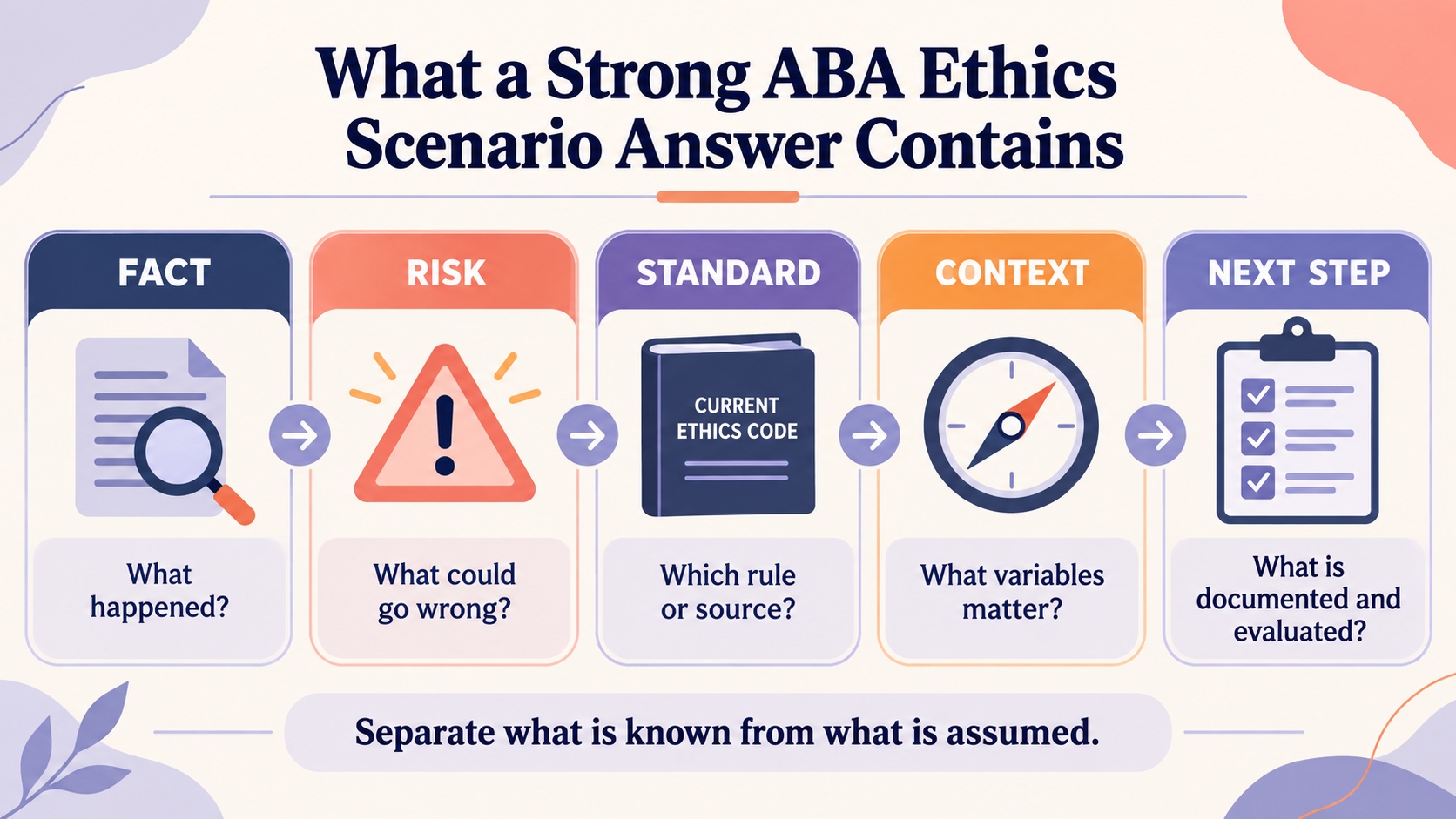
Quick answer: apply the ABA Ethics Code by defining the concern, identifying clients and stakeholders, locating relevant standards, considering risks and context, consulting people or sources with appropriate competence, documenting the reasoning and action, and evaluating the outcome. A strong answer does not simply name a rule. It explains why the rule matters and what information or safeguard is needed next.
The six-step ethics reasoning loop
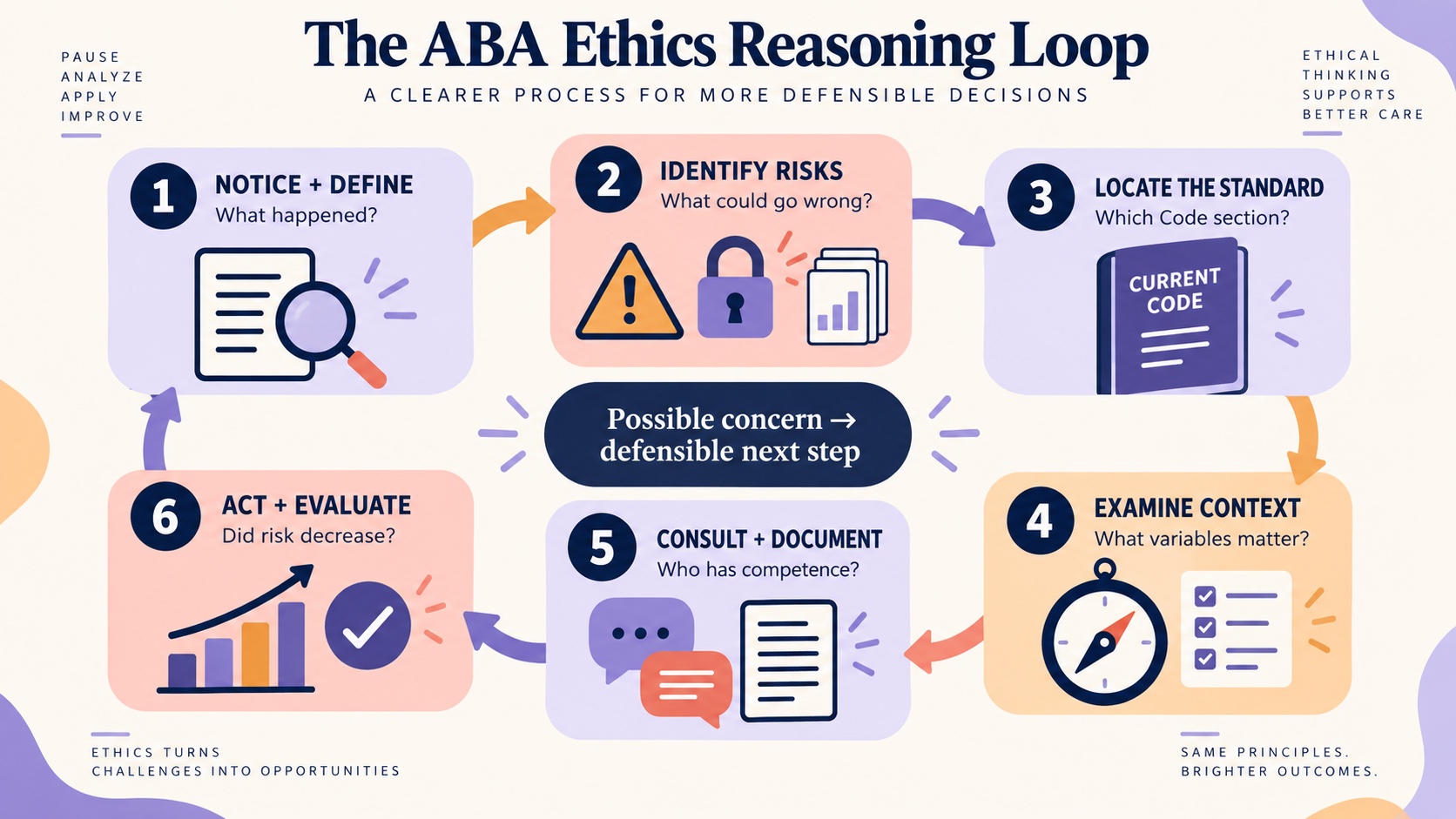
- Notice and define the concern. Describe the behavior, communication, or decision in observable terms. “A supervisor is unethical” is a conclusion. “A staff member was asked to post a service video on a personal account” is a fact pattern that can be examined.
- Identify people and risks. Ask who is the client, who are the stakeholders, whose privacy or welfare may be affected, and what harm could occur. Include risks to dignity, safety, confidentiality, autonomy, service quality, or the profession.
- Locate the relevant standard. Check the current Code rather than relying on memory or an old study sheet. More than one standard may be relevant. A digital-content question may involve confidentiality, informed consent, public statements, and client responsibility at the same time.
- Examine context and alternatives. Consider client preference, social acceptability, cultural and language variables, role boundaries, competence, law, licensure, organizational policy, and the restrictiveness or likely maintenance of possible actions. Ask what safer alternatives could meet the legitimate goal.
- Consult and document. A learner should not solve a complex real concern alone. Consult the responsible supervisor, organization, current official resources, or other qualified professionals as appropriate. Record the concern, information reviewed, people consulted, decision, safeguards, and due dates without exposing unnecessary confidential details.
- Act and evaluate. Take the action within the person’s role and competence, protect immediate safety and confidentiality, then evaluate whether the response reduced risk and supported the client. If the action did not solve the issue, the loop continues.
This loop is not a replacement for the Code’s exact wording or for local law. It is a study structure that makes hidden reasoning visible. It also prevents a common error: jumping from one alarming fact to a final label without checking what is known, what is missing, and who has responsibility to respond.
Scenario one: privacy and public content
A clinic asks a trainee to upload a short video from a service setting to a personal social-media account. The trainee is told that no name appears, so the video is probably fine. How should a learner approach the question?
Start with facts. What people, voices, materials, schedules, room details, or routines appear? Could someone in the community identify the client even without a name? Was informed consent obtained for this specific use and audience? Is assent relevant? What does organization policy say about recording, storage, and digital publication?
Next, identify the risk rather than announcing the verdict. The possible risks include loss of confidentiality, unwanted public exposure, reuse or copying, and pressure on a trainee who is not authorized to make the decision. The relevant Code standards may not be limited to one privacy sentence. Public statements, informed consent, client responsibility, role competence, and applicable law may all matter.
A defensible study answer would pause publication, protect the material, consult the responsible supervisor or policy owner, confirm the consent and audience conditions, and document the decision. It would not tell a student to investigate or publish a real client’s details. The learning target is the reasoning sequence: concrete facts, relevant risk, current source, consultation, safeguard, and evaluation.
Scenario two: role and competence
Imagine that an employee is asked to design a new intervention for a complex problem behavior because the usual supervisor is unavailable. The employee has seen similar procedures but has not been trained to design this intervention independently.
The first question is not whether the employee is motivated. It is whether the role, training, supervision, and decision authority are defined. The Code’s competence principle and practice standards matter, but so do immediate client risks, organizational procedures, scope of practice, and the availability of qualified consultation.
A strong scenario response would avoid pretending to be competent, communicate the limitation, seek qualified supervision or referral, protect service continuity, and document the concern and next step. If an interim action is needed for safety, it should remain within the person’s role and established plan. “Try something familiar” is not a substitute for assessment, training, and appropriate oversight.
This example also shows why “ask a supervisor” is sometimes incomplete. The learner should know what to bring to the consultation: the observable concern, the relevant facts, immediate risks, what has already been tried, the standard or policy consulted, and the decision that needs authorization.
How context changes the analysis
Client and stakeholder roles: identify who receives services and who is affected or invested in them. A parent, employer, funder, teacher, or supervisor may have an important role, but their request does not erase the client’s welfare, rights, or privacy.
Culture and communication: language, disability, culture, family values, and power differences can change how consent, assent, goals, and acceptable communication are understood. Cultural responsiveness is part of ethical analysis, not a decorative add-on after the technical answer.
Law and policy: the Code does not erase licensure requirements, privacy rules, mandated-reporting duties, research review requirements, contracts, or organization policy. The current facts determine which additional source must be checked.
Evidence and uncertainty: distinguish what is observed, what is reported, what is documented, and what is inferred. If the fact pattern is incomplete, say what information is needed. Ethical reasoning becomes weaker when a student fills gaps with a confident assumption.
What to document and evaluate
For a study answer, imagine a concise decision record with seven fields:
- the date, setting, and professional role;
- the observable concern and the people affected;
- the relevant Code standards and other sources checked;
- known risks, missing information, and contextual variables;
- consultation received and who has authority or competence;
- the action, safeguard, transition, or referral chosen; and
- the follow-up date and evidence used to evaluate whether the response helped.
Documentation should be accurate, secure, and limited to what is needed. It should not reproduce identifiable client information in a study forum or public post. In real practice, the required record and retention period depend on the setting and applicable rules.
Common errors and a practice routine
- Rule-number hunting without facts: define the scenario before selecting a standard.
- Declaring a violation too quickly: identify a possible concern and the evidence needed for a responsible decision.
- Ignoring role boundaries: a request, title, or good intention does not create competence.
- Forgetting stakeholders and culture: technical efficiency does not replace client-informed and culturally responsive analysis.
- Stopping after consultation: document the action and evaluate whether it reduced risk.
Practice with a three-column note: fact, possible risk or standard, and next defensible action. Then add a fourth line: “What would change my analysis?” Use the ABA Theory Blocks for ethics vocabulary, free ABA questions for scenario practice, and the ABA Definition Search when consent, confidentiality, competence, or multiple relationships need another pass. The ABA Study Online app can hold short retrieval practice, but current official sources remain the reference for Code wording and certification-related decisions.
ABA Ethics Code application FAQ
How do I apply the ABA Ethics Code to a scenario?
Define the facts, identify affected people and risks, locate relevant standards, consider context and alternatives, consult appropriate resources, document the decision, and evaluate the result.
Should I always choose the answer that says to report someone?
Not automatically. The correct next step depends on the facts, immediate safety, applicable Code standards, role, law, organizational procedure, and available consultation. Study the process, not a single reflex answer.
What if the scenario does not give enough information?
State what is known, identify the missing information, protect immediate safety and confidentiality, and explain which qualified person or current source should be consulted.
Is this an official BACB ethics decision?
No. It is a study framework. For a real concern, consult the current BACB Code, applicable law and licensure rules, organization policy, and qualified supervision or other appropriate authorities.
Sources
- BACB Ethics Codes
- Ethics Code for Behavior Analysts, Updated 08/2024
- BACB introduction to the Ethics Code for Behavior Analysts
- Teaching Behavior Analysts to Address Unethical Behavior: Developing Evidence-Based Ethics Instructional Methods
- Ethical Behavior Analysis: Evidence-Based Practice as a Framework for Ethical Decision Making
- Ignorance and Cultural Diversity: the Ethical Obligations of the Behavior Analyst