ABA Coursework for BCaBA: What to Check Before You Enroll
Searching for ABA coursework for BCaBA usually means you are trying to answer a practical question: which classes or program can help you meet the behavior-analytic coursework part of the BCaBA pathway? That question matters, but coursework is only one part of certification. A class list, certificate of completion, or “exam prep” label does not by itself establish that your degree, coursework evidence, fieldwork, application, and examination requirements are complete.
The safest way to compare programs is to separate the route from the resource. First identify whether you are considering Pathway 1 or Pathway 2. Then check the current BACB handbook and transition materials for the application date that applies to you. Finally, ask what evidence the institution can provide—not only what subjects appear in its brochure. This guide helps you organize that review without making an eligibility decision for you.
Table of Contents
The short answer: what BCaBA coursework must do
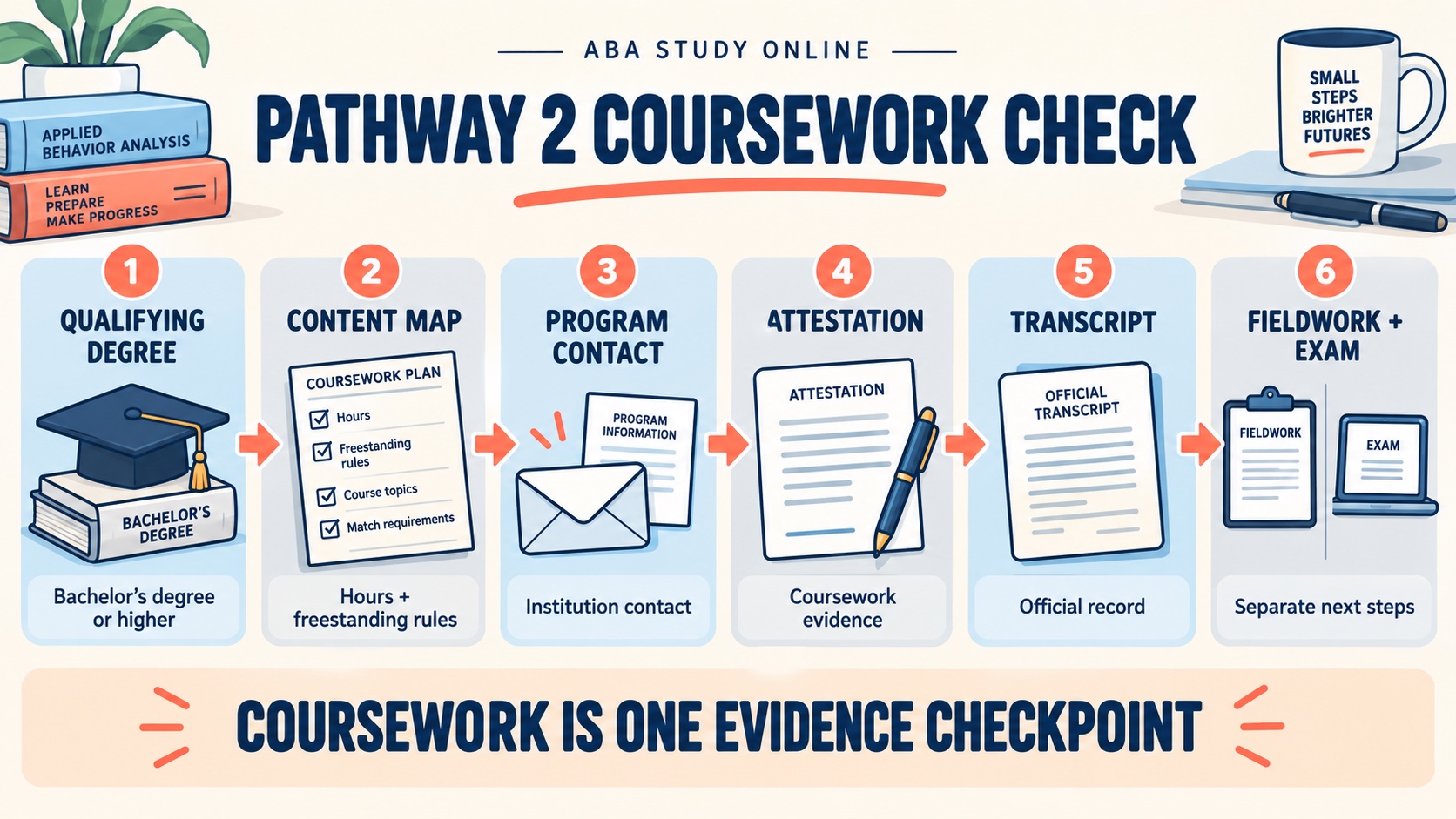
For a person using BCaBA Pathway 2, the coursework must meet the behavior-analytic content and instructional-hour requirements described by the BACB. The coursework is completed through an institution with a Pathway 2 Program Contact, and the application process uses evidence such as the institution’s coursework attestation and official transcripts. The current BCaBA Handbook controls the details.
That wording creates three useful questions for every program:
- Content: Do the courses cover the required behavior-analytic areas, rather than only general psychology or a broad helping-profession curriculum?
- Structure: Do the instructional hours and freestanding-course rules match the rule set that applies to your application?
- Evidence: Can the institution explain who submits the Pathway 2 coursework attestation and how your official transcript will document the completed work?
A program may be useful for learning and still require additional verification before you rely on it for an application. Conversely, a school may use a title such as “ABA certificate” even though the relevant question is the course content, institution, documentation, and applicable BACB pathway. Read the title as an invitation to investigate, not as the final answer.
Pathway 1 and Pathway 2 are different decisions
The BACB’s 2027 BCaBA materials continue to describe two eligibility pathways. Pathway 1 is the degree route: a bachelor’s degree or higher from an ABAI-accredited behavior-analysis degree program, followed by the other applicable requirements. Pathway 2 is the behavior-analytic coursework route: a bachelor’s degree or higher, the required coursework through the appropriate institution and contact, supervised fieldwork, and the rest of the application and examination process.
This distinction changes how you read a course page. If your degree program itself is the relevant accredited route, the program’s degree status is a central piece of evidence. If you are using Pathway 2, the course map and attestation process deserve close attention. A general ABA class taken somewhere else may be educationally valuable but still may not be the coursework evidence you need for the BCaBA application.
Do not choose a pathway based on which description sounds shorter. Choose it based on the degree and program evidence you actually have, the date you expect to submit a complete application, and the current handbook language. If your education crosses institutions or you are transferring credits, ask the program contact how the institution will evaluate and document the complete sequence before you enroll in scattered classes.
What to check in Pathway 2 coursework
1. The institution and Pathway 2 Program Contact
The contact is not a decorative line on a school website. The BACB’s university guidance describes a designated program contact who reviews the student’s coursework and, when appropriate, submits the coursework attestation. Starting in 2026, the attestation process is part of how Pathway 2 coursework is documented for an application. Ask the school who holds that role, how students request the attestation, and what happens if credits were earned at more than one institution.
2. The content areas and instructional hours
Compare the program’s course map with the BACB table, not only with a list of familiar words. A curriculum may mention assessment, ethics, or intervention without showing how its hours are allocated. Look for a written crosswalk that names the applicable content areas, the instructional hours, and any freestanding-course requirement. Save the version you reviewed because a course catalog can change between enrollment and application.
3. The transcript and attestation evidence
Ask how completed work will appear on an official transcript and how the institution records a course that is split into multiple parts. The school’s certificate can show that you completed its program, but the BACB application may require an official transcript and an attestation from the Pathway 2 Program Contact. These documents answer different questions. Keep copies of syllabi, course descriptions, and completion records in case the program tells you to retain them for your own records.
4. The boundary between coursework and fieldwork
A course can teach concepts and procedures; it does not automatically create supervised fieldwork hours. Ask the program whether fieldwork is included, separately arranged, or not offered. If it is included, ask which document explains the supervision arrangement and which handbook rules the program is using. Do not count a classroom assignment, observation exercise, or practicum label as qualifying fieldwork without checking the current handbook and your supervisor’s guidance.
5. The delivery format
Online, asynchronous, synchronous, and hybrid describe how instruction is delivered. They do not, by themselves, prove that the course sequence meets the current BCaBA requirements. Online can be a good fit when you need a repeatable schedule, but you still need the same content, hours, institutional evidence, and attestation path. A polished learning platform is not a substitute for a clear course map.
How the 2027 coursework transition changes the checklist
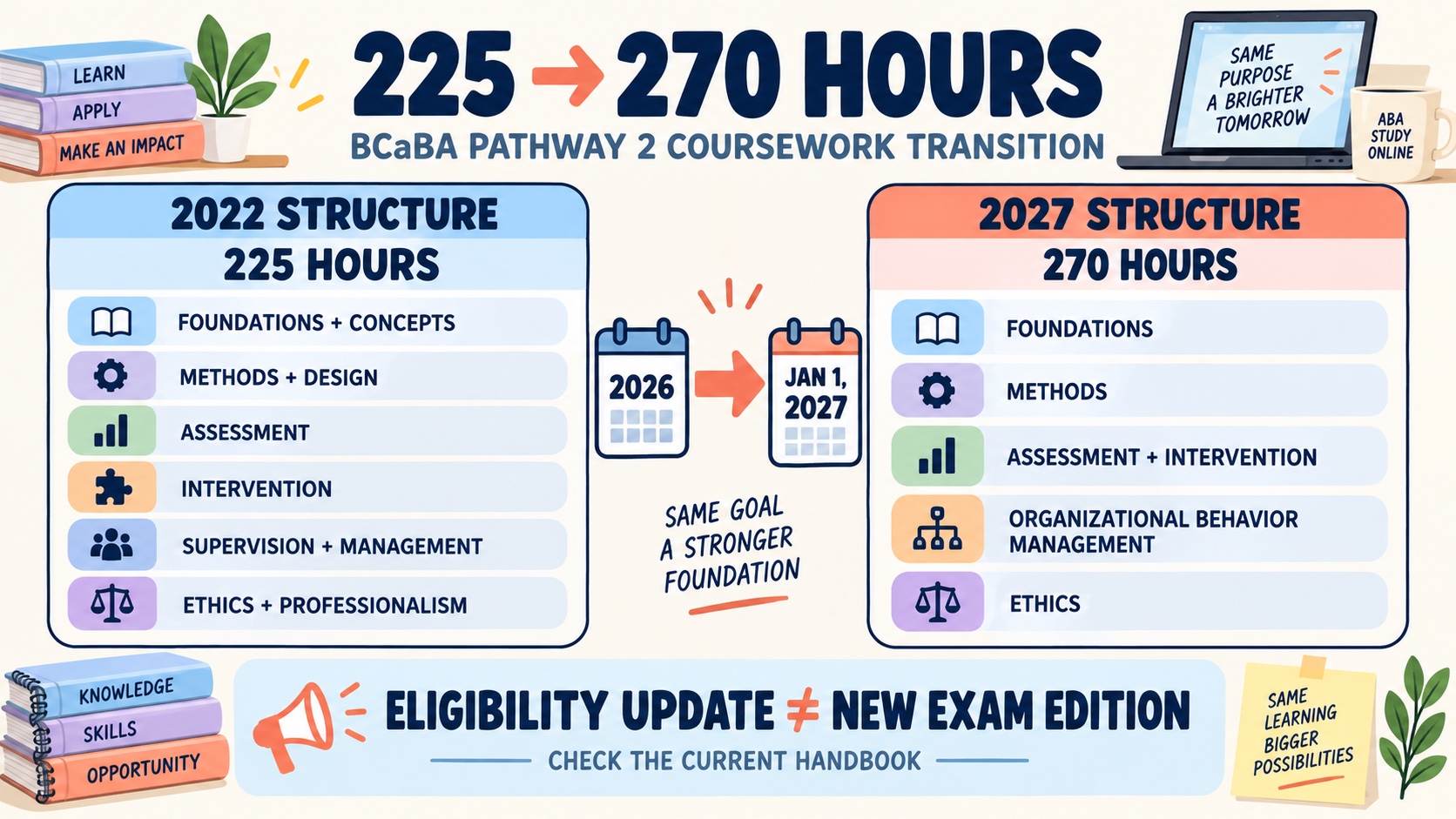
The BACB transition guidance compares the current 2022 Pathway 2 coursework structure with the requirements that take effect January 1, 2027. The current table totals 225 instructional hours. The 2027 table totals 270 instructional hours and reorganizes the content into new areas with more freestanding-course expectations.
At a high level, the 2027 table describes:
- Foundations of Behavior Analysis: 45 hours and one freestanding course.
- Methods of Behavior Analysis: 45 hours and one freestanding course.
- Behavior Assessment & Intervention: 90 hours and two freestanding courses.
- Organizational Behavior Management: 45 hours and one freestanding course.
- Ethics in Behavior Analysis: 45 hours, with at least 15 hours in a freestanding course.
The important planning point is not to memorize a single number without a date. If the BACB receives a complete application by December 31, 2026, the official transition materials say it may be reviewed under the current 2022 requirements, assuming the application is complete and the other rules are met. Beginning January 1, 2027, the updated requirements apply. Check the official source for your application timing rather than trying to fit your situation into a social-media summary.
Also keep the exam boundary clear. A 2027 eligibility and coursework update does not automatically mean that the BCaBA examination has become a “7th edition.” Coursework requirements, fieldwork rules, application evidence, and examination content are related but separate questions. Use the current BCaBA Handbook and examination resources for each one.
How to compare an online or certificate program
Once you know the pathway and date, compare programs with the same questions. This keeps the decision concrete and makes sales language easier to evaluate.
Ask for the course crosswalk
Request a document that maps every course to the applicable content area, instructional hours, and freestanding-course rule. If the answer is only “our program is designed for BCaBA students,” ask for the underlying map. A crosswalk does not guarantee that the BACB will approve your application, but it gives you something specific to review with the program contact.
Ask what the institution can attest
Ask who submits the attestation, when it is submitted, and what must be complete first. Confirm whether transfer credits or courses from another school can be included in the institution’s review. If the program cannot explain the evidence path, pause before paying for a large bundle of courses.
Separate education value from certification claims
A course can help you learn measurement, behavior assessment, intervention, ethics, or organizational behavior management even when it is not the exact course you need for certification. That learning value is real, but it is different from an eligibility claim. Look for clear wording about what the program provides, what it does not decide, and which current BACB source a student should read next.
Plan for the whole sequence
Coursework research should connect to a larger timeline: degree evidence, coursework evidence, supervised fieldwork, application documents, examination preparation, and the date you expect to apply. The timeline helps you see whether a program’s course calendar fits your transition window. It also prevents a common mistake—finishing classes and only then discovering that the fieldwork or attestation step needs a different contact or document.
What coursework does not prove
ABA coursework for BCaBA is not the same as BCaBA certification. Completing a course sequence does not itself prove that you have a qualifying degree, completed the required supervised fieldwork, submitted a complete application, received authorization, passed the examination, or met ongoing maintenance requirements. The BACB reviews the applicable evidence under its current rules.
It also does not turn an independent study guide or practice app into a university course. ABA Study Online can help you organize concepts, review terminology, work through original questions, and return to missed areas. It cannot issue a BACB coursework attestation, verify a degree, approve fieldwork, or guarantee a result. Keep those roles separate so your study tools support the application plan instead of confusing it.
A practical enrollment checklist
Before enrolling, save the page and ask these questions in writing:
- Which BCaBA pathway am I using?
- Which application date and rule set am I planning around?
- Does the course map show the required content areas, instructional hours, and freestanding courses?
- Does the institution have a Pathway 2 Program Contact for the route I am considering?
- How will the institution submit or document my coursework attestation?
- How will the completed courses appear on an official transcript?
- Are transfer credits, split courses, or older classes handled in writing?
- Which requirements remain separate from coursework, especially fieldwork and the examination?
- Does the program distinguish educational support from a certification decision?
- Where should I verify the answer if the program page and BACB handbook use different wording?
If a program answers these questions clearly, you have a better basis for a conversation with the program contact, supervisor, or advisor. If it avoids the evidence questions and focuses only on speed, price, or a broad promise of eligibility, treat that as a reason to investigate further.
Ready to turn coursework into practice?
Use the official BACB sources for eligibility and attestation decisions. For independent study between coursework sessions, continue with the ABA Study Online BCaBA learning path, try free BCaBA practice questions, or use the ABA Study Online app for short review and progress tracking. These study resources do not replace qualifying coursework, supervised fieldwork, an application decision, or the examination.
ABA coursework for BCaBA FAQ
Can I complete BCaBA coursework online?
Online delivery can be possible, but “online” is not the eligibility test. Check the institution, course map, instructional hours, freestanding-course rules, transcript evidence, and Pathway 2 attestation process against the current BACB materials.
Is an ABA certificate the same as BCaBA certification?
No. A school certificate usually documents completion of that school’s program. BCaBA certification is a separate BACB process involving the applicable degree, coursework, fieldwork, application, examination, and maintenance requirements.
Do I need 225 or 270 coursework hours?
The answer depends on the rule set and application timing. The BACB’s transition guidance compares 225 instructional hours under the 2022 coursework structure with 270 instructional hours under the 2027 structure. Review the complete application boundary and current handbook rather than choosing a number from an undated program page.
Does the 2027 change mean a new BCaBA exam edition?
Not automatically. The 2027 materials address eligibility, coursework, fieldwork, and maintenance. Check the current examination information and BCaBA Test Content Outline separately for exam-content questions.
Who can tell me whether my specific coursework qualifies?
The BACB’s official handbook and application process control the decision. Your institution’s Pathway 2 Program Contact can explain its coursework attestation process, and a qualified advisor or supervisor can help you organize questions. A blog, course advertisement, or study app should not make a personal eligibility determination.