ABA Competency Assessment: What It Measures and How It Differs From an Exam
An ABA competency assessment asks a practical question: can the learner perform a defined behavior under the conditions that matter? A written exam can show that someone recognizes a correct answer. A training certificate can show that someone completed instruction. A competency assessment adds performance evidence through observation, demonstration, or another defined evaluation method.
There is no single universal “ABA competency assessment” that applies identically to every role. Requirements depend on the credential, organization, supervisor, jurisdiction, and current official documents. The current RBT process provides a useful official example, but it should not be copied as a rule for BCBA or BCaBA certification, fieldwork, or employer onboarding.
Quick answer: an ABA competency assessment evaluates whether a person can perform specific, observable behavior-analytic tasks to a defined standard. It usually requires more than knowing a definition. The learner may need to demonstrate measurement, teaching, behavior-reduction, communication, or professional tasks while an authorized assessor observes the performance and documents the result.
Three ideas that are easy to confuse
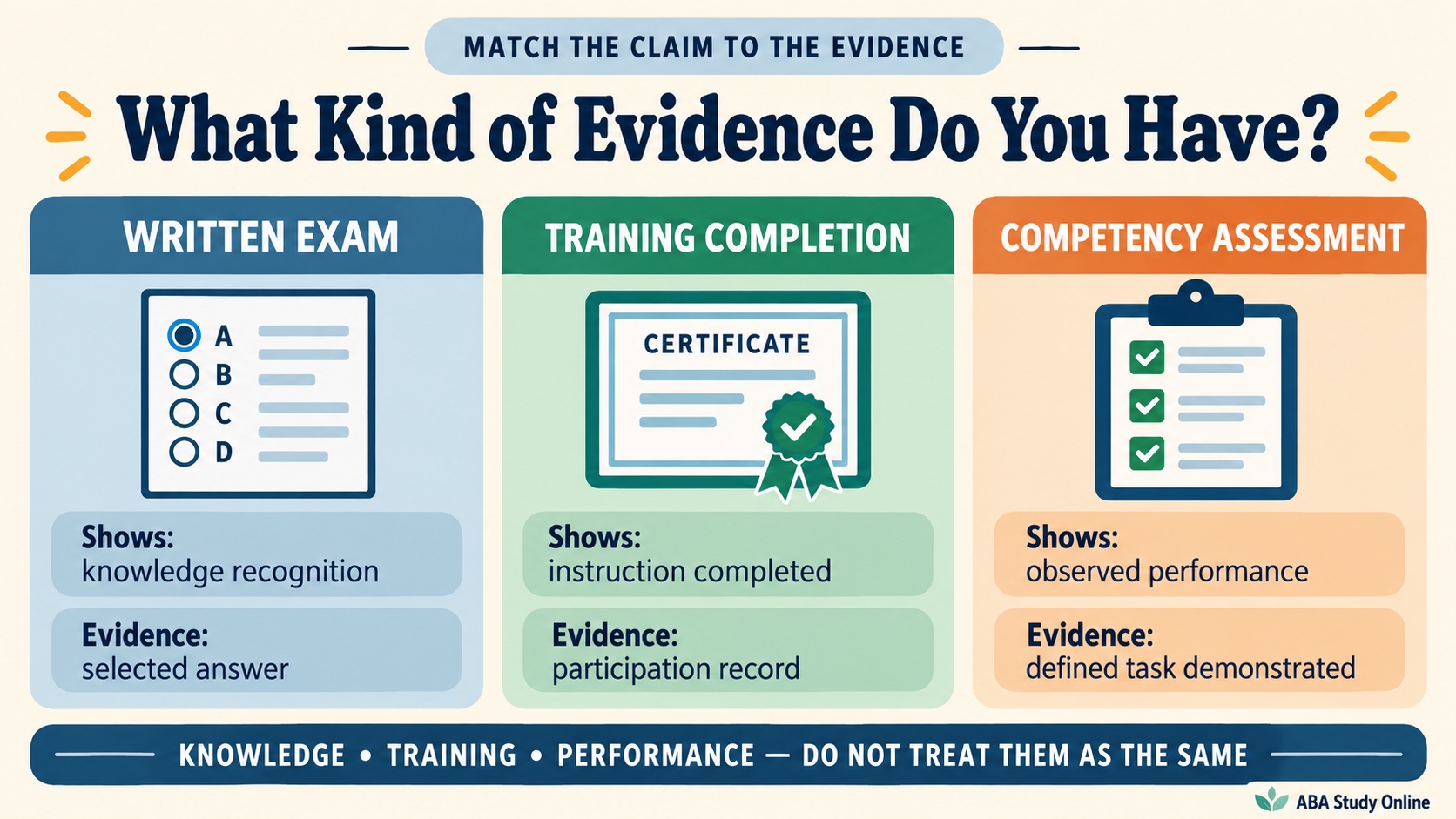
A written exam samples knowledge through questions. The current BACB certification exams are multiple-choice exams with four answer choices and one correct answer per question. Exam preparation helps a learner recognize principles and apply them to scenarios, but a correct answer is not the same as physically or verbally completing a task.
Training completion documents participation in a course or instructional sequence. Training may include lecture, video, modeling, practice, and feedback. Completion says that the learner finished the required training experience; it does not automatically prove that every skill is fluent, accurate, or performed under the conditions required by a separate assessment.
Competency assessment evaluates performance against defined criteria. The assessor needs a target that can be observed and a decision rule for what counts as competent. Depending on the role and official packet, a task may be demonstrated through observation, interview, role-play, or another permitted method. The current form and assessor instructions control.
This distinction is useful beyond certification. In a workplace, a supervisor might ask an employee to demonstrate how to record data, deliver an instruction, implement prompting, or respond to a procedural question. A learner can be knowledgeable and still need more practice before performance is reliable.
Competency evidence should also be interpreted in context. A learner may perform accurately with a clear cue, familiar materials, and immediate support, yet need another rehearsal when the setting changes. That does not make the first demonstration meaningless; it tells the trainer to define the conditions more carefully. Ask whether the task was demonstrated with the required materials, within the allowed time, using the expected communication and documentation steps. Clear conditions make the result more useful and reduce the temptation to treat a vague impression as a pass or fail decision.
The current RBT example
The BACB’s current RBT Initial Competency Assessment Packet is effective January 1, 2026. It is a role-specific assessment after the required RBT 40-hour training, not a general test for everyone who studies ABA. The current packet organizes 19 tasks into four sections: Measurement; Assessment; Skill Acquisition and Behavior Reduction; and Professionalism and Requirements.
The packet requires all 19 tasks. Three tasks from the Skill Acquisition and Behavior Reduction section must be demonstrated with a client, while other tasks may use the methods allowed in the packet, such as observation, role-play, or interview. The assessor and the current official packet determine what is permitted. A study article should help a reader understand the structure, not replace the form or the assessor.
The current RBT Handbook also places the assessment in a specific application window: after the required training and no more than 90 days before an RBT certification application. The completed assessment is part of the application materials. Anyone preparing for an application should verify the current handbook, packet version, assessor qualifications, and submission instructions directly with the BACB.
This example shows why the broad keyword needs careful wording. “ABA competency assessment” may refer to RBT requirements, an employer’s skills check, a supervised practice evaluation, or a training program’s performance rubric. The name alone does not tell you which standard applies.
The competency evidence loop
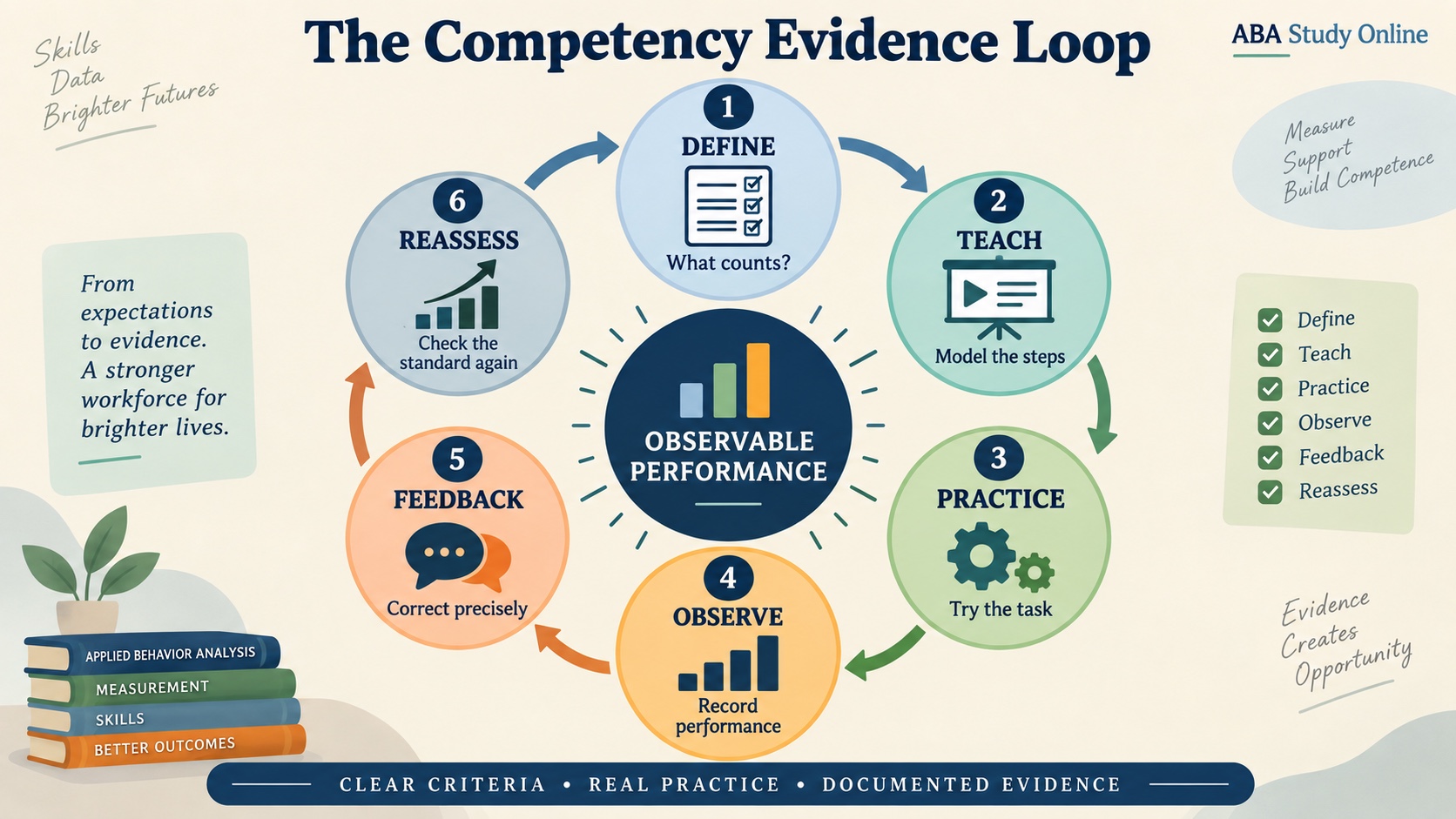
For study and supervision conversations, use this six-step loop:
- Define the task. State what the learner must do, under what conditions, and what counts as an accurate response.
- Teach the components. Explain the rationale, model the task, and identify the safety, dignity, data, or communication details that matter.
- Practice in a realistic format. Use role-play, rehearsal, examples, or the method allowed by the official requirements.
- Observe performance. Collect evidence of what the learner actually did rather than inferring competence from confidence or familiarity.
- Give usable feedback. Identify the specific step that was accurate, the step that needs correction, and the opportunity to try again.
- Reassess against the same standard. A new score should reflect a new demonstration under the defined criteria, not simply that the learner read the feedback.
The loop is a learning framework, not an official BACB procedure. A credentialing assessment may restrict feedback during the final determination, require a particular form, or specify who can assess. Follow the current official instructions whenever the assessment is tied to an application or credential.
An original study scenario
Imagine a learner studying event recording. On a written quiz, the learner correctly identifies the definition of frequency and selects the right formula. During practice, however, the learner misses some responses, records two events in one tally, and forgets to mark the observation period.
The quiz shows useful knowledge, but the practice observation reveals a performance gap. A competency-focused response would define the recording steps, model one example, rehearse with a short video or role-play, provide specific feedback, and observe another demonstration. The final question is not “did the learner sound confident?” It is “did the learner meet the stated performance criteria under the permitted conditions?”
This scenario also shows why competency is not the same as perfection in every situation. The standard must be explicit, relevant, and tied to the task. A learner should know whether the assessment evaluates accuracy, timing, procedural integrity, communication, safety, or several dimensions together.
How to prepare without memorizing a script
Start with the current official requirements for your role. Identify the exact task, demonstration method, assessor role, time window, and documentation. Do not rely on a screenshot, an old checklist, or a study page when a current packet or handbook is available.
Then practice in small observable units. For each task, write the cue, the response, the measurement or quality criterion, and one likely error. Rehearse until you can explain why the step matters, not only recite its order. Ask a qualified supervisor or trainer for feedback when the task affects real services, safety, confidentiality, or client dignity.
Use the ABA Theory Blocks for vocabulary, free ABA questions for scenario reasoning, and the ABA Definition Search for terms such as procedural integrity, prompting, measurement, and reinforcement. The ABA Study Online app can support flashcards, section practice, audio review, progress, and tools, but it cannot conduct or sign an official competency assessment.
Common competency-assessment mistakes
- Confusing recognition with performance: choosing the right answer does not automatically show that the task can be performed.
- Using an old checklist: official packets, forms, and windows can change; verify the current version.
- Practicing the script instead of the skill: memorized wording can break down when the setting or example changes.
- Skipping feedback: repeated incorrect practice can make the error fluent.
- Assuming one role’s requirements apply to another: RBT assessment rules are not BCBA or BCaBA certification requirements.
- Letting a study tool impersonate an assessor: a website or app can support preparation but cannot create official authorization.
ABA competency assessment FAQ
What is an ABA competency assessment?
It is an evaluation of whether a learner can perform defined behavior-analytic tasks to a stated standard. The exact tasks, methods, assessor, and documentation depend on the role and governing requirements.
Is a competency assessment the same as the BCBA or RBT exam?
No. A certification exam primarily samples knowledge through questions. A competency assessment evaluates demonstrated performance. A credential pathway may require both, but they are different evaluations.
What does the current RBT competency assessment cover?
The current RBT Initial Competency Assessment Packet, effective January 1, 2026, contains 19 required tasks across measurement, assessment, skill acquisition and behavior reduction, and professionalism and requirements. Verify the current packet before preparing an application.
Can ABA Study Online complete my competency assessment?
No. Study resources can help you review concepts and rehearse scenarios. An official assessment must follow the current role-specific requirements and be completed and signed by the authorized assessor or responsible professional.
Sources
- BACB Supervision, Assessment, Training, and Oversight
- BACB RBT Initial Competency Assessment Packet: Effective January 1, 2026
- BACB Registered Behavior Technician Handbook
- BACB Examination Information
- Glick (2026), The Effects of an Online Asynchronous Training on the Measurement Section of the RBT Competency Assessment