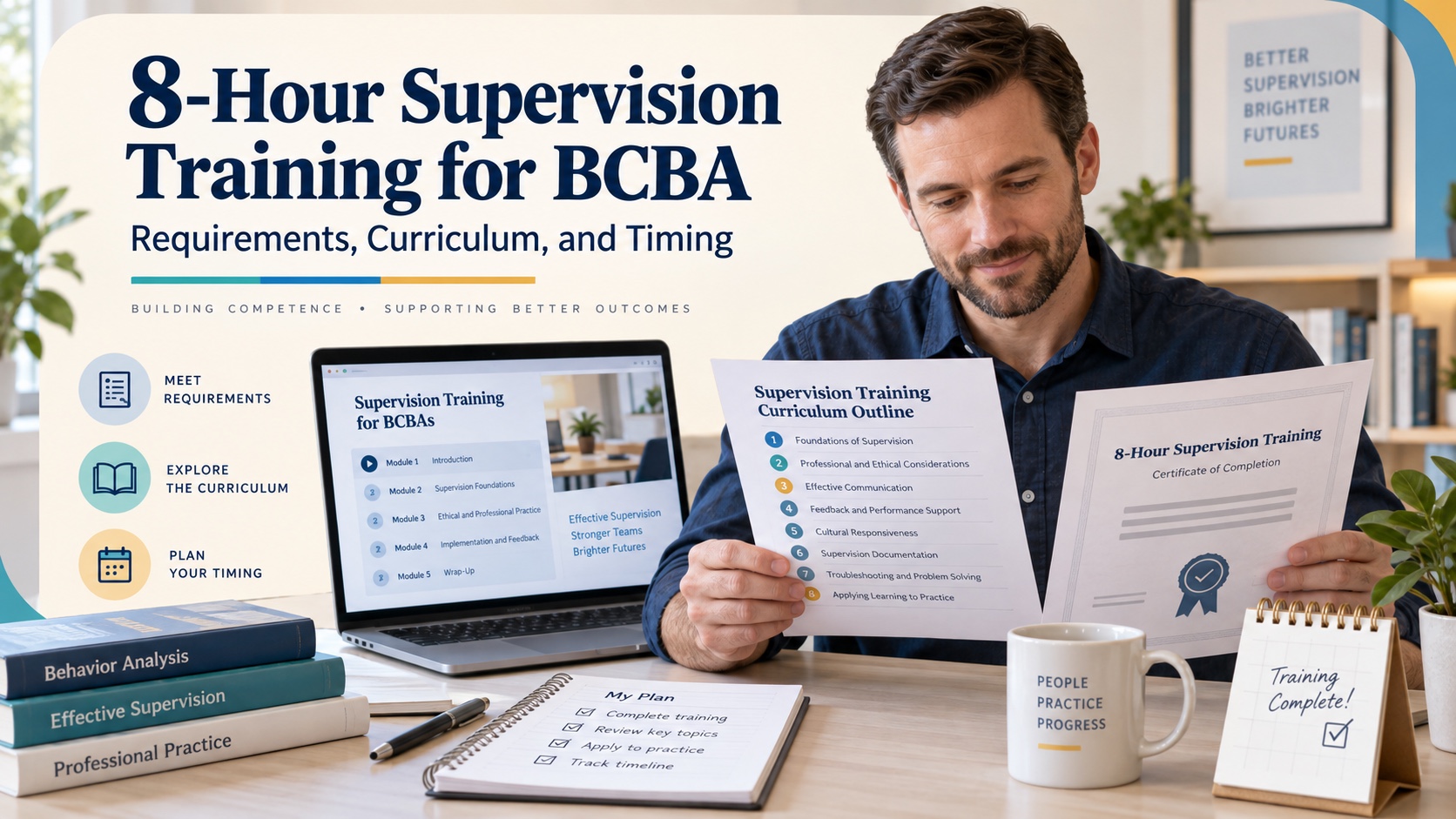
8-Hour Supervision Training for BCBA: Requirements, Curriculum, and Timing
If you searched for 8 hour supervision training BCBA, you may be trying to answer a practical question: can I begin supervising yet, and what evidence do I need first? The BACB requirement is easy to oversimplify. It is not a course title, a certificate that makes every supervision role automatic, or another name for supervision continuing education.
The current BACB supervision guidance says covered supervisors must complete 8-hour supervision training based on the Supervisor Training Curriculum Outline (2.0) before providing the applicable supervision. The relevant role, current handbook, provider status, completion record, and any state or workplace rules still matter. This guide separates those pieces so you can verify the arrangement before signing a contract or counting on a training certificate.
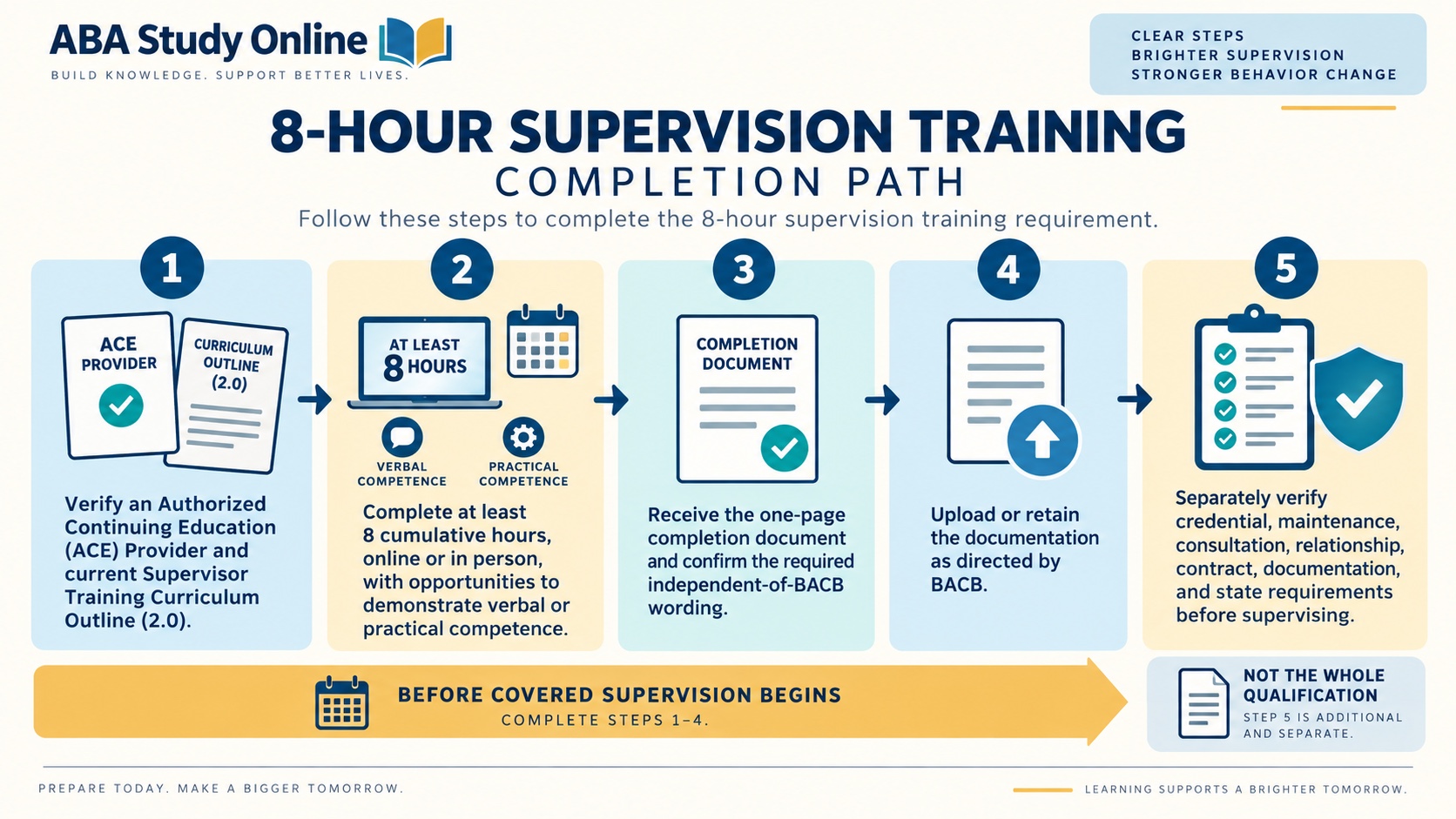
Quick answer: the BACB requires supervisors in covered roles to complete at least 8 cumulative hours of training based on the Supervisor Training Curriculum Outline (2.0) before providing that supervision. The current outline permits online or in-person delivery, may be divided into units as brief as one hour, requires opportunities to demonstrate verbal or practical competence, and says the training may be completed up to 180 days before the learner’s original BACB certification date. The completion document must be handled through the BACB process, and the training does not by itself prove that a person meets every supervisor qualification.
Who needs the training?
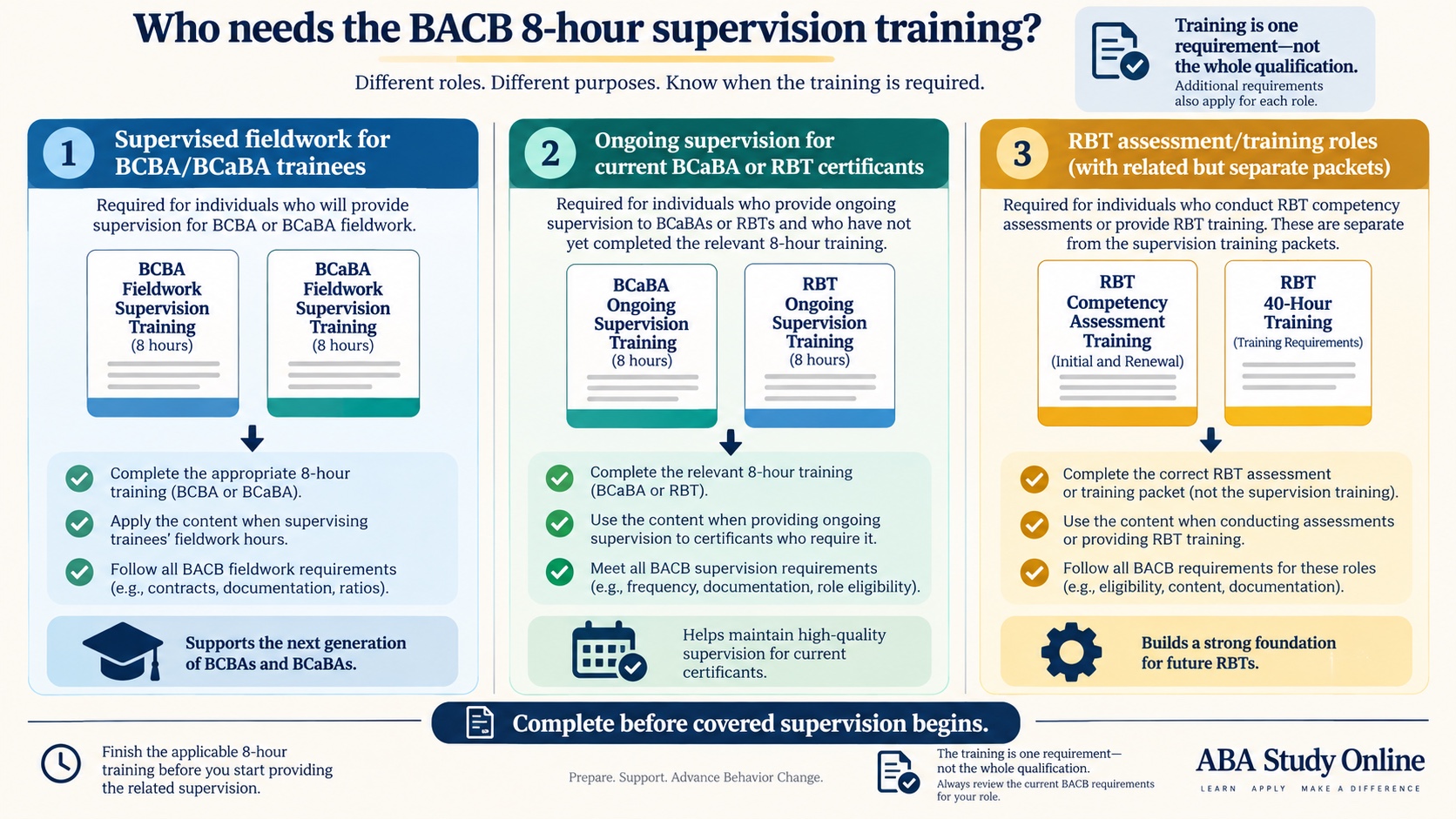
Start with the person being supervised and the purpose of the relationship. The BACB’s current role table treats several activities as related but distinct.
| Supervision context | Who is receiving oversight? | Why the 8-hour training matters |
|---|---|---|
| Supervised fieldwork | A trainee acquiring fieldwork toward BCBA or BCaBA certification | The supervisor must complete the training before providing the covered fieldwork supervision and must also meet the applicable handbook requirements. |
| Ongoing service supervision | A current BCaBA or RBT who requires ongoing supervision | The training supports the supervisor’s preparation for an ongoing supervisory relationship; the BCaBA or RBT Handbook supplies the role-specific rules. |
| RBT assessment or training | An RBT applicant completing a competency assessment or required training | The current BACB role guidance connects these activities with qualified BCBA or BCaBA oversight and the required supervision training, but the packet or training requirements remain separate documents. |
This is why “I am a BCBA” is not the whole answer. Certification status is important, but it does not erase the need to verify training, maintenance, experience or consultation requirements, the relationship to the client or organization, documentation, and state licensure. A supervisor should know which rule set applies before accepting responsibility.
What does “before providing supervision” mean?
It means the training is a prerequisite, not an after-the-fact repair. A supervisor should not begin the covered relationship and then plan to take the course later. The current outline also says supervisors, supervisees, and trainees should confirm the date the supervisor completed the training before initiating the supervisory relationship. That simple date check can prevent a long period of uncertain documentation.
What the current curriculum covers
The 8-hour label describes the minimum duration, not the full learning objective. The current Supervisor Training Curriculum Outline (2.0), Version 05/2026, is organized around the skills needed to create and maintain an effective supervisory relationship. The content is intended to be demonstrated, not merely watched or clicked through.
Purpose, risk, and preparation
The outline asks supervisors to explain the purpose of supervision, including high-quality services, procedural fidelity, behavior-analytic and ethical repertoires, problem solving, decision making, assistance seeking, and progress monitoring. It also asks learners to recognize ineffective supervision: missed training opportunities, weak performance, client risk, poor ethical decision making, and the risks that can accompany high-volume work.
Preparation includes checking certification status, reviewing maintenance requirements, assessing feasible supervision capacity, and creating a secure record system. The record system may need to hold contracts and forms, supervision and work logs, performance evaluations, and documents that would be needed for a BACB audit. This makes the training relevant before the first meeting, not only after a problem appears.
Structured supervision and feedback
The curriculum includes structured supervision content, competence evaluation, meeting frequency and format, individual or group supervision, agendas, multiple supervisors, feedback behavior, communication boundaries, and performance reviews. A competent supervision plan gives the supervisee or trainee a clear target, an opportunity to practice, a way to receive feedback, and a method for checking progress.
That emphasis is consistent with peer-reviewed behavior-analytic supervision guidance. Competency-based supervision treats skills as observable repertoires that need mastery criteria, practice, feedback, and generalization—not as abilities that automatically appear because a person attends meetings. The research literature also emphasizes bidirectional feedback and the social validity of supervision. Those ideas help explain why the BACB outline includes both trainee performance and supervisor performance evaluation.
Fieldwork, behavioral skills training, and ethics
For supervisors of BCBA or BCaBA trainees, the outline includes the trainee’s degree, coursework, fieldwork, and maintenance requirements; a supervision contract before supervision begins; documentation of the relationship; training objectives; restricted and unrestricted fieldwork; and varied fieldwork opportunities. It also includes behavioral skills training, predetermined mastery criteria, assignments, deadlines, and evidence of completion.
The outline also addresses observations, performance evaluation, professionalism, ethical behavior, boundaries, and ending the relationship appropriately. These topics are not decorative extras. They shape whether supervision helps a trainee become more capable, protects the people receiving services, and leaves a record that can be understood later.
Timing, online delivery, and completion proof
The current outline gives several practical parameters:
- Minimum duration: at least 8 cumulative hours.
- Unit structure: the training may be offered in units as brief as 1 hour, as long as the cumulative duration reaches the minimum.
- Delivery: online or in person is allowed under the outline; delivery format does not remove the content and competence expectations.
- Demonstration: activities must give learners opportunities to demonstrate verbal or practical competence in the curricular areas.
- Timing before certification: the current outline says the training may be completed up to 180 days before the learner’s original BACB certification date.
- Provider: the BACB supervision page directs readers to Authorized Continuing Education, or ACE, Providers for this training.
Documentation matters as much as attendance. The current outline says the ACE Provider must give the learner a one-page document showing completion of the full training. The training materials and completion documentation must include the statement that the program is based on the BACB Supervisor Training Curriculum Outline (2.0) but is offered independent of the BACB. The learner uploads the documentation into their BACB account. After the documentation is approved and all other relevant supervision eligibility requirements are met, the learner may begin providing supervision.
So, before enrolling, do not ask only “Is this eight hours?” Ask whether the provider is authorized, whether the current curriculum is identified, how demonstrations and participation are handled, what completion document is supplied, and how the record is used in the BACB process. A course page that says “8-hour” without answering those questions deserves a closer look.
What the training does not replace
The easiest way to avoid an expensive misunderstanding is to separate the training from the other requirements around it.
| Not the same as | Why the distinction matters |
|---|---|
| BCBA certification | The training does not replace the degree, coursework, fieldwork, application, examination, or maintenance requirements for becoming a BCBA. |
| Supervision CEUs | Continuing education for maintaining a credential is a different category from the initial training required before covered supervision. |
| Fieldwork hours | Completing supervisor training does not give a trainee qualifying fieldwork hours and does not make every workplace activity count. |
| RBT competency assessment | An RBT assessment uses its own current packet, task conditions, responsible assessor rules, and documentation. |
| State licensure | BACB requirements and state practice rules may overlap, but a BACB training record is not a state license. |
The 2027 BACB changes make date control especially important. BACB’s upcoming-changes page lists revisions to BCBA and BCaBA eligibility and maintenance requirements beginning January 1, 2027. That page is not a substitute for the current supervision page or curriculum outline. If your certification or supervision relationship begins during a transition, check the live BACB requirements and the applicable handbook instead of assuming that a future summary, older course page, or blog post has the final answer.
A course and supervision verification checklist
Use this checklist before you rely on an 8-hour supervision training record:
- Name the role. Write whether the relationship is BCBA or BCaBA fieldwork, ongoing BCaBA supervision, RBT supervision, RBT assessment, or RBT training.
- Open the current BACB source. Start with the supervision and training page, then open the relevant handbook, packet, or fieldwork resource.
- Check the provider. Confirm that the provider is an ACE Provider and that the course identifies the current Supervisor Training Curriculum Outline (2.0).
- Check the learning design. Confirm the minimum eight cumulative hours and opportunities to demonstrate verbal or practical competence, not only passive video time.
- Check the timing. Record the completion date, the original certification-date relationship, and the date the supervision relationship is intended to begin.
- Check the evidence. Make sure you will receive the required one-page completion documentation and know how it is uploaded or retained.
- Check the remaining qualification. Verify credential status, maintenance or consultation rules, client and organizational relationships, contracts, records, and state or employer requirements separately.
Common mistakes
- Choosing by the title alone: “8-hour” does not prove provider authorization, current curriculum alignment, or adequate demonstrations.
- Taking the course after supervision begins: the training is a prerequisite for covered supervision, so verify the date first.
- Confusing training with CEUs: initial supervision training and ongoing credential-maintenance education answer different questions.
- Assuming a BCBA credential is enough: current qualification, maintenance, consultation, relationship, documentation, and state rules still matter.
- Using an old PDF: curriculum versions and BACB requirements can change; check the live source and record the version date.
- Turning a general supervision meeting into proof of training: ordinary supervision, fieldwork hours, and a formal 8-hour training record are not interchangeable.
FAQ
Does every BCBA need the 8-hour supervision training?
The requirement is tied to covered supervision roles, not simply to holding the BCBA credential. The current BACB guidance identifies supervision of BCBA or BCaBA fieldwork trainees and ongoing supervision of current BCaBAs or RBTs who require supervision. Confirm the role and current handbook before deciding whether it applies to your situation.
Can the 8-hour supervision training be completed online?
The current Supervisor Training Curriculum Outline (2.0) allows online or in-person delivery. An online course still needs to meet the duration, curriculum, competence-demonstration, provider, and documentation expectations. Verify the current offering rather than relying on the delivery label alone.
Can the training be split into shorter sessions?
Yes, the current outline says the training may be offered in units as brief as one hour, provided the cumulative duration reaches at least eight hours and the activities cover the required curriculum and demonstrations.
Is the 8-hour course the same as supervision CEUs?
No. The 8-hour training is a prerequisite for covered supervision roles. Supervision CEUs are continuing-education requirements connected to credential maintenance. They should be tracked and verified separately.
Does completing the course make someone qualified to supervise automatically?
No. The course is one requirement. The supervisor must also meet the credential, maintenance, experience or consultation, relationship, documentation, handbook, and state or employer rules that apply to the role.
Where should I verify the current rule?
Start with the BACB’s supervision and training page and the current Supervisor Training Curriculum Outline (2.0). Then open the BCBA, BCaBA, or RBT handbook or packet that matches the relationship. If the date crosses a 2027 transition, verify the live BACB requirements again before beginning.
Sources and further reading
- BACB Supervision, Assessment, Training, and Oversight
- BACB Supervisor Training Curriculum Outline (2.0), Version 05/2026
- BACB Recent and Upcoming Changes to Requirements
- Towards a Competency-Based, Ethical, and Socially Valid Approach to the Supervision of Applied Behavior Analytic Trainees
- Recommended Practices for Individual Supervision of Aspiring Behavior Analysts
- BCBA learning resources
- BCBA practice questions
- ABA glossary
- Free ABA study resources
- ABA Study Online app