40-Hour RBT Training: What the 2026 Requirement Includes and What Comes Next
If you are searching for 40 hour RBT training, you may be trying to answer a practical question: “What exactly does this course allow me to claim?” The short answer is that a qualifying 40-hour course satisfies one RBT certification requirement. It does not, by itself, make you an RBT, replace the initial competency assessment, or authorize you to sit for the examination.
For applicants using the 2026 requirements, the BACB sets boundaries around the training window, curriculum, delivery, trainer oversight, and completion certificate. Understanding those boundaries helps you keep the training course separate from the next steps: competency assessment, application, examination, and ongoing supervision.
This guide focuses on requirement interpretation and sequence. It is independent educational information, not a BACB publication, provider recommendation, certification decision, or pass guarantee.
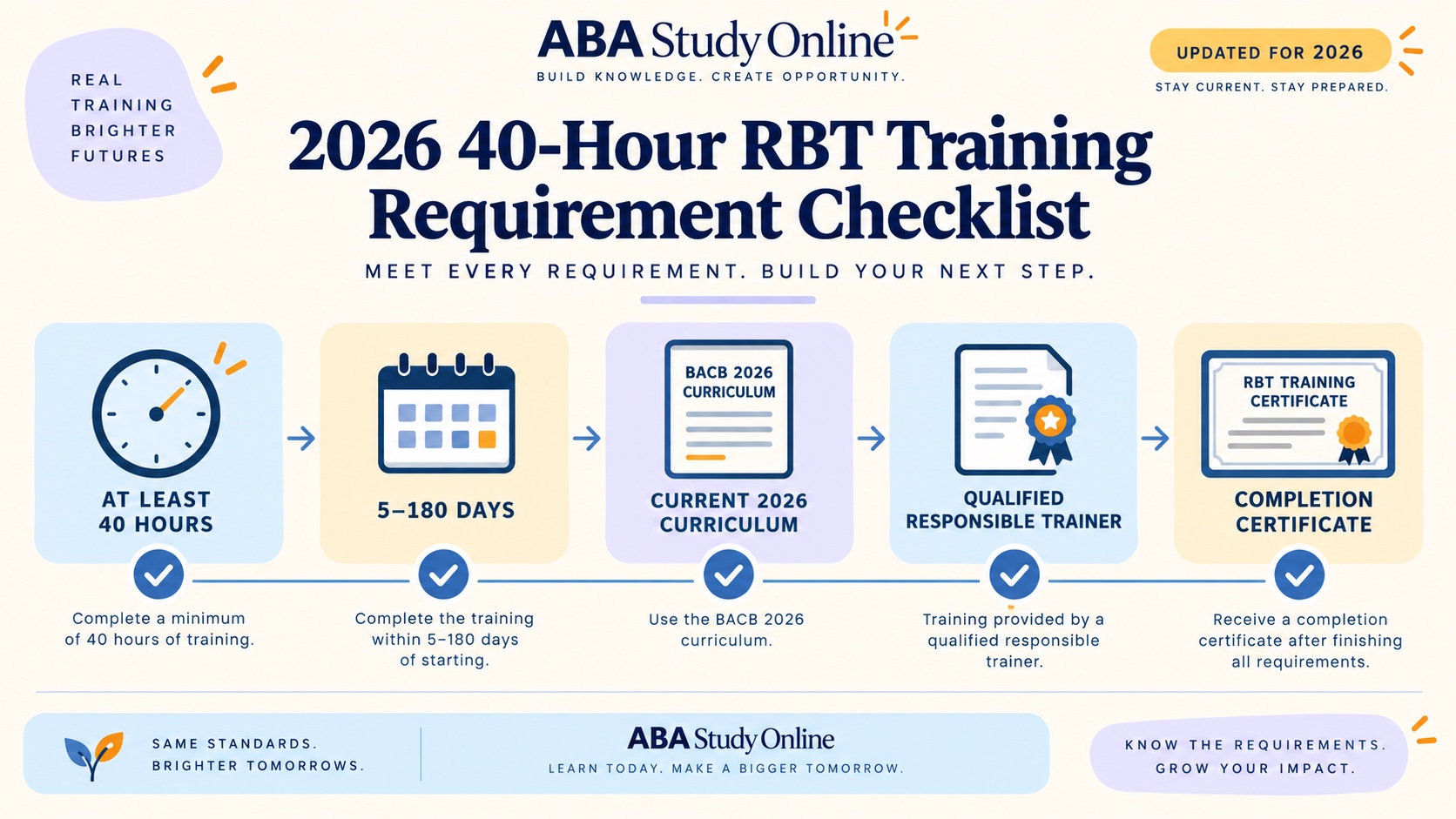
Quick answer: A qualifying 2026 40-hour RBT training must meet the BACB’s current curriculum outline and be completed in no fewer than 5 days and no more than 180 days, counting the start and end dates. The provider gives you a completion certificate for the RBT application. After training, you still need the other applicable eligibility steps, the initial competency assessment, application approval, examination authorization, and the RBT examination. Ongoing supervision is a separate professional requirement.
The 2026 timing window
The phrase “40 hours” describes the amount of training, but the 2026 rule also controls how quickly or slowly those hours may be completed. The training must take at least 5 days and no more than 180 days. The BACB handbook counts both the start date and the end date in that calculation.
That means a course advertised as 40 hours should not be scheduled as a single-day marathon. It also should not remain open indefinitely while a learner watches occasional lessons. The date window is part of the documentation that shows whether the training meets the applicable requirement.
For a simple calendar example, if training begins on January 1, the earliest completion date under the handbook’s example is January 5. The latest date in the handbook’s 180-day example is June 29. Your own dates depend on the actual start date and the current rule, so use the live RBT Handbook before submitting an application.
A useful record includes the start and end dates, the amount of time you completed, the course or provider identity, and the responsible trainer. Keep those records even if the course platform also stores them. A login screen or payment receipt alone may not prove that the 2026 curriculum and timing requirements were met.
What the training must cover
The BACB’s RBT 2026 40-Hour Training Requirements and Curriculum Outline is the source for the course boundary. The required curriculum is broader than a collection of definitions or a quick introduction to reinforcement.
| Curriculum area | Minimum time | Why it matters for the training boundary |
|---|---|---|
| Introduction to applied behavior analysis | 2 hours | Provides the basic behavior-analytic framework and vocabulary. |
| Preparing for service delivery | 1 hour | Connects preparation, environment, rapport, and assent to actual sessions. |
| Data collection and graphing | 3 hours | Builds objective observation, measurement, calculation, graphing, and reporting skills. |
| Assisting with behavior assessments | 3 hours | Explains how an RBT supports assessment activities within the assigned role. |
| Behavior-change interventions | 20 hours | Covers teaching and behavior-change procedures, integrity, generalization, and safety boundaries. |
| Service delivery documentation and reporting | 3 hours | Links objective notes, confidentiality, and timely supervisor communication. |
| Ethics and professionalism | 5 hours | Addresses dignity, boundaries, cultural responsiveness, and professional conduct. |
| Next steps in certification | 1 hour | Separates training from assessment, application, examination, supervision, and maintenance. |
The listed minimums add up to 38 hours, with the provider allocating the remaining 2 hours to reach at least 40 hours. A provider may spend more time on an area, but it should be able to show how the complete program covers all required areas. The largest block is behavior-change interventions, but that does not make the other sections optional.
Look for active learning opportunities, not just a timer. The current requirements describe behavioral-skills-training components such as instruction, modeling, examples and nonexamples, role-play, feedback, quizzes, interactive activities, or instructor-led discussion. Assigned reading alone cannot represent the complete training experience.
For example, a strong data lesson should let a learner practice writing an observable description and selecting a measurement system. A strong documentation lesson should distinguish an objective session note from an interpretation or diagnosis. A strong intervention lesson should make clear that an RBT follows the written plan and supervisor direction rather than independently inventing a new intervention.
Online, in-person, and blended delivery
The BACB handbook says 40-hour training may be offered by an employer, a university, or an online training program. The delivery format is not the only question. An online course still needs to meet the current timing, content, active-learning, trainer, and documentation requirements.
When reviewing an online course, ask how it records your actual completion dates and training time. Find out how you receive feedback, how role-play or skill practice works, and whether an instructor is available when a question involves a scope boundary. A platform that only displays video minutes may not show the whole training process.
“Online” also does not mean “officially provided by the BACB.” BACB states that it does not provide 40-hour training, completion certificates, or training-program recommendations. The provider should clearly identify its own responsible trainer and should not present a private course as a BACB-endorsed program.
Trainer oversight and the completion certificate
The responsible trainer matters because the training is not merely a self-study playlist. The BACB’s supervision-and-training guidance identifies BCaBAs and BCBAs as roles that may train RBTs, with qualified assistant trainers involved under the responsible certificant’s oversight. The responsible trainer must meet the applicable supervision-training requirement, and the provider should be able to identify that person before enrollment.
The completed 40-hour training certificate is uploaded with the RBT certification application. Treat it as evidence of training completion, not as the RBT credential. Keep a copy of the certificate and the related records. Check the name, BACB ID, start and end dates, amount of training, responsible trainer information, and any assistant-trainer information before you submit an application.
The course provider should also explain how it handles incomplete training. A learner who stops partway through may need records of what was completed, and the responsible trainer has documentation responsibilities. If a provider cannot explain who oversees the course or what appears on the certificate, that is a reason to pause and verify the program against the official outline.
What comes after training
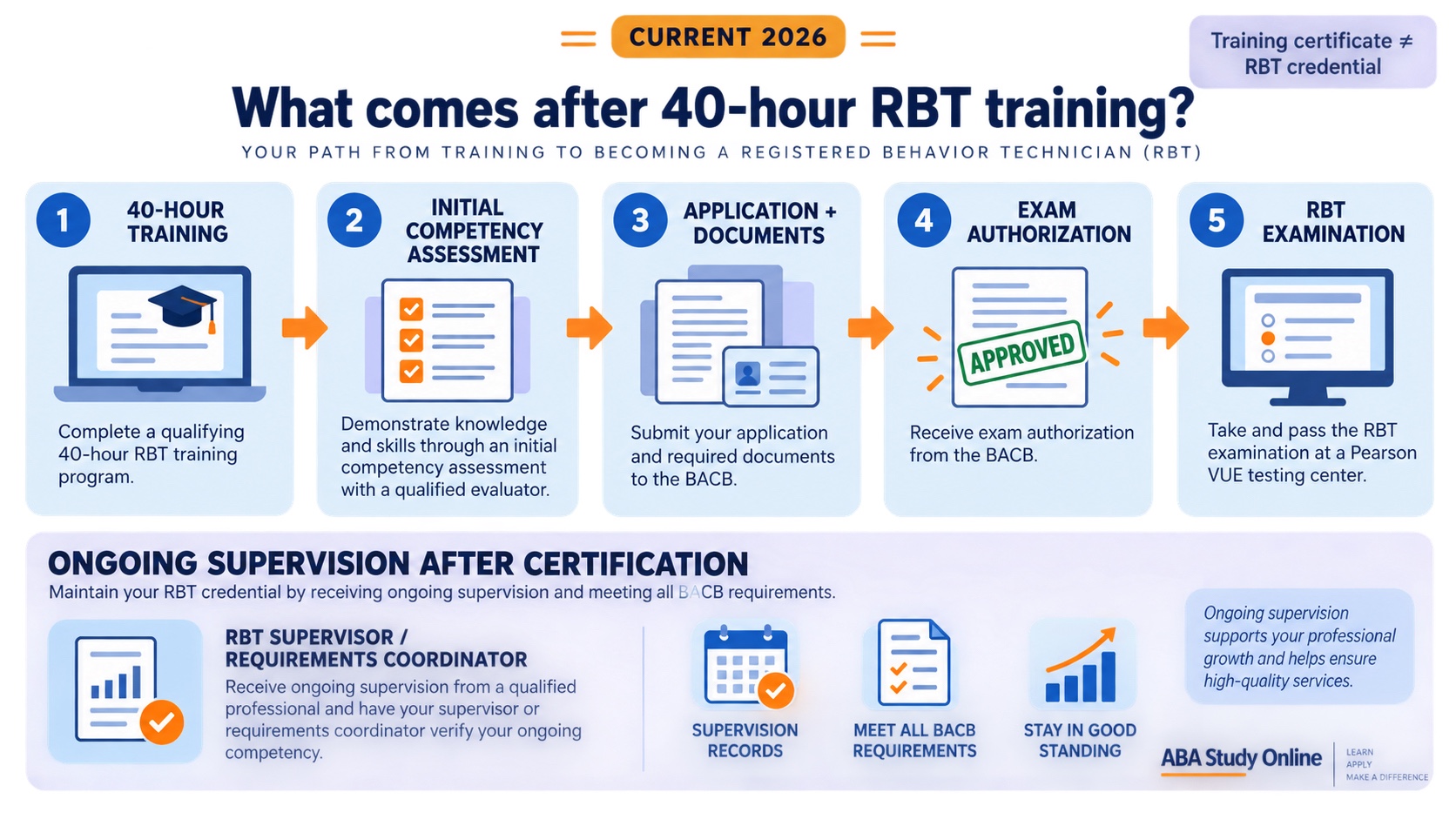
Training is the beginning of the RBT application sequence, not the finish line. The next steps are connected but separate:
- Initial competency assessment: After the required training, demonstrate the specified skills with a qualified assessor. This is not the same as receiving a course certificate.
- Application and documentation: Submit the application and the required supporting records, including the training certificate and the competency-assessment documentation.
- Approved determination and examination authorization: Wait for the current application process to authorize the examination before scheduling it.
- RBT examination: Study from the current RBT Test Content Outline and official handbook. The exam outline is not the same as the 40-hour training curriculum.
- Ongoing supervision: Once certified, RBT practice remains under the direction and close supervision of an RBT Supervisor and/or RBT Requirements Coordinator responsible for the work.
The RBT certification guide covers the broader checklist. If your next question is about the initial assessment, use the RBT competency assessment guide. If your next question is exam content, use the current RBT exam guide and the official TCO. Keeping those pages separate prevents a course certificate from being treated as proof of every later step.
Common mistakes
- Finishing in one day: The 2026 rule includes a minimum five-day window, not only a 40-hour total.
- Leaving the course open forever: The maximum window is 180 days, counting the start and end dates.
- Assuming passive video is enough: Check for the required curriculum and behavioral-skills-training components.
- Calling the certificate a credential: The certificate documents training; it does not make you an RBT.
- Skipping the competency assessment: Training and demonstration of skill are separate requirements.
- Studying the exam outline instead of checking the training outline: The RBT TCO describes exam content, while the 40-hour curriculum describes training requirements.
- Trusting an endorsement claim: BACB does not provide or recommend private 40-hour training programs.
FAQ
Can I complete 40-hour RBT training online?
An online format may count when the program meets the current BACB requirements for timing, curriculum, active learning, trainer oversight, and documentation. Online delivery alone does not prove that a course qualifies.
How fast can I finish the 40-hour RBT training?
Under the 2026 requirement, it must take no fewer than 5 days and no more than 180 days. Use the current RBT Handbook for the calculation because both the start and end dates count.
Does the 40-hour course include the RBT exam?
No. The course is a training requirement. The examination is a later step with its own authorization, content outline, testing process, and result.
Does completing the course make me an RBT?
No. You still need the other applicable eligibility requirements, initial competency assessment, application process, examination authorization, examination, and ongoing supervision after certification.
What should I do if the provider will not identify the responsible trainer?
Pause before enrolling and compare the course information with the current BACB training outline and supervision-and-training page. A provider should be able to explain who oversees the course, how the certificate is issued, and how the required records are maintained.
Official sources
- BACB RBT Handbook
- BACB RBT 2026 40-Hour Training Requirements and Curriculum Outline
- BACB Registered Behavior Technician resources
- BACB Supervision, Assessment, Training, and Oversight
- BACB Test Content Outlines for BACB Certifications
- Dunlosky et al. (2013), learning techniques review
- Roediger & Butler (2011), retrieval practice review