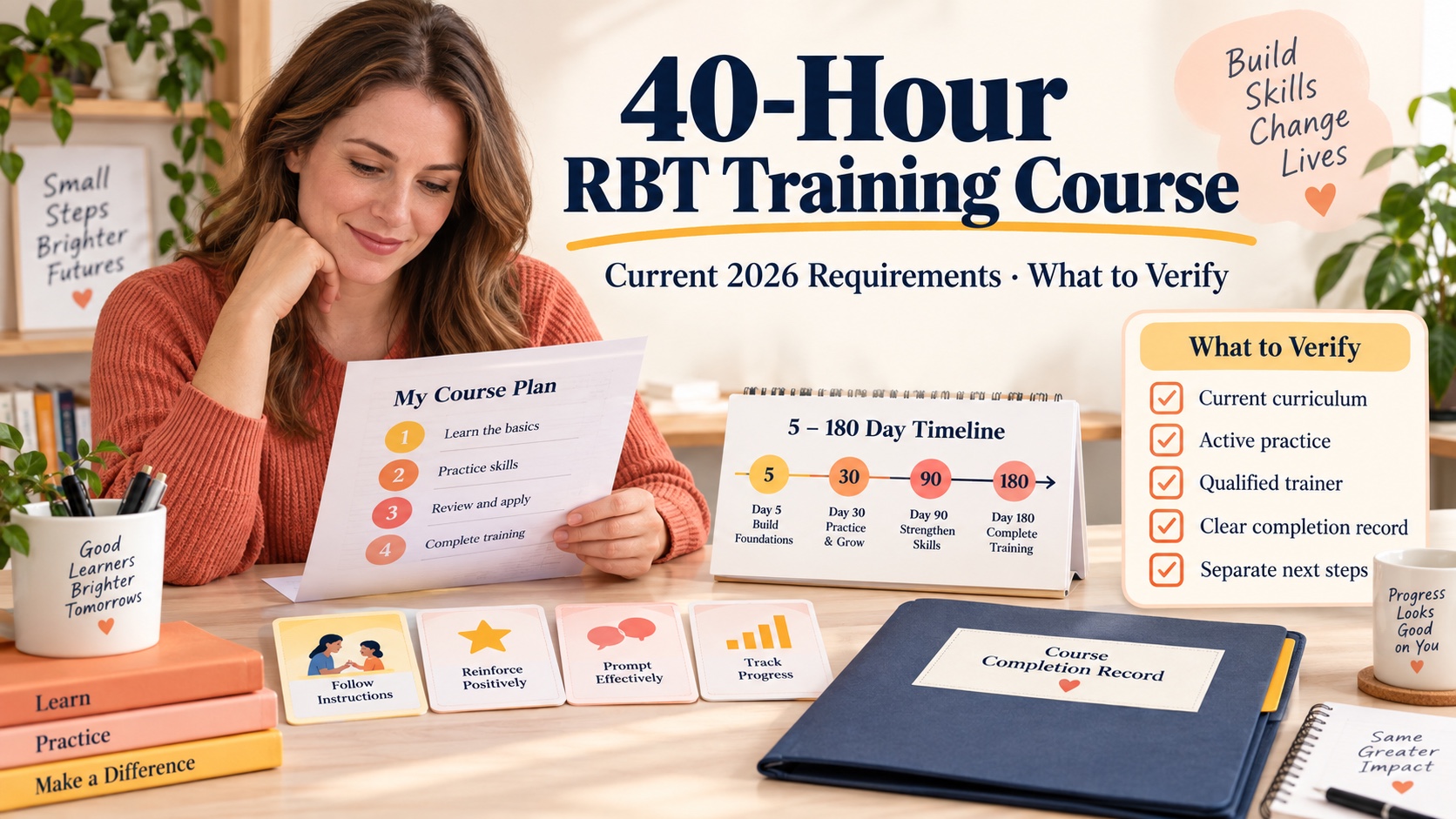
40-Hour RBT Training Course: What to Verify Before You Enroll
A 40-hour RBT training course is an important first step for someone preparing to apply for RBT certification, but the label by itself does not tell you whether a course is ready for your situation. Before you enroll, look for the current training window, the required curriculum, active skills practice, qualified trainer information, and a clear record of completion.
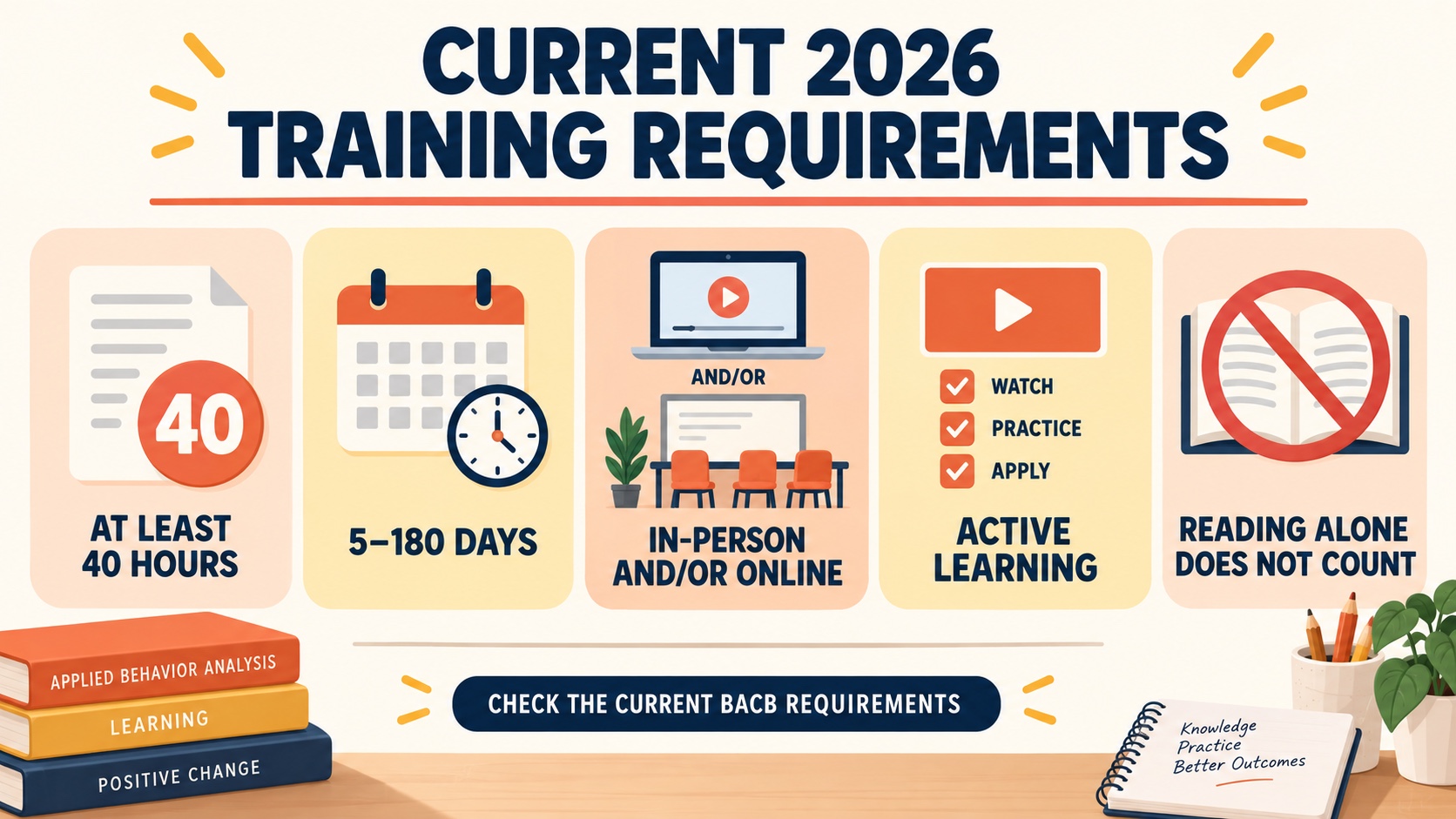
For new RBT applicants applying on or after January 1, 2026, the BACB’s current requirements describe training of at least 40 hours, completed over no fewer than 5 days and no more than 180 days. Training may be in person, online, or a combination. It also needs interactive learning components; assigned reading alone may not count toward the overall duration. The safest way to compare courses is to audit the course page against those requirements rather than choosing by price, speed, or a “certificate” headline.
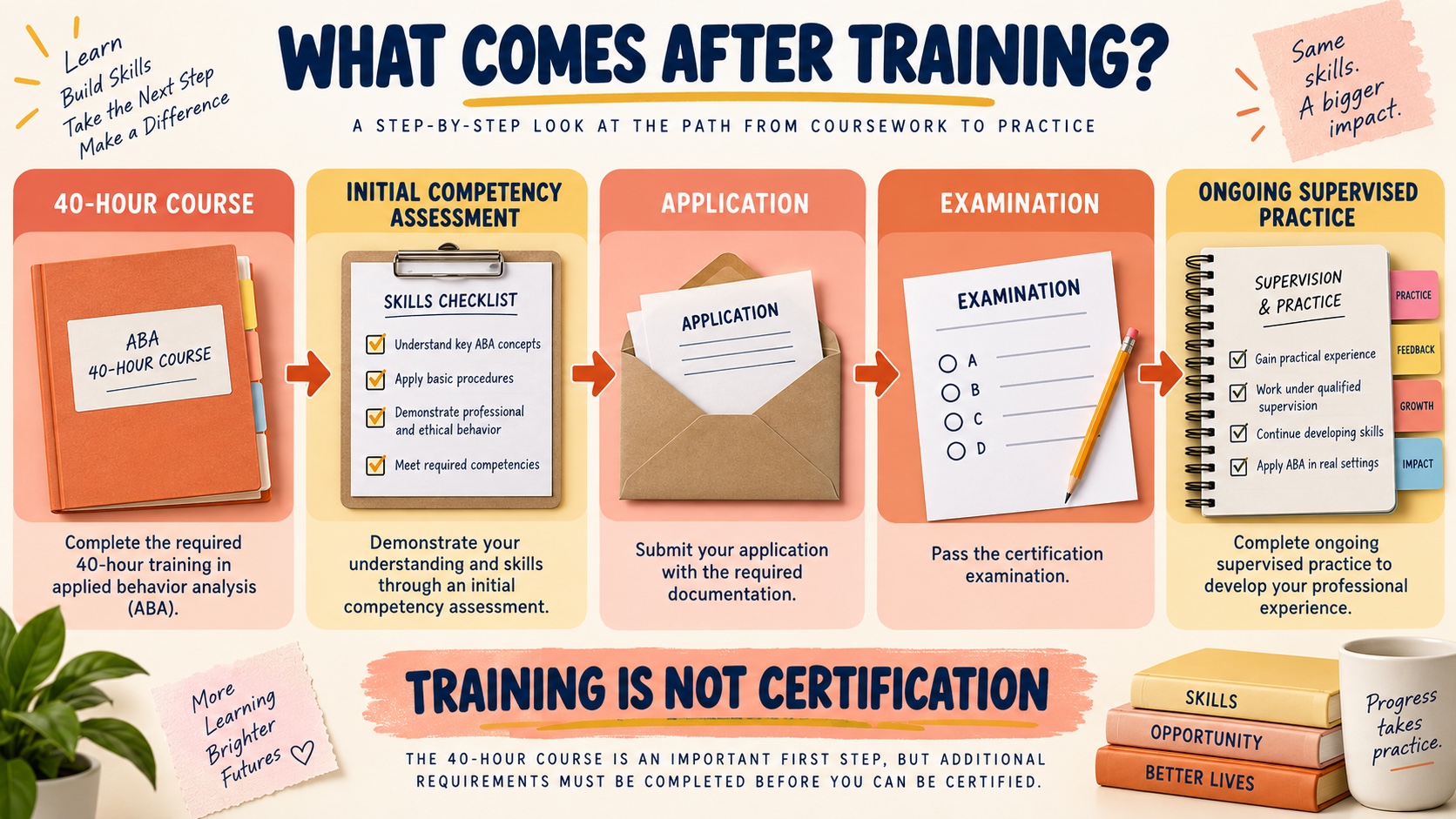
One boundary matters from the beginning: finishing the course does not make you an RBT. Training is separate from the Initial Competency Assessment, application, examination, and ongoing supervised practice. This guide helps you evaluate a course and understand the next steps. It is educational information, not a certification decision or a promise that any particular course will be accepted.
Table of Contents
What a 40-hour RBT training course actually does
The course gives an applicant a structured introduction to the knowledge and practical behaviors expected in the RBT role. It should connect concepts to observable work: preparing materials, describing behavior, following a written plan, using prompting and reinforcement appropriately, recording data, protecting client dignity, and responding within the limits of the role. A strong course does not merely place a long slide deck behind a timer. It gives the learner chances to see, practice, answer, and receive feedback.
It is helpful to separate five things that are often compressed into one sales sentence:
- 40-hour training: the required training experience and curriculum coverage.
- Initial Competency Assessment: a separate demonstration of relevant skills under the applicable process.
- Application: the submission and documentation step for certification review.
- Examination: the separate knowledge assessment required in the certification pathway.
- Ongoing supervision: the supervised practice and documentation that continue after certification.
Those stages connect, but a course provider should not imply that one payment or one completion badge replaces all of them. When you read a course page, ask whether each promise describes training only or quietly suggests an outcome that belongs to another stage.
Current 2026 requirements to verify
The official BACB requirements are the starting point for course comparison. Use the current source directly because training pages and older blog posts may continue to repeat earlier rules.
At least 40 hours
The course must provide at least 40 hours of training. That does not mean a provider can turn any collection of files into 40 hours by adding an inflated estimate. Ask how the provider defines the training time, what activities are included, and how completion is recorded. A course that lists 40 hours but gives no schedule, lesson map, participation rule, or completion evidence deserves a closer look.
A 5-to-180-day completion window
The current requirements specify no fewer than 5 days and no more than 180 days. This is easy to miss when a course advertisement emphasizes “finish in a weekend” or “work at your own pace.” A convenient format can still be flexible, but the advertised completion process needs to fit the current window. Write down the date you start, the date you finish, and any provider rule that controls access or completion.
Online, in person, or combined delivery
Online delivery is not automatically a problem. The current requirements permit in-person and/or online training. The more useful question is whether the online experience still provides the required instructional and practice components. A page that says “100% online” but never explains modeling, role-play, feedback, quizzes, or instructor interaction has not answered the important question.
Current curriculum coverage
Use the current 2026 RBT 40-Hour Training Curriculum document as a coverage check. You do not need to memorize every section before enrolling, but you should be able to see how the course maps its lessons to the current curriculum. Look for practical areas such as measurement and data, assessment-related responsibilities, skill acquisition, behavior reduction, documentation, professional conduct, and the boundaries of the RBT role. The provider should identify what is taught, not simply display a generic “ABA basics” label.
Active behavioral-skills-training components
The requirements describe active elements such as didactic or video instruction, modeling with exemplars and nonexamples, in-vivo role-play with feedback, content quizzes, interactive activities, instructor-led discussion, or a combination. These elements matter because knowing a definition is different from performing a skill.
Assigned readings may support the course, but the official boundary is important: readings alone may not count toward the overall duration. If the entire course appears to be a reading list with a final “I finished” button, pause before paying. Ask how the provider creates practice, interaction, and evidence that the learner engaged with the material.
How to audit the course page and trainer
You can screen most course pages with a short audit. Open a note while you browse and record the answer to each question. A missing answer is not automatically disqualifying, but it tells you what to ask before enrolling.
- Who is responsible for the training? The current requirements identify a Responsible Trainer who is a BCaBA, BCBA, or BCBA-D and has completed the required 8-hour supervision training.
- Is the Responsible Trainer identified? The person should be identifiable at the start of the training and on the completion documentation. A company name alone makes verification harder.
- Is an Assistant Trainer involved? An Assistant Trainer may provide some or all of the training when the official conditions are met and must hold RBT certification or higher. The course page should explain who teaches which part.
- Does the provider fit the BACB jurisdiction? The current requirements include a jurisdiction boundary. Check the official wording instead of assuming that a globally accessible website has satisfied every condition.
- Are relationship and employment boundaries addressed? The requirements contain limits involving the trainer’s relationship to or employment of the trainee. A transparent provider should be able to explain how it handles those boundaries.
- Is there a current lesson map? The lesson titles should connect to the current curriculum, not just to a general ABA marketing category.
- How is completion verified? Look for attendance, time, activity, quiz, discussion, or other completion procedures. “Watch whenever” is a format description, not a complete record policy.
- What support exists when you are stuck? A discussion board, instructor contact, scheduled office hour, or feedback process can reveal whether the course is designed for learning rather than passive access.

Be especially careful with phrases such as “BACB-approved course,” “guaranteed certification,” or “pass the exam with one purchase.” The BACB’s role and the provider’s role are not interchangeable. A course can be designed to meet the training eligibility requirements while still being offered independently of the BACB, and completing it does not guarantee application approval or an examination result.
What active learning should look like
Imagine a lesson on prompting. A passive version might define prompt fading, show a few paragraphs, and end with a multiple-choice item. An active version might explain the concept, show a correct example and a common error, ask the learner to identify the difference, provide a short role-play or demonstration, and give feedback on the learner’s response. Neither format has to be theatrical. The important feature is that the learner can connect the idea to an observable action.
The same test works across the course:
- Measurement: Do you practice choosing or recording a measure, rather than only memorizing definitions?
- Skill acquisition: Do examples show how a teaching procedure is implemented and adjusted within the written plan?
- Behavior reduction: Does the course emphasize following the supervisor’s plan, client dignity, safety, and accurate data instead of improvising a treatment?
- Professional conduct: Are boundaries, confidentiality, communication, and scope of practice connected to realistic decisions?
- Feedback: Can you tell what to do when an answer or performance is incomplete?
This is also where a free course deserves the same review as a paid course. Free access can remove a financial barrier, but it does not answer the questions of trainer qualification, current curriculum, active learning, records, and completion timing. Evaluate the design first and the price second.
A course-page comparison scenario
Suppose Jordan finds two online course pages. Course A advertises “40 hours in one weekend,” has a long list of videos, and displays a completion badge. It does not name a Responsible Trainer, explain the 5-to-180-day window, or describe role-play and feedback. Course B is less flashy. It shows a current lesson map, names the Responsible Trainer, explains Assistant Trainer roles, includes practice and quizzes, and describes the completion record.
Jordan should not conclude that Course B is automatically accepted or that Course A is automatically invalid based only on the advertisements. But Course B has made the questions answerable. Jordan can verify the trainer, read the activity details, ask how the record is issued, and check that the completion dates will fit. Course A has not yet provided enough information to make the same decision.
That difference is the point of a course audit. You are not trying to choose the most colorful page or the shortest promise. You are trying to identify whether the course can show its design, responsibility, interaction, timing, and documentation clearly enough for you to make an informed enrollment decision.
What the certificate and records should help you prove
There is not one universal certificate layout that answers every application question. However, a useful completion record should make the training identifiable. Before enrolling, ask whether the final documentation will connect your name to the course, the training dates, the number of hours, the Responsible Trainer, and the provider or program information. Also ask where you can retrieve the record later.
Keep more than a screenshot of a congratulatory page. Save the certificate or completion record, the course outline, the provider’s completion policy, and any confirmation that explains how the hours and activities were calculated. If the provider changes its website, your own file should still show what you completed and when.
A certificate is evidence of course completion; it is not the same thing as certification. It also does not replace the Initial Competency Assessment, application materials, examination, or ongoing supervision. If a course page uses the word “certified” to describe the badge you receive after training, read the wording carefully and compare it with the official RBT pathway.
What comes after the 40-hour course
Once the training is complete, the next step is not to call yourself an RBT immediately. The current pathway includes additional requirements. The exact sequence and documentation depend on the official rules that apply to your application, so use the current RBT Handbook and BACB application resources as your source of truth.
- Complete and retain the training record. Make sure the dates, hours, trainer, and course information are available.
- Complete the Initial Competency Assessment. This is a separate step that evaluates relevant skills through the applicable process.
- Prepare the application. Gather the required documents and follow the current application instructions.
- Meet the examination requirement. Training is preparation for the pathway, not a substitute for the examination.
- Continue supervised practice after certification. An RBT’s learning and supervision responsibilities continue; they are not finished when the course certificate is downloaded.
If you are comparing your options, ABA Study Online’s RBT learning path can help organize concepts, and the free RBT practice questions can help you review. You can also use the ABA definition search, browse free ABA resources, or continue practice in the ABA Study Online app. These are study destinations, not a substitute for the official application rules or a claim that the app awards RBT certification.
FAQ and official sources
Can the 40-hour RBT training course be online?
Yes, the current BACB requirements allow in-person and/or online delivery. The online course still needs to meet the current hour, completion-window, curriculum, active-learning, trainer, and record requirements.
How long do I have to finish the course?
The current requirements specify no fewer than 5 days and no more than 180 days. Check the provider’s process and keep your own start and completion dates.
Does a free RBT course count?
Free access does not decide eligibility. Review the same requirements you would review for a paid course: current content, qualified responsibility, active learning, completion evidence, timing, and documentation.
Does completing 40 hours make me an RBT?
No. The course is one training step. The Initial Competency Assessment, application, examination, and ongoing supervised practice are separate parts of the pathway.
What should I do if a course page does not name the trainer?
Ask the provider for the Responsible Trainer’s identity, qualifications, role, and documentation policy before enrolling. If the provider cannot explain who is responsible for the training, you do not yet have enough information to audit the course.
Where should I confirm the rules?
Start with the current BACB RBT 40-hour training requirements, the 2026 RBT curriculum document, the RBT Handbook, the BACB RBT page, and the BACB’s supervision and training resources. Recheck them when you are close to enrollment or application because requirements and forms can change.