2027 BCBA Requirements: What Changes on January 1 and What Does Not
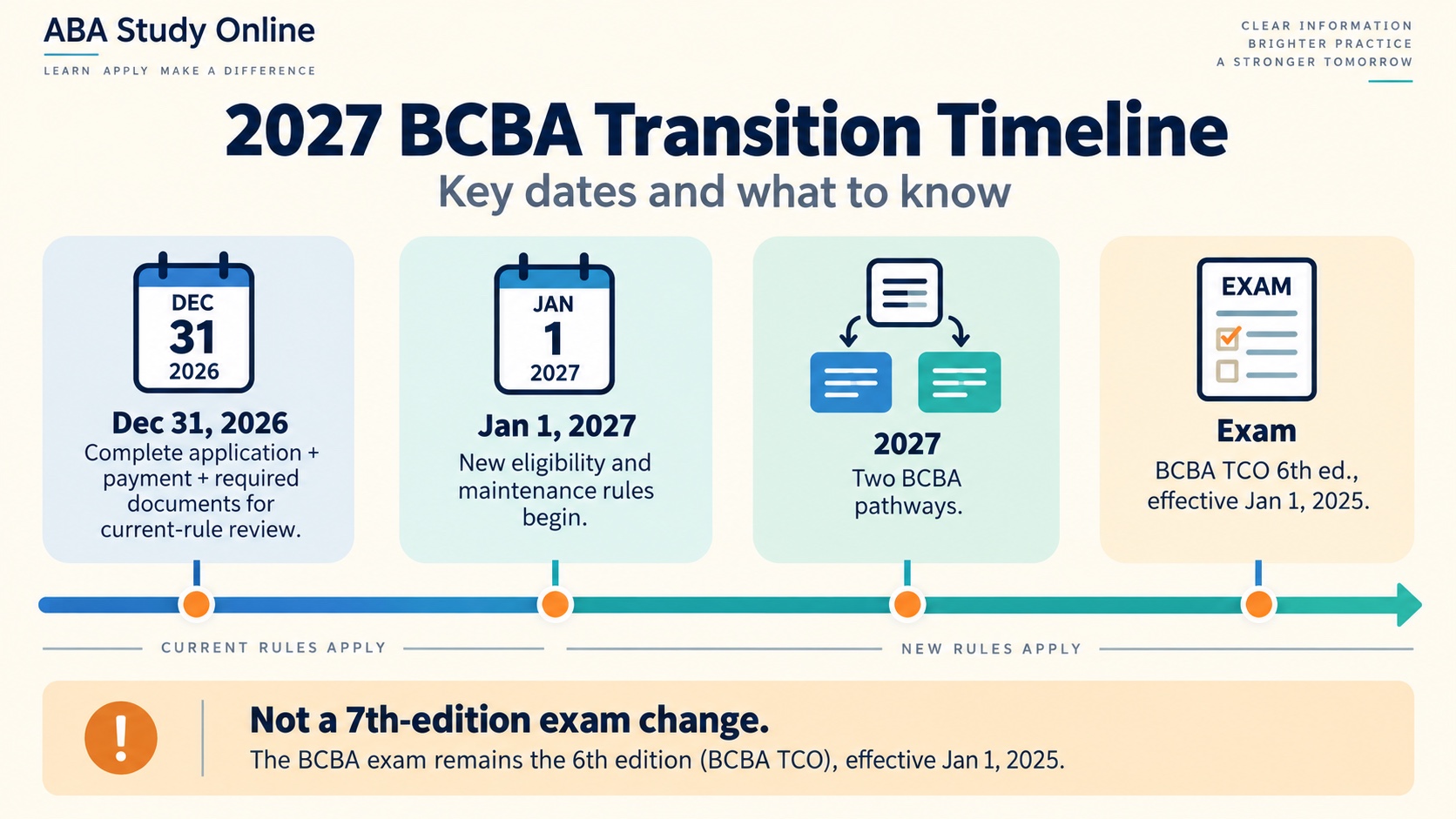
The phrase 2027 BCBA requirements covers several different rule changes, so it is easy to mix them together. The most important date is January 1, 2027, when revised eligibility and maintenance requirements take effect. If you want your complete application reviewed under the current 2022 requirements, the BACB says it must be received with payment and required documents by December 31, 2026.
This guide separates the transition deadline, eligibility pathways, coursework, fieldwork, maintenance, and examination. The exam correction is especially important: the 2027 BCBA Requirements document says the examination is based on the BCBA Test Content Outline, 6th edition, effective January 1, 2025. The 2027 eligibility change is not a seventh-edition task list.
Quick answer: on January 1, 2027, BCBA applicants move to two eligibility pathways, Pathway 2 coursework is reorganized into new content areas and course structures, fieldwork and maintenance requirements are revised, and pathways 3 and 4 are discontinued for new applications. The examination remains based on the BCBA Test Content Outline, 6th edition. Use the official transition guide for the date that applies to your application.
The January 1, 2027 transition
The BACB’s transition announcement gives applicants a practical boundary: to be reviewed under the current 2022 requirements, a complete application—including payment and all required documents—must be received by December 31, 2026. “I finished most of my coursework” or “my supervisor knows I am applying” is not the same as the BACB receiving a complete application.
If you plan to apply close to the transition, compare both rule sets with your program contact, supervisor, or advisor. The BACB’s BCBA 2027 transition guide says that applicants who want to use pathway 3 or 4 must apply and meet all requirements before January 1, 2027. After the transition, the 2027 pathway structure governs new applications.
This is why a single “2027 checklist” copied from a school blog can be risky. Read the date of the source, identify whether it discusses eligibility or maintenance, and then open the relevant BACB handbook or requirements document. The document that controls you depends on your application timing and pathway.
The two 2027 BCBA pathways
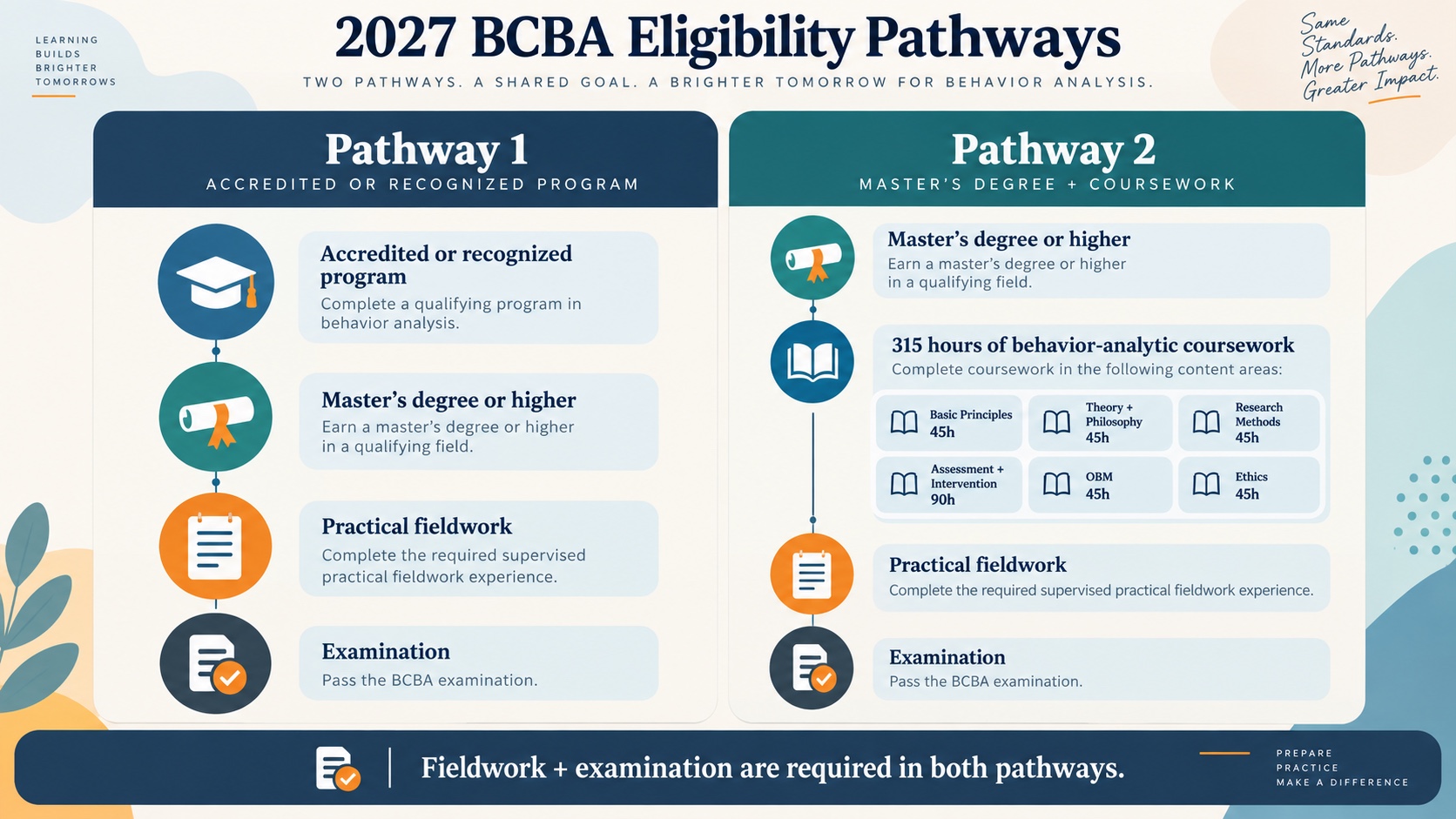
Beginning January 1, 2027, the BACB’s high-level BCBA overview describes two eligibility pathways:
| Pathway | Degree/coursework direction | Other major components |
|---|---|---|
| Pathway 1 | Master’s degree or higher from an APBA-accredited program or an ABAI-accredited/recognized behavior-analysis degree program | Practical fieldwork and the BCBA examination |
| Pathway 2 | Master’s degree or higher plus qualifying behavior-analytic coursework | Practical fieldwork and the BCBA examination |
Pathway 1 is not simply “any master’s degree plus experience.” The 2027 document specifies the recognized or accredited program conditions. Pathway 2 is not simply “take a few ABA classes.” It has a defined set of content areas, instructional hours, freestanding-course conditions, time limits, and a qualified program contact. Your transcript and program documentation have to be evaluated against the current rules.
2027 Pathway 2 coursework
The 2027 Pathway 2 coursework total is 315 instructional hours. The high-level content areas are:
- Basic Principles of Behavior: 45 hours within one freestanding course.
- Theory and Philosophy in Behavior Analysis: 45 hours within one freestanding course.
- Research Methods in Behavior Analysis: 45 hours within one freestanding course.
- Behavior Assessment and Intervention: 90 hours within two freestanding courses.
- Organizational Behavior Management: 45 hours within one freestanding course.
- Ethics in Behavior Analysis: 45 hours within one freestanding course.
The transition guide shows how some 2022 content areas map into the 2027 structure. For example, older philosophical-underpinnings content is separated into Basic Principles and Theory & Philosophy, and assessment and behavior-change content is reorganized into Behavior Assessment & Intervention. Do not assume that course titles map automatically. Ask your program contact to document how the coursework meets the 2027 descriptions.
The 2027 document also states that Pathway 2 coursework must be completed at the master’s or doctoral level at the qualifying institution, within the relevant time window, for academic credit, with a passing grade, and not in less than one calendar year. Those details make an official transcript and program attestation more useful than a general course catalog description.
Fieldwork and examination boundaries
The 2027 high-level fieldwork table lists two options: 2,000 hours for supervised fieldwork or 1,500 hours for concentrated supervised fieldwork. The supervision percentage is 5% for supervised fieldwork and 7.5% for concentrated supervised fieldwork. A supervisory period includes a minimum of 20 hours and a maximum of 160 hours of fieldwork.
The 2027 overview also lists at least 60 minutes of cumulative observation for supervised fieldwork and 90 minutes for concentrated fieldwork, at least 50% of supervised hours as individual supervision, and at least 60% of total supervised fieldwork hours as unrestricted activities. These are high-level values. Your actual forms, supervisory period records, and other fieldwork conditions must follow the current BCBA Handbook.
The examination is a separate lane. The 2027 BCBA Requirements document says the exam is based on the BCBA Test Content Outline, 6th edition, which took effect January 1, 2025. Therefore, “2027 BCBA requirements” does not mean “BCBA 7th edition.” If a study page makes that claim, check the official BACB test-content-outline page before changing your study plan.
Maintenance and continuing education
The 2027 BCBA maintenance framework keeps the total at 32 CEUs per two-year recertification cycle, including 4 ethics CEUs and 4 supervision CEUs for supervisors. The 2027 document also clarifies the ethics category to include events related to BACB ethics requirements and/or cultural/contextual responsiveness, connected to behavior-analytic practice or applied research and behavior-analytic literature or established practice.
Keep that future value separate from the current June 2026 BCBA Handbook, which lists 3 supervision CEUs for supervisors. The rule you use depends on the maintenance period and document that governs your certification. A future summary page should not be used to rewrite a current cycle’s records without checking the handbook and BACB guidance.
Maintenance also includes ethics and self-reporting requirements and a recertification application every two years. This article is not a complete maintenance handbook; its purpose is to help you identify the 2027 boundary and route yourself to the right official document.
What the 2027 change does not mean
The transition does not mean that an applicant can skip supervised fieldwork, take a different exam, or replace official documentation with a study certificate. The BCBA remains a graduate-level certification, and the application still depends on the applicant meeting the pathway, coursework or program, fieldwork, examination, ethics, and documentation requirements that apply to the chosen route.
It also does not mean that every course called “2027 BCBA” is an official BACB resource. A prep course can explain a public document, but it cannot decide whether your degree program is accredited, whether your transcript meets a freestanding-course rule, or whether your fieldwork forms are complete. Treat “2027” as a date and version label to verify, not as proof of approval.
How to plan your document review
- Write down your target application date. If you are aiming for current 2022 review, treat December 31, 2026 as the complete-application receipt boundary described by BACB.
- Identify your pathway. Ask whether your degree program fits Pathway 1 or whether your transcript and program contact support Pathway 2.
- Compare your coursework line by line. Record the 2027 content area, instructional hours, freestanding-course evidence, grade, institution, and completion date.
- Audit fieldwork records. Check hours, supervision percentage, supervisory-period limits, observation, individual supervision, unrestricted activities, and the correct form version.
- Keep the exam lane current. Study to the BCBA TCO 6th edition unless the BACB publishes a later official outline.
- Use official transition guidance for exceptions. A general article cannot determine whether your personal application is complete or which documents BACB will accept.
Common mistakes
- Calling 2027 a seventh-edition exam: the 2027 BCBA document points to the 6th-edition TCO.
- Waiting past the transition date with a pathway 3 or 4 plan: the transition guide says those pathways must be completed before January 1, 2027.
- Confusing a submitted interest form with a complete application: BACB’s deadline language includes payment and required documents.
- Using course titles as proof: 2027 Pathway 2 needs the required areas, hours, course structure, institution, grade, and program documentation.
- Mixing current and future supervision CEUs: current BCBA and 2027 BCBA maintenance summaries use different supervision minimums.
- Treating a summary as a personal eligibility ruling: confirm your record with your program contact, supervisor, and the current BACB documents.
FAQ
What are the 2027 BCBA requirements?
The 2027 requirements revise BCBA eligibility and maintenance beginning January 1, 2027. They move new applicants to two pathways, reorganize Pathway 2 coursework, revise fieldwork details, and change certain maintenance values. The complete conditions are in the 2027 BCBA Requirements document and current BCBA Handbook.
Can I still use BCBA pathway 3 or 4?
The transition guide says you must apply through pathway 3 or 4 and meet all requirements before January 1, 2027. If that will not happen, plan against the 2027 pathway structure instead.
Is the 2027 BCBA exam based on a 7th edition?
No. The published 2027 BCBA Requirements document says the exam is based on the BCBA Test Content Outline, 6th edition, effective January 1, 2025.
How many hours are in the 2027 Pathway 2 coursework?
The high-level 2027 Pathway 2 coursework total is 315 instructional hours across six content areas. Program-level conditions, freestanding-course rules, timing, grades, and documentation still matter.
Where can I study for the current BCBA exam?
Use the current BACB outline first, then use contextual study resources such as the BCBA learning path, BCBA practice questions, and the ABA glossary. Study resources do not determine eligibility or replace the BACB’s application review.
Sources
- BACB 2027 BCBA Requirements
- BACB Guidance for Meeting the BCBA Requirements During the 2027 Transition
- BACB 2027 BCBA and BCaBA Requirements: What You Need to Know
- BACB Recent and Upcoming Changes
- BACB BCBA Handbook
- BACB Test Content Outlines
- Related: BCBA learning path
- Related: BCBA practice questions