2027 BACB Changes: BCBA, BCaBA, RBT, and Transition Deadlines
If you are searching for the 2027 BACB changes, you may be trying to decide whether to apply before the transition, check a university curriculum, update a fieldwork plan, or understand whether the change affects RBTs. The short answer is that the major January 1, 2027 reform is for BCBA and BCaBA eligibility and maintenance requirements. RBT has its own 2026 requirements transition, so the 2027 BCBA/BCaBA rules should not be copied into an RBT checklist.
The official BACB materials call this the 2027 BCBA and BCaBA Requirements transition. You may see informal references to a “7th edition,” but that is not the name of the BACB change described in the official transition pages. This guide uses the BACB’s own labels, separates confirmed changes from personal planning questions, and points you back to the handbook or transition guide that controls your route.
Table of Contents
Short answer: what changes in 2027
The BACB says significant BCBA and BCaBA certification changes take effect on January 1, 2027. The changes cover core eligibility and maintenance areas, including degree or coursework, supervised fieldwork, continuing education, and ongoing supervision. The exact requirement depends on whether you are applying for BCBA, applying for BCaBA, or maintaining an existing certification.
Three distinctions make the transition easier to understand:
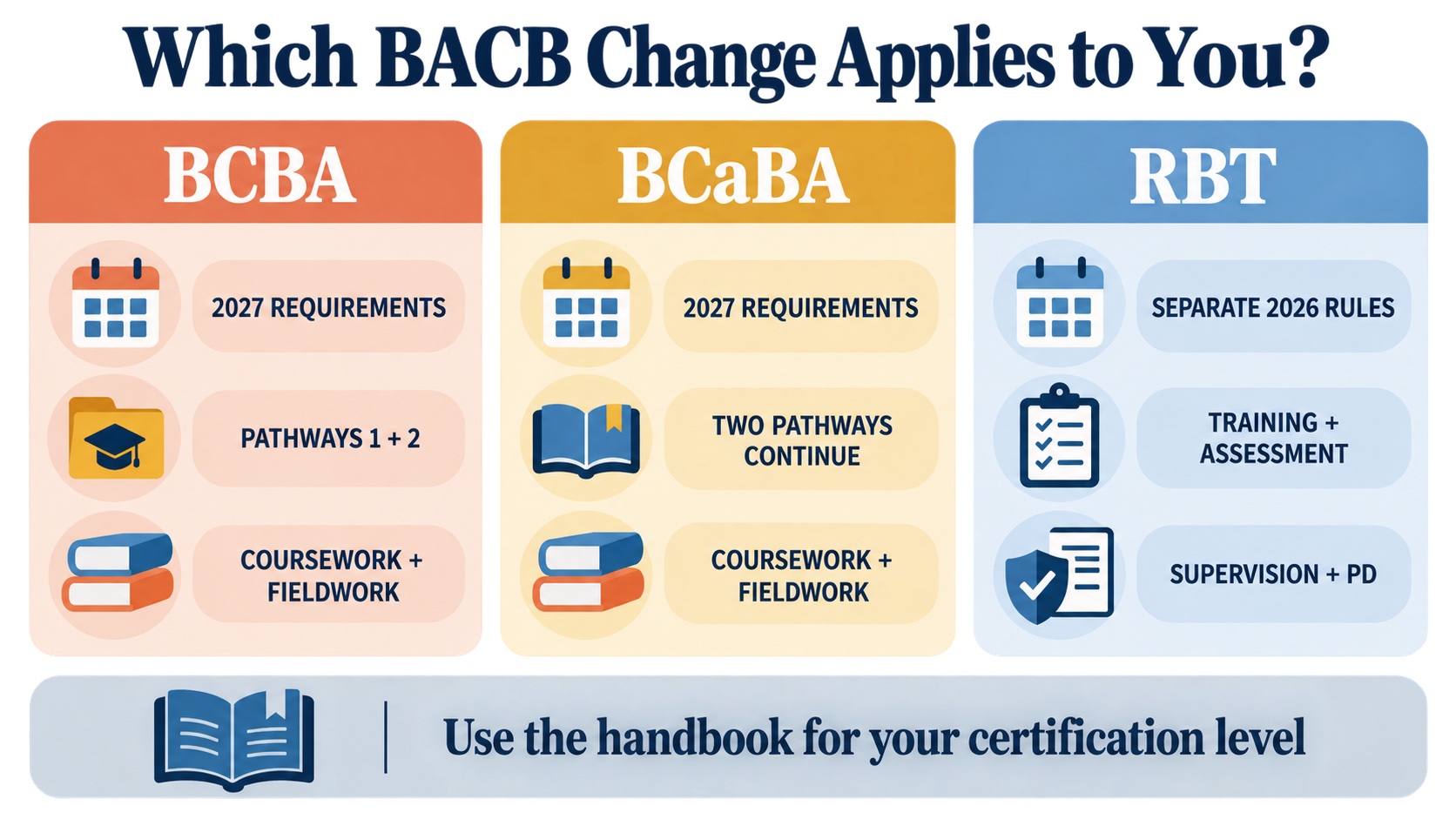
- Certification level: BCBA and BCaBA have separate 2027 requirement documents. RBT is not covered by the same reform.
- Application date: applying under the current 2022 requirements is different from applying on or after January 1, 2027.
- Requirement category: a degree, coursework, fieldwork, examination, continuing education, and supervision record are different evidence categories. Completing one does not automatically satisfy the others.
The 2027 timeline and application cutoff
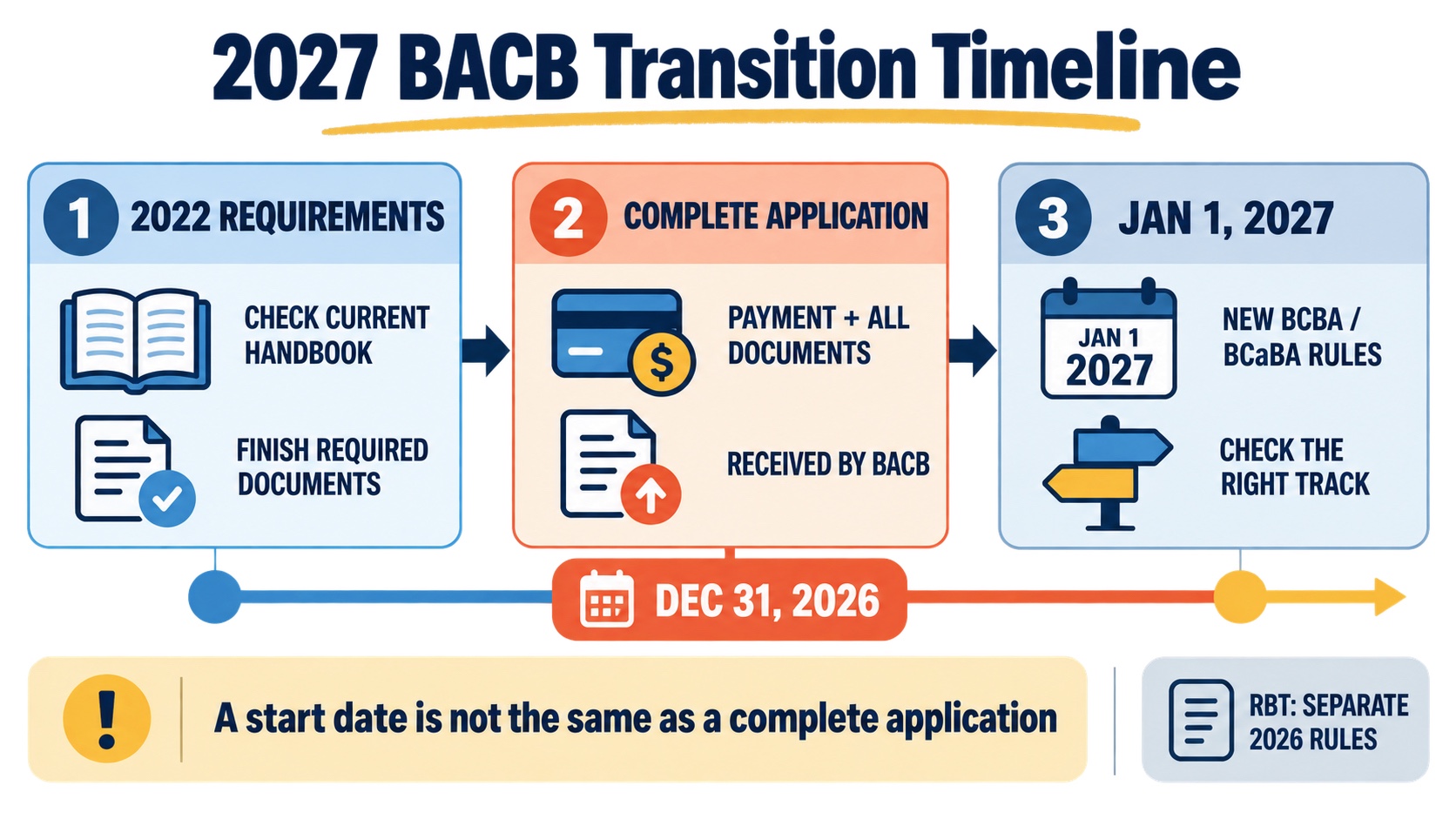
The BACB’s transition announcement says that to be reviewed under the current 2022 requirements, a complete BCBA or BCaBA application—including payment and all required documents—must be received by December 31, 2026. On January 1, 2027, the new requirements take effect for the applicable applications and maintenance decisions.
That sentence matters because “I started my degree,” “I finished a course,” or “I opened an application” is not the same as a complete application received by the BACB. Your own situation may also involve a university verification, fieldwork forms, transcripts, coursework attestations, or documents that need correction. Treat the deadline as a planning boundary, not as a promise that an incomplete file will be reviewed under the old rules.
If you are near the boundary, create two columns in your planning document:
- Current-route column: the 2022 requirement source, remaining documents, fieldwork records, coursework evidence, and the date you can submit a complete application.
- 2027-route column: the new handbook, transition guide, revised coursework map, fieldwork requirements, maintenance rules, and any additional evidence you would need if the application is reviewed under the new rules.
Do not choose a route solely because a social-media post says one version is easier. Compare the official guide with your exact degree, coursework, fieldwork, and application status. If an advisor or supervisor helps you, ask them to identify the source and version behind each conclusion.
What changes for BCBA candidates
The official 2027 BCBA summary describes two eligibility pathways beginning January 1, 2027. Pathway 1 is based on a qualifying accredited or recognized program. Pathway 2 combines a graduate degree with behavior-analytic coursework and supervised fieldwork. The BACB’s transition table also states that BCBA Pathways 3 and 4 are discontinued for the 2027 requirements.
The coursework structure is another major planning point. The BCBA transition guidance identifies several areas that need careful transcript review for applicants moving from the 2022 rules to the 2027 rules:
- Basic Principles of Behavior: a 45-hour freestanding course.
- Theory and Philosophy in Behavior Analysis: a 45-hour freestanding course.
- Research Methods in Behavior Analysis: a 45-hour freestanding course.
- Behavior Assessment and Intervention: 90 hours across two freestanding courses.
- Organizational Behavior Management: 45 hours in a freestanding course, an increase from the earlier allocation described in the transition guide.
These labels are not a recommendation to retake every course. They are a reason to compare your transcript and course syllabi with the official conversion table. A course title that sounds close may not prove the required content, hours, or freestanding-course structure. Your program contact, advisor, or the BACB—not a third-party summary—should resolve an individual coursework question.
BCBA candidates should also review the revised fieldwork and maintenance requirements. The BACB identifies changes to supervised fieldwork, continuing education, and ongoing supervision as part of the 2027 reform. This article intentionally does not replace the current BCBA Handbook with a single simplified number, because the applicable details depend on the route, application timing, and whether the question concerns initial certification or maintenance.
What the announcement does not mean
The transition does not mean that every person currently studying must restart a degree, that every course completed before 2027 becomes unusable, or that a social-media summary can decide whether a transcript qualifies. It means that the applicable requirements change at a defined date and that the BACB has published conversion guidance for people moving between requirement sets. Your evidence still needs to be reviewed in the correct category: degree, coursework, fieldwork, application, examination, or maintenance. If a course was combined with another subject, ask how the transition guide treats that exact course rather than relying on its title. If your application is incomplete, ask what remains missing and which requirement set the BACB will use when the file is complete.
What changes for BCaBA candidates
BCaBA candidates also receive a 2027 requirements transition, but the BCaBA route is not identical to the BCBA route. The official BCaBA transition material says the two eligibility pathways continue: an accredited or recognized degree route and a coursework route. The coursework content, freestanding-course structure, fieldwork, and maintenance details still need to be checked against the 2027 BCaBA documents.
The BCaBA transition guide highlights several coursework changes, including a standalone Foundations course, a revised Methods of Behavior Analysis allocation, two freestanding courses for Behavior Assessment and Intervention, and a larger Organizational Behavior Management allocation. These examples show why a BCaBA applicant should not borrow a BCBA conversion table or assume that the same course titles have the same effect at both certification levels.
Use the document that matches the certification you are seeking. Save the version you reviewed, ask your program contact which courses satisfy the new categories, and keep fieldwork verification records aligned with the applicable handbook. A general “2027 BACB changes” article can orient you; it cannot certify that your transcript or fieldwork is compliant.
What does not transfer to RBT
The 2027 BCBA and BCaBA reform should not be used as an RBT requirement checklist. The BACB has separate RBT eligibility and maintenance changes, including 2026 training, competency-assessment, professional-development, and examination materials. The RBT page and RBT Handbook are the correct sources for an RBT applicant or certificant.
This distinction is especially important for ABA Study Online readers who study across tracks. A BCBA candidate may need a graduate degree, qualifying coursework, supervised fieldwork, and an examination. An RBT candidate follows a different paraprofessional route with its own training, competency assessment, examination, supervision, and maintenance requirements. Similar words—training, supervision, renewal—do not mean the requirements are interchangeable.
A personal transition checklist
- Name your track: BCBA, BCaBA, or RBT.
- Name your action: initial application, examination preparation, fieldwork, recertification, or ongoing supervision.
- Record the deadline: if you are seeking review under 2022 BCBA/BCaBA requirements, verify whether your complete application can be received by December 31, 2026.
- Download the correct guide: use the BCBA or BCaBA 2027 requirements and transition guide, or the RBT materials for RBT questions.
- Audit evidence: compare degree, coursework, syllabi, fieldwork forms, supervision records, attestations, and application documents against the right handbook.
- Ask one precise question at a time: “Does this course satisfy this 2027 category?” is more answerable than “Am I grandfathered?”
- Save the source version: requirements can be updated, so keep the URL, document title, and date you checked.
For track-specific study, use the ABA Study Online BCBA learning hub, the BCaBA learning route, or the RBT learning hub. These resources support study planning; the BACB remains the authority for certification eligibility and transition decisions.
Common mistakes to avoid
- Calling the change a “7th edition” without a source: use the BACB’s official 2027 BCBA and BCaBA Requirements labels.
- Applying the 2027 BCBA rules to RBT: RBT has a separate requirements timeline.
- Assuming starting a program preserves the 2022 rules: the BACB’s transition statement refers to a complete application received by the deadline.
- Using a BCBA table for BCaBA: both tracks change, but their pathways and content documents are not identical.
- Trusting course titles alone: verify content hours, freestanding-course structure, syllabi, and program documentation.
- Treating a summary as an eligibility decision: the official handbook and BACB review control an individual application.
2027 BACB changes FAQ
What are the 2027 BACB changes?
The major January 1, 2027 changes revise BCBA and BCaBA eligibility and maintenance requirements, including degree or coursework, supervised fieldwork, continuing education, and ongoing supervision. BCBA Pathways 3 and 4 are discontinued under the 2027 BCBA requirements.
What is the deadline to use the current BCBA or BCaBA requirements?
The BACB says a complete application, including payment and all required documents, must be received by December 31, 2026 to be reviewed under the current 2022 requirements. Confirm your exact status and required documents with the current BACB materials.
Is there a 7th edition of the BACB exam in 2027?
The official transition pages reviewed here call the reform the 2027 BCBA and BCaBA Requirements. They do not frame it as a generic “7th edition” announcement. Check the certification-specific examination and handbook pages for the exam version that applies to your route.
Do the 2027 changes affect RBT certification?
Not as the same BCBA/BCaBA reform. RBT has separate 2026 eligibility, examination, supervision, and maintenance materials. Use the RBT Handbook and RBT requirements page for RBT questions.
Will my old coursework automatically count in 2027?
Do not assume that it will. Compare your transcript, syllabi, content hours, and freestanding-course structure with the official transition guide for your certification level. A program advisor or the BACB must resolve an individual course question.
Official sources and verification notes
- BACB: Recent and Upcoming Changes to BACB Requirements
- BACB: 2027 BCBA and BCaBA Requirements — What You Need to Know
- BACB: 2027 BCBA Requirements and 2027 BCaBA Requirements
- BACB: Guidance for Meeting BCBA Requirements During the 2027 Transition
- BACB: Guidance for Meeting BCaBA Requirements During the 2027 Transition
- BACB: RBT requirements and 2026 transition resources
- ABA Study Online BCBA learning hub, BCaBA learning route, and RBT learning hub