2026 RBT Competency Assessment: What the Initial Assessment Covers
If you search for the 2026 RBT competency assessment after finishing your 40-hour training, the first thing to clear up is the name. The Initial Competency Assessment is not the written RBT certification examination. It is a supervised demonstration that you can perform the tasks on the current BACB form with competence.
The current packet is effective January 1, 2026, and it contains 19 task items. This guide helps you read the form, prepare your practice, and organize your documents. It does not replace the BACB packet, decide whether you are competent, or sign your application.
Quick answer: complete the current Initial Competency Assessment after the required 40-hour training and no more than 90 days before submitting the RBT certification application. The form has 19 tasks. Every task must be completed, and three tasks from the skill-acquisition and behavior-reduction group must be demonstrated with a client. Depending on the task, the assessor may use a client demonstration, role-play, or live interview.
Assessment versus the RBT examination
The written RBT examination checks knowledge through multiple-choice questions. The Initial Competency Assessment checks performance and professional judgment in a supervised setting. You may know the definition of continuous measurement and still need to demonstrate that you can record it accurately while a session is happening. You may be able to describe prompting and still need to show how you use and fade a prompt without taking over the learner’s response.
Those are related skills, but they are not the same evaluation. The BACB Handbook lists the assessment among the eligibility materials that accompany the certification application. It separately describes the examination, its content outline, scheduling, and testing procedures. Older study pages can also mention a 20-task form, so check the effective date before you build a practice checklist.
A useful study order is therefore: learn the concept, rehearse the observable action, ask for feedback, and then review the current form. Treating the assessment like a quiz can leave a gap between recognizing a term and performing the task.
The 19-task map
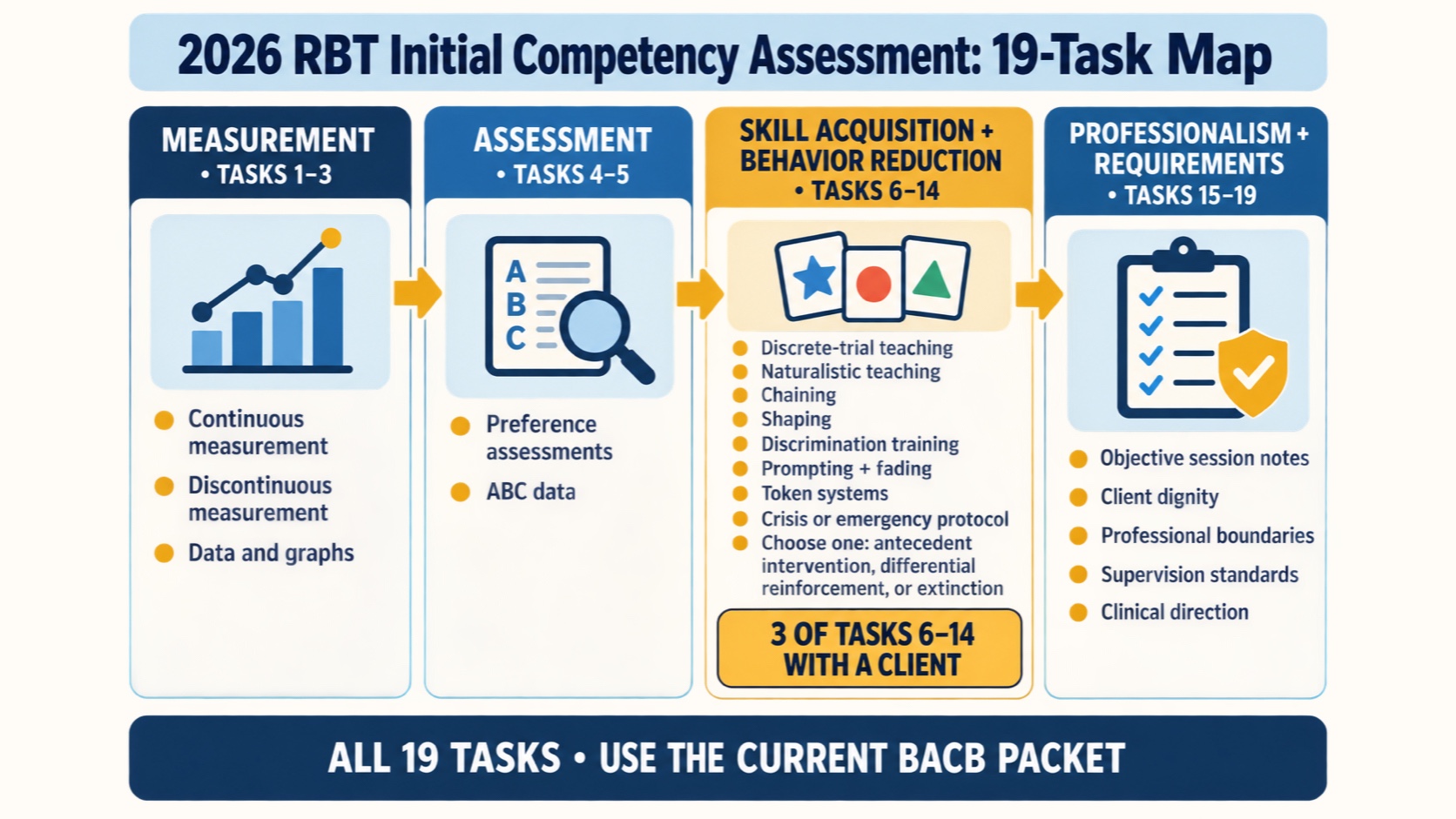
The packet organizes the tasks into four sections. The headings tell you how to prepare, but they do not mean that every task is assessed in the same way.
- Measurement, tasks 1–3: implement continuous measurement, implement discontinuous measurement, and enter data or update graphs. Practice matching the recording method to the operational definition and keeping the record usable.
- Assessment, tasks 4–5: conduct preference assessments and collect ABC data. Your preparation should include what you will present, what you will record, and how you will describe the observation without adding an unsupported interpretation.
- Skill acquisition and behavior reduction, tasks 6–14: the group includes discrete-trial teaching, naturalistic teaching, chaining, shaping, discrimination training, prompting and prompt fading, token systems, crisis or emergency procedures according to protocol, and one selected option among antecedent interventions, differential reinforcement, or extinction. Three of tasks 6–14 must be demonstrated with a client.
- Professionalism and requirements, tasks 15–19: generate objective session notes, explain how to maintain client dignity, explain professional boundaries, describe BACB supervision standards for RBTs, and describe when you would seek clinical direction from your supervisor.
Notice how the final section is not a collection of “soft skills” that can be skipped. A clean session note, respectful language, a clear boundary, and timely clinical direction are part of safe behavior-analytic service delivery. The assessment asks you to connect technical work with professional conduct.
Client, role-play, and interview formats
The current packet describes three possible assessment types. With a client means the assessor observes you performing the task with a client who is receiving behavior-analytic services. Role-play means you perform in a situation similar to one that could occur with a client, with another person acting in that role. Interview is a live conversation in which you accurately describe the concept and give examples and nonexamples when applicable.
Do not assume that you can choose any format for any task. The task grid controls the available options. For example, the crisis or emergency task includes an interview option, while the professionalism and requirements tasks are primarily interview-based. Three tasks in the skill-acquisition and behavior-reduction section must be performed with a client, so a complete role-play-only plan does not meet the form’s instruction.
Practice the method, not just the vocabulary. For continuous measurement, rehearse defining the response, starting and stopping the observation, and recording without guessing. For a session note, practice separating what happened from why you think it happened. For clinical direction, practice naming the boundary: what you can implement under the plan and what needs supervisor guidance.
Timing and application order
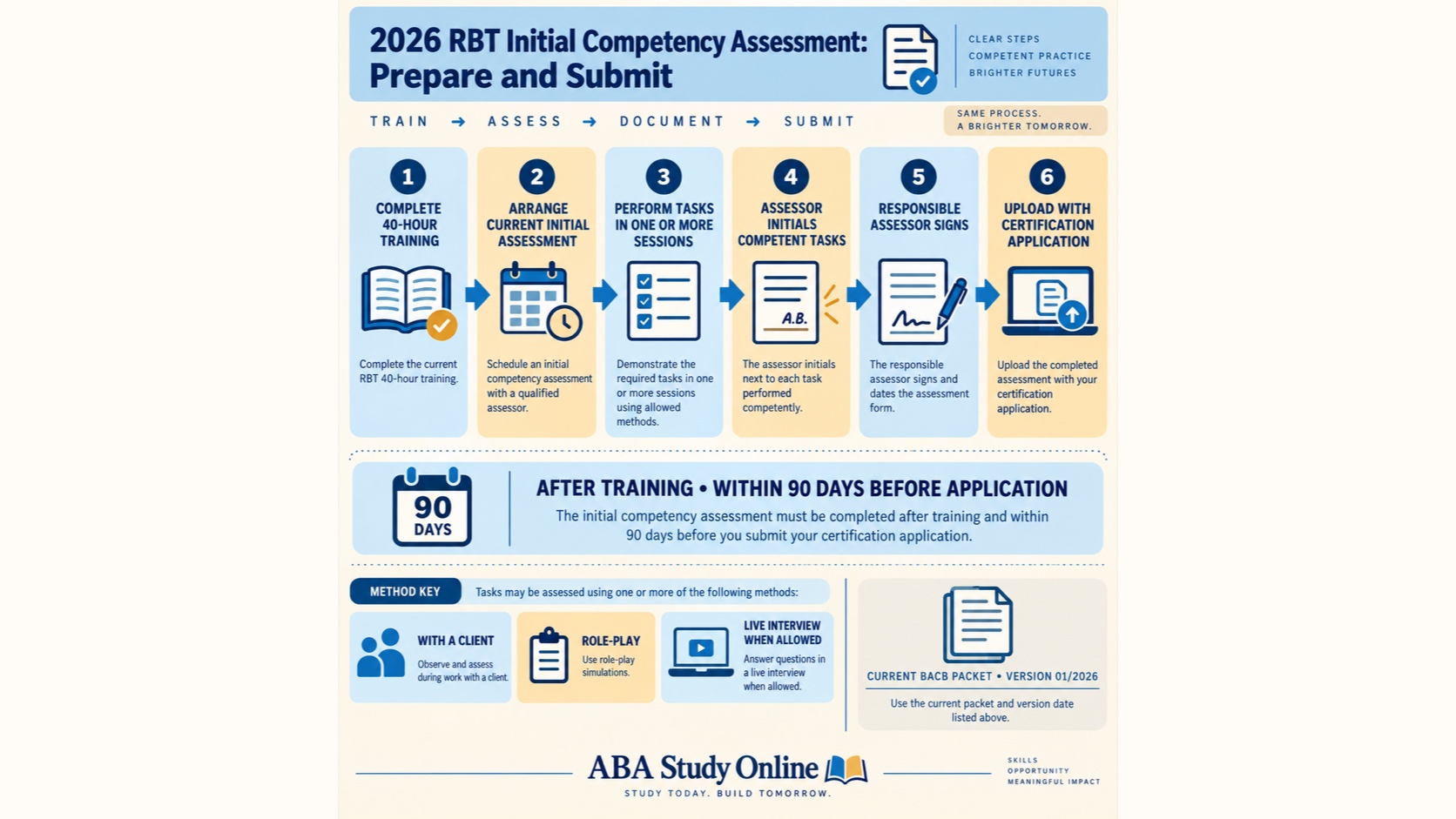
The BACB sequence is straightforward:
- Complete the required 40-hour training that meets the current requirements.
- Arrange the current Initial Competency Assessment with the responsible assessor.
- Complete the assessment after training and no more than 90 days before submitting the certification application.
- Make sure the assessor initials the task items after competent performance and completes the final attestation.
- Upload the completed current assessment with the other required application documents.
The assessment may take one or more sessions. It may occur in person, live through the internet, or through recorded videos created specifically for the assessment. If a task is not yet competent, the assessor may provide corrective feedback and assess it again on another day. The final assessment of a task cannot include corrective feedback delivered during that final evaluation.
Who oversees the assessment
The responsible assessor is an active BCaBA or BCBA who has completed the required 8-hour supervision training. The packet also sets an organizational relationship expectation: the applicant, assessor or assessors, and the organization providing services to the involved client must fit the required employment or contractual relationship. The responsible assessor signs the form and remains responsible for the quality of the assessment, even when portions are delegated.
Qualified assistant assessors may help with delegated portions when they meet the current requirements and have demonstrated proficiency. The responsible assessor must have a process for evaluating readiness, protecting consistency, and keeping records. The applicant should not treat an informal friend, an unrelated online quiz, or a generic checklist as a substitute for the responsible assessor and current packet.
Documentation matters after the session too. The applicant submits the completed Initial Competency Assessment with the certification application. The responsible assessor keeps assessment records for at least seven years under the current packet. Use the official form; the BACB states that non-BACB forms will not be accepted.
How to prepare without memorizing scripts
A practical preparation routine can fit into several short sessions. Start with one section of the form and turn each task into an observable action. Then ask a supervisor or trainer to identify the performance standard before you rehearse. For example:
- Measurement: use a brief scenario to choose a measurement method, record the response, and update a simple graph. Check accuracy before speed.
- Assessment: rehearse presenting choices in a preference assessment and writing ABC notes that stay close to observable events.
- Teaching and behavior reduction: practice a complete teaching sequence, including the instruction, prompt, learner response, consequence, and prompt-fading decision. For crisis or emergency procedures, follow the workplace protocol rather than inventing your own response.
- Professionalism: write one objective session note, one example of protecting dignity, one boundary example, and one situation where you would pause and seek clinical direction.
Use RBT Theory Blocks for vocabulary, RBT practice questions for scenario reasoning, and the ABA Definition Search when a term such as latency, motivating operation, or differential reinforcement needs a clear explanation. A printable ABC Data Sheet can help you rehearse objective observation, but no site tool replaces the official form or assessor review.
Common mistakes
- Studying an old task count: check that your material matches the packet effective January 1, 2026 and the current 19-task form.
- Calling it the RBT exam: the competency assessment and written certification examination serve different purposes.
- Leaving client demonstrations until the end: plan the three required client demonstrations from tasks 6–14 early.
- Using one format for everything: follow the method options printed for each task.
- Confusing explanation with competence: describing prompting is not the same as applying and fading a prompt appropriately.
- Submitting an unofficial form: use the current BACB packet and keep the signed documentation with the application records.
- Adding interpretation to notes: start with observable descriptions and seek clinical direction when the situation exceeds your role.
2026 RBT competency assessment FAQ
How many tasks are on the 2026 RBT Initial Competency Assessment?
The current packet contains 19 task items, and all 19 must be completed. Older resources may show a different count, so use the effective date and current packet.
Is the competency assessment the same as the RBT exam?
No. The competency assessment is a supervised demonstration of practical tasks. The RBT examination is a separate multiple-choice certification examination.
Can the assessment be completed online?
The packet allows live assessment through the internet and observations of recorded videos created specifically for the assessment, as well as in-person sessions. The task-specific method rules and assessor requirements still apply.
How close to my application can I complete it?
Complete it after the 40-hour training and no more than 90 days before submitting the RBT certification application. Confirm the current Handbook and packet before scheduling.
Can ABA Study Online sign the assessment?
No. ABA Study Online can help you study concepts and organize practice, but the responsible assessor named by the current BACB requirements evaluates and signs the assessment.
Sources
- BACB RBT Initial Competency Assessment Packet: Effective January 1, 2026
- BACB Registered Behavior Technician Handbook
- BACB Registered Behavior Technician resources
- BACB Guidance for Meeting RBT Requirements During the 2026 Transition
- BACB Supervision, Assessment, Training, and Oversight
- BACB RBT Test Content Outline (3rd ed.)